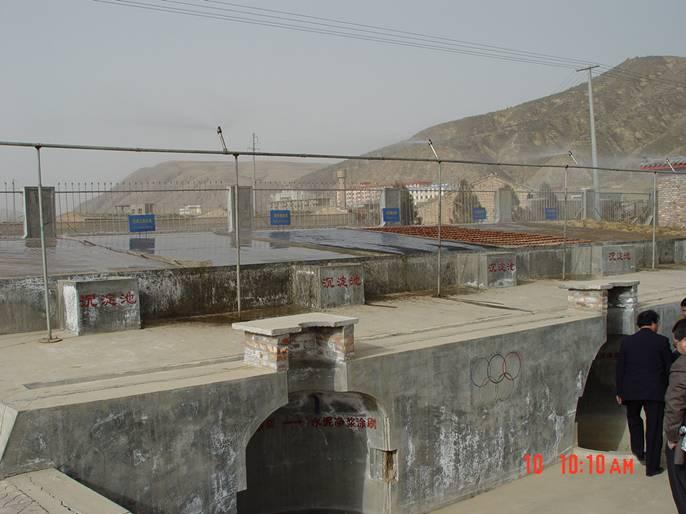
Rainwater Cellars introduced through government support
Type: Approaches
Creation: 2010-09-28 00:00 Updated: 2017-07-12 17:01
Compilers: Anna Schuler
Reviewers: Laura Ebneter
Country/ region/ locations where the Approach has been applied
- Country: China
- Region/ State/ Province: Gansu
- Further specification of location (e.g. municipality, town, etc.), if relevant: Anding
Description of the SLM Approach
Short description of the Approach
Government takes the lead and propelled by project, the rainwater collection for irrigation technology scales up by demonstration.
Detailed description of the Approach
Dingxi County of Gansu Province is short of water resource. There is an old saying it's hard to exchange a cup of water for a cup of oil in Anding of Dingxi. During drought years, drinking water became a crisis and people had to walk dozens of miles to get water. With no self-relief capacity the local people live a hard life. To resolve water shortage, the most realistic method is to tap into the potential of local precipitation. Under the support of the Gansu provincial government, researches on rainwater collection were conducted during the period from 1988 to 1992 and water cellar technology was proven technically and economically feasible with its functions in preventing erosion, developing arid cropland and ecosystem recovery.
In 1994, the government disseminated water cellar technology in the northwestern part of the county covering 14 townships and 4376 households. After completion, the drinking water supply problem was mitigated for 22,000 people and 8700 animals. In 1995, a severe drought hit Gansu and the provincial government immediately initiated “1-2-1 Rainwater Collection Project, under which the government supplied cement and the local people provided sand/stone and labor to build water cellars. According to this project each household should build one water catchment with an area of100m2 made by concrete cement and two water cellars and one backyard cashcrop forest. By the end of 2000, a total of 57800 households were involved in the project to provide drinking water to 60,900 people and 333,900 heads of livestock. In addition, dryland farming has seen great development. Since 1996, water cellar technology has been diversified and evolved. The water collection fields have extended from roof and courtyard to road surface, ditch, hillside, land brink, etc and the application has been widened to scale livestock farming, spot watering and conservation irrigation of farmland based on the achievement of the 1-2-1 rainwater collection project. Moreover, water cellar technology has been gradually combined with greenhouse production, tourism agriculture, etc to form a development model integrating rainwater conservation irrigation, dryland farming and improved livelihood standards.
Photos of the Approach