
Sub-district (Jamoat) level support for sustainable land management
Type: Approaches
Creation: 2011-05-24 00:00 Updated: 2021-11-02 15:51
Compilers: Nandita Jain
Reviewers: David Streiff, Alexandra Gavilano, Joana Eichenberger
Country/ region/ locations where the Approach has been applied
- Country: Tajikistan
- Region/ State/ Province: Sughd, Khatlon, RSS, GBAO
- Further specification of location (e.g. municipality, town, etc.), if relevant: 7 districts and 39 sub-districts
- Map: View Map
Description of the SLM Approach
Short description of the Approach
Provision of technical and financial management assistance through Jamoat (“Sub-District”) level organizations to farmers in a large small grants programme.
Detailed description of the Approach
Aims / objectives: The Tajikistan - Community Agriculture & Watershed Management Project (CAWMP), aimed to use a sub-district level organization to provide more efficient, transparent and accountable services to farmers for the project duration. CAWMP financed small grants to farmer groups for agricultural production in environmentally sustainable ways in Tajikistan’s uplands. The sub-district level support for this initial six year period, together with support from other project partners, helped (a) enable project implementation, and (b) build farmer capacity to sustain the investments after the end of six-year project, even in the absence of continued outside support.
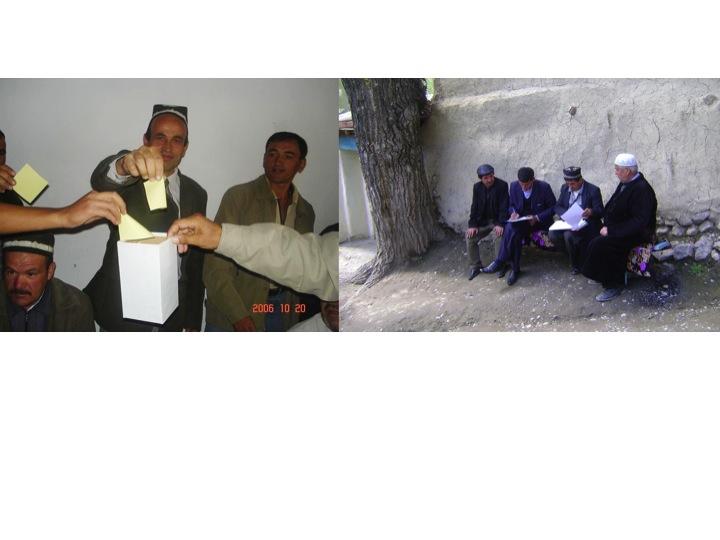
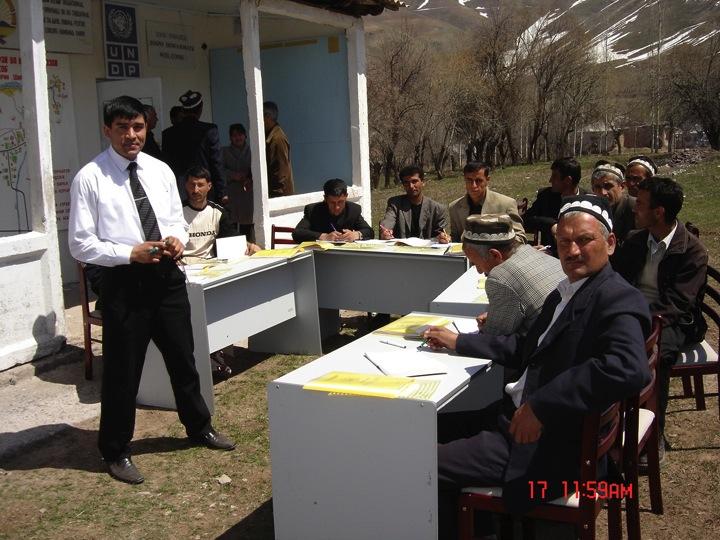
Methods: In four project sites 39 Jamoat (“sub-district”) Development Committees (JDCs) operated as NGOs with elected officers and helped organize 43,000 households into groups to implement 4,000 rural production investments that included varied SLM technologies in 402 villages. JDCs managed $7.4 million in small grants. Use of the JDC built upon existing initiatives to strengthen local governance. The JDCs collaborated and received support from a government-appointed Project Management Unit (PMU), field-based Project Coordination Units (PCUs), and four contracted Facilitating Organizations (FOs). These partners helped train JDCs in financial, organizational, and technical aspects (e.g. fund flow, participatory planning, SLM technologies), and assisted villages to form new JDCs where none existed.
Stages of implementation: JDCs, with FOs and PCU specialists, undertook activities including: 1) preparation of participatory village-based Community Action Plans (CAPs) that included proposed rural production investments and formation of Common Interest Groups (CIGs) of households [See TAJ046}; 2) participation in sub-district and project-site/watershed level screening and approval of rural production proposals from CIGs to ensure economic, environmental and social feasibility [See TAJ045]; 3) management and disbursement of grant funds from the PMU to CIGs [See TAJ 044]; 4) overseeing formal investment agreements with participating CIGs; 5) monitoring, evaluation and reporting; and 6) liaison with other villages and relevant government agencies to facilitate permissions, resource use agreements, issuance of land use rights, etc.
Role of stakeholders: JDCs comprised elected village representatives and the government’s sub-district officials. Generally, JDC members have relatively higher levels of education and relevant knowledge and experience than the local population. A JDC chairperson and secretary were elected and a qualified accountant/bookkeeper appointed. JDCs met monthly and established committees, (e.g., gender, environment, financial management and social). CAWMP paid an honorarium for the accountant and incremental travel costs for all JDCs. For newly established JDCs, CAWMP also provided funds for office facilities, plus an honorarium for the chairperson, and an additional honorarium for another officer if one was female.
Photos of the Approach
- 📍 Surkhob watershed, RSS
- 📷 UNDP