
Village-level participatory planning for sustainable agriculture and land management
Type: Approaches
Creation: 2011-05-24 00:00 Updated: 2021-11-02 15:51
Compilers: Nandita Jain
Reviewers: David Streiff, Alexandra Gavilano, Joana Eichenberger
Country/ region/ locations where the Approach has been applied
- Country: Tajikistan
- Region/ State/ Province: Sughd, Region of Republican Subordination, Khatlon, Gorno Ba
- Further specification of location (e.g. municipality, town, etc.), if relevant: Jirgital, Tajikibad, Vanj, Aini, Matcha, Pendjikent, Danghar
- Map: View Map
Description of the SLM Approach
Short description of the Approach
Design and implementation of participatory planning for village-level sustainable agriculture and land management investments through small grants for groups of upland farmers.
Detailed description of the Approach
Aims / objectives: As part of the CAWMP, participatory planning aimed to generate village-based community action plans (CAPs) that identified priority investments and beneficiaries for small grants to sustainably increase rural production. A total of 402 three-year plans were developed, through which about 4000 investments in four upland project sites were funded that resulted in increased livelihood assets for over 43,000 households and more than 96,000ha under improved land management practices.
Methods: Under supervision of a government-appointed Project Management Unit (PMU), four international facilitating organizations (FOs) were contracted to work closely with local field coordination units and Jamoat (“sub-district”) Development Committees (JDCs). An operational manual laid out guidelines for developing CAPs and the management of rural production investments. Activities could be proposed for three types of investment that would increase/improve: a) farm productivity, b) land resource management and c) small-scale infrastructure to support rural production. CAPs were required to include: (i) identifiers such as a location map, numbers of beneficiaries, area covered; (ii) an indicative list of investments and associated Common Interest Groups (CIGs) by investment type and cost; (iii) estimate of labor and materials needed; (iv) estimates of beneficiary contribution for each investment and (v) list of beneficiaries resulting from the improvements, and (vi) signed agreements to participate in the cost sharing, labor provision and subsequent operation and maintenance. Within each village, fixed amounts of funding were available and were exceeded by the value of proposed investments. Thus villagers considered the available budget, number of beneficiaries and associated risks when selecting investments (see TAJ044 for details). A beneficiary contribution of at least 25% of the value of the grant was required. In some cases, FOs and JDCs obtained other financing for activities outside of CAWMP.
Stages of implementation: Key steps in the implementation included: 1) Training of facilitators in participatory planning 2) Open village assembly introducing CAWMP and the CAP guidelines; 3) Participatory rural appraisals (PRA); 4) Sharing of findings in village assembly and identification of potential rural investments; 5) Prioritizing proposals and formation of CIGs; 6) Circulation of CAP, e.g., public display in JDC offices; 7) Preparation and submission of rural investment proposals with assistance from FOs and PCUs to JDCs/JRCs for initial screening and approval; and 8) Periodic meetings to review CAPs.
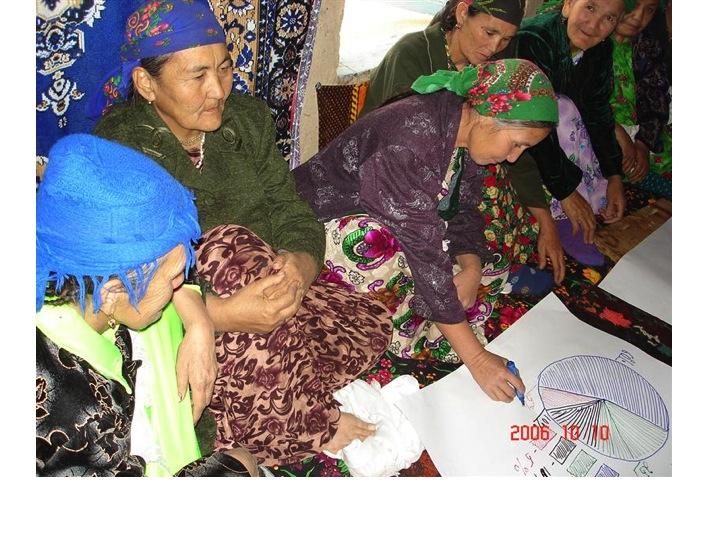
Role of stakeholders: Within villages, vulnerable households were identified and appraised through the use of PRA tools, such as wealth ranking and villager consultations and often were selected as priority recipients of initial investments. During the course of the project, environmental appraisal aspects of the planning process were strengthened through additional training in tools for participatory analysis.
Photos of the Approach
- 🗓 2016-10-10