SLM small grant allocation mechanisms
Type: Approaches
Creation: 2011-05-24 00:00 Updated: 2021-11-02 16:10
Compilers: Nandita Jain
Reviewers: David Streiff, Alexandra Gavilano, Joana Eichenberger
Country/ region/ locations where the Approach has been applied
- Country: Tajikistan
- Region/ State/ Province: Sughd, Region of Republican Subordination, Khatlon, GBAO
- Further specification of location (e.g. municipality, town, etc.), if relevant: Jirgital, Tajikibad, Vanj, Aini, Matcha, Penjikent, Danghara
- Map: View Map
Description of the SLM Approach
Short description of the Approach
Mechanisms to facilitate participatory decision-making about grant allocation among land users and improve transparency and accountability in flow of funds to beneficiaries in small-grant programmes for SLM.
Detailed description of the Approach
Aims / objectives: As part of the Community Agriculture & Watershed Management Project (CAWMP), this approach helped beneficiaries and project partners allocate grants and manage the flow of funding while promoting fairness, transparency, and ownership. It facilitated appropriate SLM choices across the highly variable agricultural, climatic and geographic conditions. Almost 4000 rural investments including SLM technologies were implemented, resulting in over 96,000ha under improved land management practices and benefits for more than 43,000 households in Tajikistan’s uplands.
Methods: This approach set a fixed budget per village, limited the grant value received per household as well as the total size of any one grant, required minimum levels of beneficiary contributions, and provided grant money to beneficiaries, enabling them to purchase the inputs.
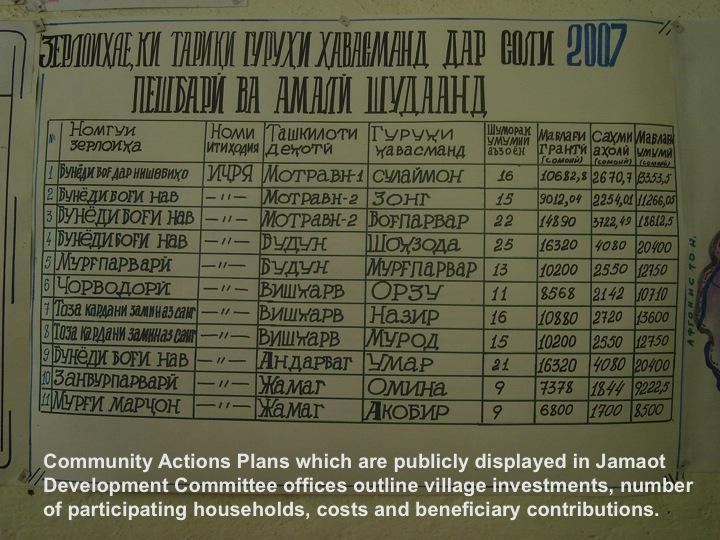
Stages of implementation: Fixed village budget: In their Community Action Plans (CAP) villages assigned priorities to grants within a set budget amount for the entire village. Project guidelines specified a formula for this budget based on amounts per investment type per household excluding beneficiary contributions ($30/household for farm productivity, $74/household for land management, and $30/household for rural infrastructure). The number of households in a village multiplied by these per-household-amounts determined the overall size of the grant funding for that village. Grant allocation limits. The villages were informed of their overall budget as well as the household limits for each category. They chose investments for groups of households (Common Interest Groups, CIGs) and allocated grant funds to subprojects accordingly. The household limits ensured that collectively at least 50% of the families would benefit directly. In practice, about 75%, of a total of about 57000 households in the project sites participated in the farm productivity and land resource management investments, and 60% in rural infrastructure investments. Grant size. Except in a few cases requiring special approval, the Project-financed grants for each subproject were lower than US$5,000, which reduced risks of the funds being used for purposes for unrelated to the Project. Beneficiary Contribution. Beneficiaries were required to contribute a minimum of 25% of the grant amount in labor, materials or cash which increased their stake in the investment, thereby strengthening ownership and sustainability. At least 5% of the grant amount for rural infrastructure had to be contributed in cash at the start in order to demonstrate financial sustainability.
Role of stakeholders: Fund flow. Once a grant proposal was approved, the PMU transferred the grant amount to the local savings bank according to the schedule specified in the agreement between Jamoat Development Committee (JDC) and CIGs. The JDC accountant transferred the funds fromthe bank to the CIGs. The CIGs then had the responsibility for purchasing inputs, which created an incentive for selecting cost-effective inputs.
Photos of the Approach