
Promotion of Sesbania species(as green manures for rice cultivation)
Type: Approaches
Creation: 2014-01-19 00:00 Updated: 2017-07-08 19:41
Compilers: Sabita Aryal
Reviewers: Fabian Ottiger
Country/ region/ locations where the Approach has been applied
- Country: Nepal
- Region/ State/ Province: Nepal
- Further specification of location (e.g. municipality, town, etc.), if relevant: Surkhet
- Map: View Map
Description of the SLM Approach
Short description of the Approach
Green manure-It is a way of adding nutrients and organic matters to soil by incorporating green manure plants which include both leguminous or non-leguminous plants. Sesbania, also known as Dhaincha, i.e. a diverse and versatile genus belonging to the family Fabaceae,which is soft,woody,annual or short lived perennial;primarily used as green manure between rice crops or as an intercrop in transplanted rice.
Detailed description of the Approach
Aims / objectives: -Leguminous green plants like Sesbania can fix atmospheric nitrogen in the form that plant can use.
-It helps to improve the soil structure as incorporating it into the soil adds organic matterr (biomass).
-The Sesbania species has high water-logging tolerance which prevents the crop from losing its nutrient content.
Methods: In nepal,institutions like NARC and research programs like Rice Research program has actively promoted Sesbania species. Dr. Bhola man singh basnet of Nepal Agriculture Research council(NARC),khumaltar has extensively carried out his research on green manure using Sesbania, which is called locally as Dhaincha.
The Hardinath Agriculture Farm in Dhanusha,now National Rice Research Program, practiced Sesbania cannabina, dhaincha as pre-rice manure annually in 20 ha for more than 20 years.
Green manure technique is an indigenous practice mainly in the foothills, middle mountains region and central terai of nepal-dhanusha,parsa,bara and Rautahat district.
Stages of implementation: Sesbania is sown before rice is planted.Sow the Sesbania seed densly and lightly cover the seed with soil.Sesbania will grow faster if the soil is kept moist.After 4-6 weeks sesbania will be 18-36 inches tall at ground level and plough in as the paddy are prepared for planting rice.
Seed production process;
Transplant a few of the largest,thickest,healthiest plant into the edges of paddy space at 2 metre intervals along the terrace edges.Seed will be ready after 6 -7 months.This can be used as seed for green manure next year.
Role of stakeholders: Government;
-Institutional roles; NARC, HAF -DDC-Municipality-VDC
Private sectors;
-Desigining policies.
Other important information: -Sesbania species can be grown even under adverse conditions of drought,waterlogging,salinity,etc.
-optimum time of Daincha seed production is the middle of March until the end of May .
-Experiment conducted at several research stataions showed that green manureing with dhaincha in rice increased the grain yields by about 20-25 percent(Pre rice green manure-a success story,B.H.S Basnet,NARC)
Photos of the Approach
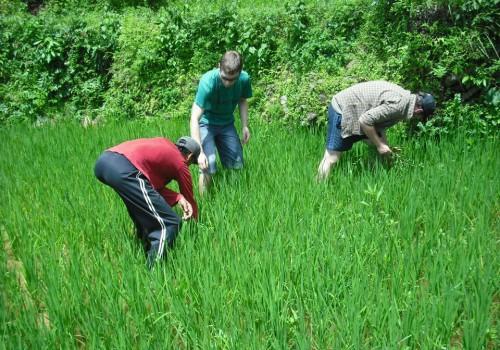
- 📍 Gumi-3, Surkhet