
Resilient Watershed Management Plan
Type: Approaches
Creation: 2018-04-05 12:45 Updated: 2018-06-08 11:25
Compilers: Askarsho Zevarshoev
Reviewers: Farrukh Nazarmavloev
Country/ region/ locations where the Approach has been applied
- Country: Tajikistan
- Region/ State/ Province: Sub-ordinate regions
- Further specification of location (e.g. municipality, town, etc.), if relevant: Rasht Valley, Faizobod District
- Map: View Map
Description of the SLM Approach
Short description of the Approach
The participatory watershed management plan (WMP) is an interdisciplinary approach at community level to raise awareness on the watershed management concept and improve understanding of the watershed approach in planning and management of natural resource.
Detailed description of the Approach
In the participatory WMPs, the main emphasis is placed on identifying critical factors (or so called thresholds) in the sub-watershed and identifying management actions to reduce the potential of negative effects of these factors on the sub-watershed ecosystems and livelihoods. In the process of participatory WMP stakeholders will identify factors that people can control and factors they cannot control. The planning is different for factors that people can control (mitigation of risk factors), for instance sustainability measures of access to safe and clean drinking water, and factors they cannot control (adaptation to risk factors), for instance melting of glaciers and formation of risk-posing glacial lakes.
In WMPs stakeholders collaborate with the technical team to incorporate key findings of the Integrated Habitat Assessment (IHA). To enhance community ownership and participation in the implementation of local development plans, communities and local authorities will be fully involved in the identification, implementation, and handover of the planning process and intervention implementations.
Based on the action plan developed as a result of participatory WMPs, interventions will be implemented to regenerate, protect, or enhance land/resource conditions in the different parts of each sub-watershed in a holistic manner in line with the IWSM approach. Projects at the village level will be identified based on the village management plan and projects operating at the sub-watershed or multi-village level will be informed by WMPs. The resilient NRM activities will be designed to specifically contribute to the improved land use and stabilization of degraded areas in the sub-watershed. During design, protection and synergies will be considered with socio-economic development project.
The WMPs will be prepared for the purpose of enhancing communities’ sustainable development through building capacities and capabilities of local communities to manage and reduce risks from natural hazards, to improve natural resources management, land use planning and pasture management. To conduct the WMP process, a working group will be established at the sub-watershed level, which will include the head of the jamoat(s), representatives from relevant district government departments (Land Management, Geology, Agriculture, Environmental Protection), and representatives from local community based organizations.
The preparation process of the WMPs will be closely coordinated and consulted with the community based organizations as well as local governments with plans conducted at the sub-watershed level. It is tentatively planned that ownership of the plans will fall to either the jamoat government (if a sub-watershed covers only one jamoat) or the district government (in the case of sub-watersheds covering more than one jamoat). However, the ownership model and other aspects of WMP process is still not clear and should be piloted in a different scenario. The WMPs will enable the target sub-watersheds to make comprehensive planning and take into account socio-economic, disaster management, and natural resources management aspects.
As a result of this process, three WMPs were developed at three sub-watershed level in Rasht Valley of Kuksu, Surkhdara and Nushor sub-watersheds. As a result the watershed committee was supported with implementation of interventions, where immediate action was required to prevent further degradation. For example in the Nushori bolo sub-watershed in consultation with government and community mobilization it was agreed to ban grazing in the most degraded upper zone of the pasture, which had also a risk of landslide. In a short period after limiting grazing the pasture areas in the upper zone of watershed started to rehabilitate.
Photos of the Approach
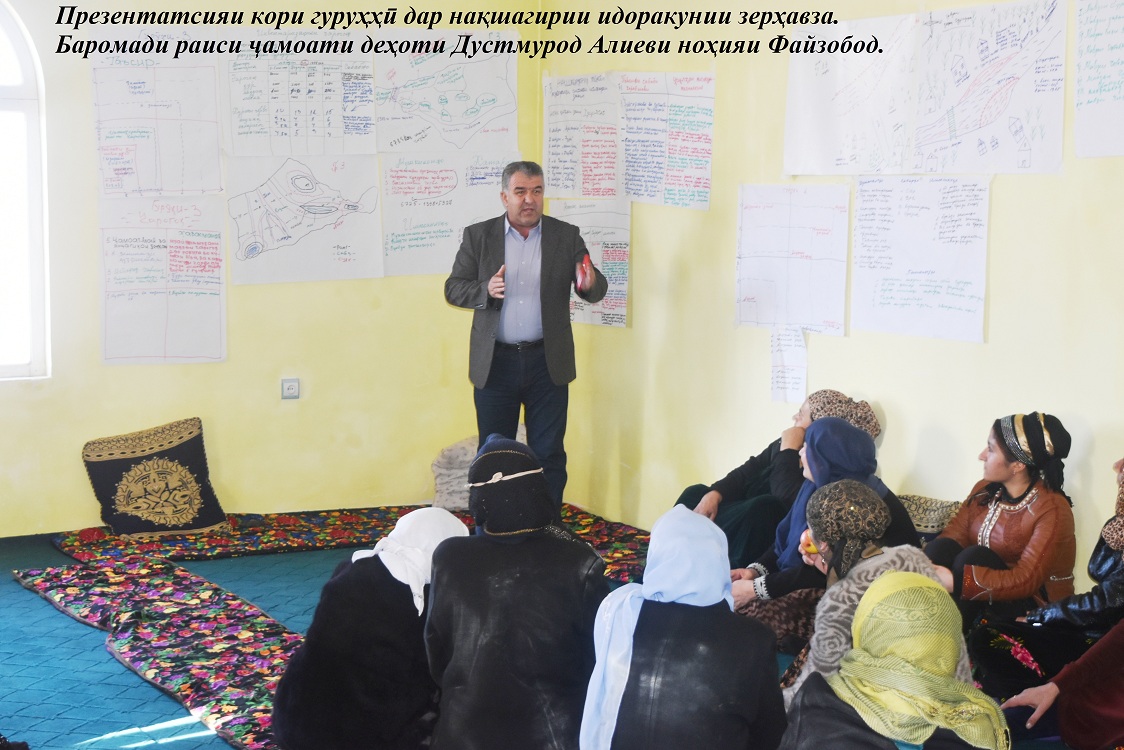
- 📍 Rasht Valley, Faizobod District
- 🗓 2017-07-12
- 📷 Zevarshoev Askarsho

- 📍 Faizobod District, Surkhdara sub-watershed
- 📷 Zevarshoev Askarsho