
Land Degradation Neutrality Transformative Projects and Programmes (LDN-TPP) for sustainable agriculture and rural development
Type: Approaches
Creation: 2021-04-22 16:15 Updated: 2021-07-29 14:39
Compilers: Daniel Zollner
Reviewers: William Critchley, Rima Mekdaschi Studer
Country/ region/ locations where the Approach has been applied
- Country: Georgia
- Region/ State/ Province: Shida Kartlii and Kakheti
- Further specification of location (e.g. municipality, town, etc.), if relevant: Gori, Kareli, Kvareli and Sagarejo
- Map: View Map
Description of the SLM Approach
Short description of the Approach
In the framework of the project ‘Generating Economic and Environmental Benefits from Sustainable Land Management for Vulnerable Rural Communities of Georgia’, Land Degradation Neutrality Transformative Projects and Programmes (LDN-TPP) were developed to implement the LDN targets at municipal level.
The approach defines the process to break down global and international LDN targets and to translate these into local contributions from the municipalities of Gori, Kareli, Kvareli and Sagarejo.
Detailed description of the Approach
The three-year project ‘Generating Economic and Environmental Benefits from Sustainable Land Management for Vulnerable Rural Communities of Georgia' funded by the Global Environment Facility (GEF), is implemented by the United Nations Environment Programme (UNEP) and executed by the Regional Environmental Centre for the Caucasus (RECC). The initiator and beneficiary of the project is the Ministry of Environmental Protection and Agriculture of Georgia. Within this framework, Land Degradation Neutrality Transformative Projects and Programmes (LDN-TPP) were developed to implement the LDN targets at municipal level.
The project aims to create an enabling environment at the community level to achieve the country's goal of Gender Responsive Land Degradation Neutrality (LDN). The project supports local farmers to apply sustainable land management and climate-smart agricultural practices to promote food security and resilience in order to reduce the impacts of erosion, salinisation and soil fertility reduction in Sagarejo, Kvareli, Gori and Kareli on 20,000 ha of pilot land. As a result, it is expected that there will be an improved understanding of the economics of land degradation and integrated land use planning at national and sub-national levels. In the preceding approach recorded under WOCAT, namely ‘Integrated Land Use Plans (ILUPs) for sustainable agriculture and rural development with special emphasis on SLM, CSA and LDN in four municipalities [Georgia]’, ILUPs were developed for four municipalities providing a detailed spatial basis. A separate study (Ballesteros et al. 2020) compiled baseline information about LDN indicators.
This approach complements the ILUP. It combines the spatial information elaborated for land use planning, the LDN baseline information with national LDN targets, UNCCD principles for LDN and municipal stakeholder priorities to come up with a concrete plan for the municipal contribution to (inter)national targets. Thus, this approach serves to operationalise the national LDN targets at municipal level. At the time of documentation of this apporach, planning was completed and the participatory process for validation and decision-making for concrete targets had been initiated.
Taking this into account, a targeted programme was designed, which breaks down national targets into municipal targets with related activities and spatially explicit priority areas for implementation. This approach serves to operationalise LDN-related recommendations and proposed actions as presented and defined in the Integrated Land Use Plan. It seeks to define the contribution of the municipalities Gori, Kareli, Kvareli and Sagarejo to the achievement of national and global LDN targets.
The output is intended to serve as a starting point for local discussion (especially with the LDN Working Group) to further specify and prioritise the objectives and measures proposed. It provides a solid basis for discussing (a) concrete measures and (b) the areas best suited for these measures. The approach is documented in a consolidated document on how the municipality can contribute to the national LDN goals, based on the specific situation and potentials of the municipality.
The LDN TPP focuses on specific objectives and actions in the area of the municipality and its various functional land units in a pro-active, forward-looking and visionary manner as a contribution to the nationally set LDN objectives and the overall LDN vision. It presents possible and recommended development pathways and focuses predominantly on LDN implementation options through the application and adoption of various SLM and CSA practices.
Photos of the Approach
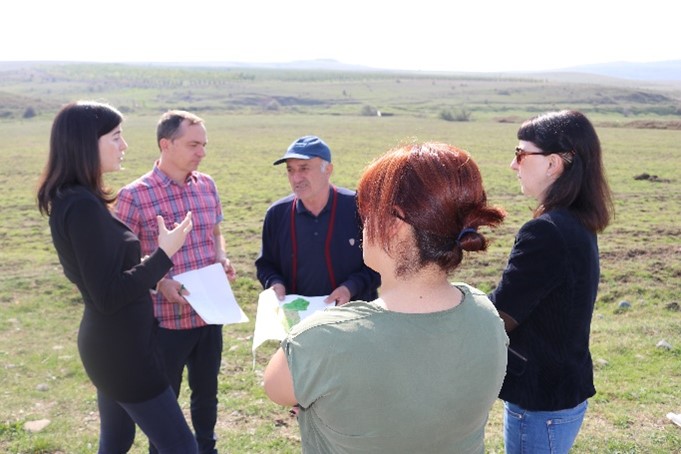
- 📍 Kareli Municipality
- 🗓 2019-11-11
- 📷 Daniel Zollner

- 📷 own figure