
Dissemination of Soil Test Results to Farmers through a Participatory Approach
Type: Approaches
Creation: 2023-03-18 07:25 Updated: 2024-04-11 12:20
Compilers: Santosh Gupta
Reviewers: Udo Höggel, Joana Eichenberger, Sally Bunning
Country/ region/ locations where the Approach has been applied
- Country: India
- Region/ State/ Province: Madhya Pradesh
- Further specification of location (e.g. municipality, town, etc.), if relevant: Mandla
- Map: View Map
Description of the SLM Approach
Short description of the Approach
A systematic approach has been developed under the project for collecting soil samples, conducting the soil test results, issuing soil health cards, building the capacity of farmers to interpret the soil health card and apply the required nutrients to the soil based on the soil test result
Detailed description of the Approach
Soil testing is a pre-cultivation activity that gives a good idea about soil structure and mineral composition ratios. The essential nutrients required for various crop growths can be estimated during soil testing. The Foundation for Ecological Security (FES) has established a state-of-the-art soil testing laboratory for testing soil samples in India's Mandla District of Madhya Pradesh. The soil test lab was established in 2016 with a capacity to test 1500-2000 soil samples every year. Based on a soil sampling process, it takes around 2 days to generate the soil test results for 20 soil samples. Collected soil samples are tested for 12 parameters. These parameters include Soil Ph, Soil organic carbon (SoC), electrical conductivity (EC), major nutrients like nitrogen(N), phosphorus (P), potassium (K), secondary nutrients like sulphur, magnesium, iron, boron, zinc, manganese, and copper. Based on the soil test report, farmers are issued a soil health card with crop-specific recommendations for additional chemical and organic inputs into the soil.
To ensure the accuracy of the sampling process and proper dissemination of generated results among the farmers, FES has developed a very systematic process which consists of:
•the collection of soil samples
•the analysis of collected soil samples in an FES lab
•the issuance of soil health cards
•the interpretation of soil test results
•noticing of test results to farmers
•farmers are able to implement practices, recommended by the test result
The entire process, from soil sampling to dissemination, is briefly mentioned below:
•Developing the grids for a random collection of soil samples: The first step is to develop a geographical grid for collecting random samples based on predefined parameters. In the irrigated areas, samples are drawn in a grid of 2.5 ha, while in rainfed areas, samples are drawn from a grid of 10 ha. While developing the grid, farmers' fields are categorized into the following parameters. Each of the parameters is assigned a specific score, and based on the obtained score, each farmer’s land is given a specific number for easy identification on soil maps. These include the a) type of soil, b) type of field, e.g., upland, medium land, or low land, c) crop cycle (Single crop, multiple crops) d) The slope of the field. This entire exercise is a soil survey exercise used to develop soil maps for each geographical unit village, block, district.
•Collection of soil samples: From each classified grid, soil samples are collected from 5 different locations between the harvest of one crop and the sowing/planting of another crop when fields are vacant. The soil samples are collected at a depth of 5 to 15 cm. All the collected soil samples are mixed repeatedly, and a portion of the collected soil is kept aside each time. The mixing process is followed 5-6 times to ensure collected soil samples represent the entire area. Finally, around 500 gm of soil is packed in plastic polythene based on the above grid parameters.
•Soil sample analysis: Collected soil samples are transported to the centralized soil test lab in Mandla (MP) for testing and analysis. The samples are analyzed by qualified lab personnel. The analysis process for the above mentioned 12 parameters takes around 2 days (considering 8-9 working hours in a day).
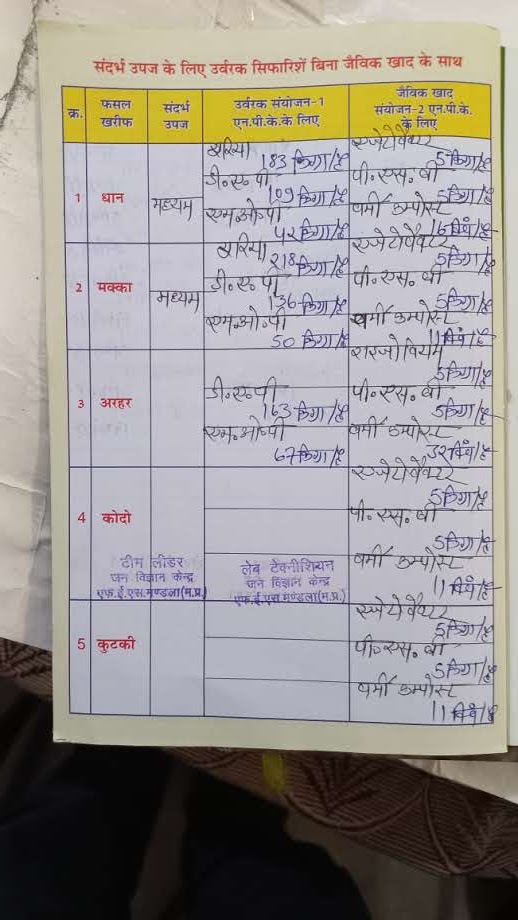
•Issuance of soil health card: Based on the results obtained from the analysis, soil health cards are issued to farmers. The soil health card contains the following information in the local language (Hindi) so that farmers understand the test results and their implications:
a.Basic details of the farmer: name, address, soil grid, GPS coordinates, field identification number, etc.
b.Soil test results for above mentioned 12 parameters: results of the soil test in their respective units, standard numbers, grading of the obtained result (acidic/saline for PH., high, medium, low for other parameters)
c.Crop-wise soil correction recommendations for major crops: recommendations for synthetic fertilizers, biofertilizers, and compost
d.Pre-printed information with photos for identification of nutrient deficiency in the crops.
•Dissemination of soil health card to farmers: To ensure that farmers understand the results and implement the practices at their field, local community resource persons reach out to every farmer to make them understand the soil test results and closely monitor their farmers’ practices across the crop stages. Farmers are also encouraged to maintain farm diaries for their practices. They are also trained in the preparation of various bio-inputs and compost for application in their field.
Photos of the Approach

- 📍 Mandala, Madhya Pradesh, India
- 📷 Santosh Gupta
- 📍 Mandla, Madhya Pradesh, India
- 📷 Santosh Gupta

- 📍 Mandla, Madhya Pradesh, India
- 📷 Santosh Gupta