
Participatory SLM Action Planning
Type: Approaches
Creation: 2023-07-05 15:59 Updated: 2024-06-04 14:13
Compilers: Karma Wangdi
Reviewers: William Critchley, Rima Mekdaschi Studer, Joana Eichenberger
Country/ region/ locations where the Approach has been applied
- Country: Bhutan
- Region/ State/ Province: Bhutan
- Further specification of location (e.g. municipality, town, etc.), if relevant: Punakha, Nabchey, Lingmukha
- Map: View Map
Description of the SLM Approach
Short description of the Approach
Participatory SLM action planning is an approach that identifies community-based and land-based issues and challenges, establishes the root causes, and finds out mitigation measures to address the issues for enhancing rural livelihoods.
Detailed description of the Approach
Participatory SLM Action Planning (SLM AP) is a methodology intended to assess potential SLM interventions in order to address the most severe problems of land degradation. Priorities are determined by identifying the main local issues and their root causes, as well as land-based livelihoods and resources. All community households are included in SLM AP, which is conducted at the chiwog (village) levels. It incorporates Participatory Rural Appraisal (PRA) & Participatory Learning Action (PLA) tools such as natural resource mapping, problem censuses, cropping calendars, history lines, prioritization, ranking and ultimately drawing up a realistic SLM action plan. An external resource person facilitates the discussion while the community decides the final action plan. The process is very interactive and focus group discussions are organized specially for facilitating women’s active participation.
Prior to the SLM action planning exercise, sensitization to available SLM technologies is a must. The sensitization program includes pictorial presentations, relevant SLM audio visuals and displaying of SLM posters. After community sensitization on the first day, the actual SLM action planning exercise is conducted the next day. The participants can discuss with their family members and identify which interventions to incorporate in the plan. The stakeholders involved in the planning exercise consists of community members, local leaders, community civil servants and resource persons. The role of the local leader is to identify interventions that benefits the whole community such as community plantations, landslide stabilization along farm roads, community water source protection and a capacity building program for rural livelihood improvements.
Though this is a holistic bottom-up approach, some of the activities may not qualify for endorsement in the final action plan due to a limited budget and high-cost investments with few beneficiaries. The other drawback is that for every action plan, travel of 3 to 4 days is needed in in every chiwog. In general, the SLM action plan consists of individual household plans and a community SLM plan. Therefore, since every household is included and action plans drawn, land users are satisfied with the approach.
Photos of the Approach
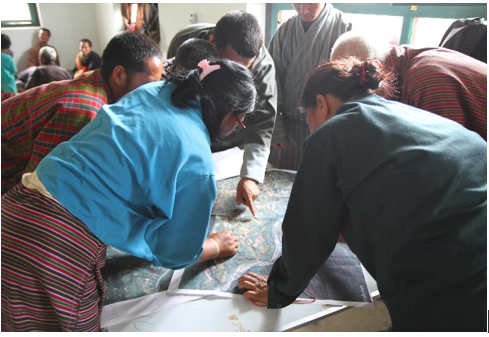
- 📍 Nabchhed chiwog, Lingmukha Gewog, Punakha Dzongkhag
- 🗓 2017-01-05
- 📷 Kuenzang Nima
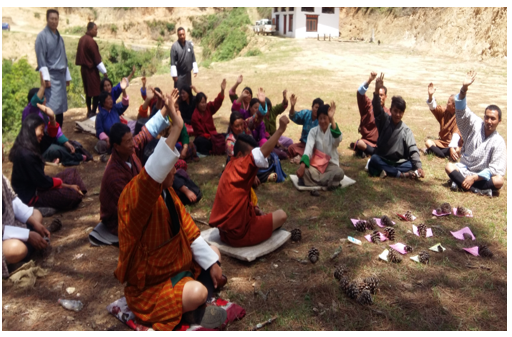
- 📍 Nabchhed chiwog, Lingmukha gewog, Punakha
- 🗓 2021-01-08
- 📷 Haka Drukpa