
Public-Private-Community Partnership for Land Degradation Neutrality
Type: Approaches
Creation: 2023-07-10 14:33 Updated: 2024-05-30 15:33
Compilers: ONGPO LEPCHA
Reviewers: William Critchley, Rima Mekdaschi Studer, Joana Eichenberger
Country/ region/ locations where the Approach has been applied
- Country: Bhutan
- Region/ State/ Province: Mongar Dzongkhag
- Further specification of location (e.g. municipality, town, etc.), if relevant: Domlung village, Ngatshang gewog
- Map: View Map
Description of the SLM Approach
Short description of the Approach
The public-private-community partnerships (PPCP) approach is a synergistically operational model that is used to achieve sustainable development in which the three parties jointly develop a business unit/service of mutual benefit and provide maximum benefit to the wider community. This approach is designed to enable economically disabled households and community organizations to generate long-term benefits through sustainable agriculture - in this case hazelnut production.
Detailed description of the Approach
The Mountain Hazelnut Venture (MHV) is a social enterprise established as a Public-Private-Community Partnership (PPCP) between the people and the Royal Government of Bhutan and a private company. The PPCP approach involves private entity funding of a project, and it has become common countrywide, The MHV has enabled a large-scale Foreign Direct Investment (FDI) project. The MHV provides hazelnut trees, agricultural inputs, and technical assistance to smallholder farmers. At harvest, the company purchases hazelnuts from partner growers, which are then processed for international export. The primary objective of this approach is to foster collaboration between the private company and the community to generate long-term income and revitalize vulnerable communities through sustainable agriculture. Hazelnut orchards stabilize mountain slopes, reduce soil erosion, improve water retention, and help adapt to, and mitigate, climate change by improving ground cover, retaining soil moisture and sequestering carbon.
The private company looks for interested farmers who are then registered. The company propagates good quality hazelnut seedlings and distributes them. This is followed up by constant monitoring by technical staff until fruits are harvested and processed. The implementation stage includes planning, providing them with necessary agricultural inputs, and technical support through extension and monitoring. Once the fruits are harvested, payment is made to the farmers. Implementation involves the MHV engaging with community members alongside agricultural extension agents to present and convince them about the benefits of the project. Additionally, the MHV provides training, workshops, and ongoing support. They finance the project while also taking on the role of monitoring and evaluating its outcomes.
There are three key stakeholders involved in this approach. They are the community members (landowners), the Royal Government of Bhutan, and the Mountain Hazelnut company. It is reported that there are more than 8,000 smallholder land users registered with MHV from 19 of 20 districts in Bhutan. The roles of the land users are to grow hazelnuts through nurturing the seedlings, harvesting the nuts, and selling them to the Hazelnut company as per the mutual agreement. Land users are provided free seedlings, consistent technical and field support, and the guaranteed buyback of nuts by the company. They also received training and assistance. The second key stakeholder is the Royal Government, who provides clearance and facilitates the establishment of business in line with the national Foreign Direct Investment (FDI) Policy. In the field, agriculture extension agents represent the government by facilitating communication between the hazelnut company and the communities. Lastly, the MHV as a private company is committed to fostering the development of entrepreneurs in the agribusiness sector across Bhutan.
The advantages of the approach to the land users are the financial, technical and material support provided by the private company. The land users can also develop their skills and knowledge through training on hazelnut cultivation and good agricultural practices (GAP). Hazelnut is a new crop in the locality.
Finally, the company is committed to generating income and improving the livelihood of rural communities in Bhutan. However, despite the noble objectives, the company has failed to realize its intended target, and this is an increasing cause of concern. Furthermore, there are complaints that the harvests have been poor – or even zero in some cases. It is clear that there had been inadequate investigation into the viability of hazelnuts in Bhutan. While failing on the economic front so far, from the land degradation neutrality (LDN) point of view, the hazelnut plantations have improved ground cover immensely thereby generating environmental benefits through stabilization of vulnerable agricultural land, reduction in land degradation and carbon sequestration.
Photos of the Approach
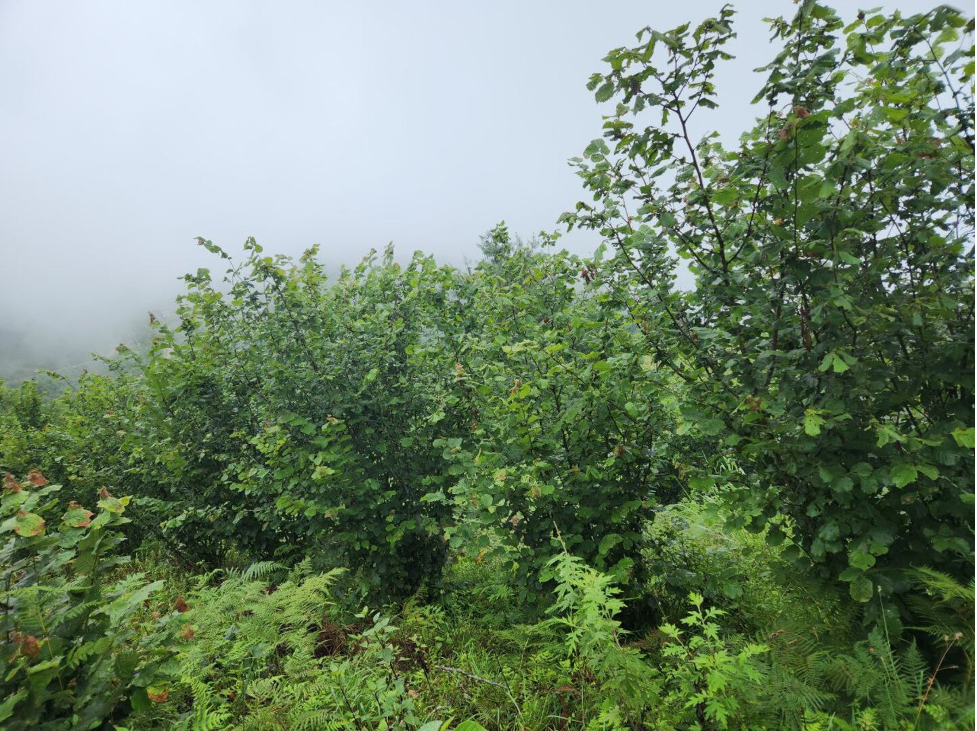
- 📍 Domlung village, Ngatshang gewog, Mongar Dzongkhag, Bhutan
- 📷 Tshewang Phuntsho

- 📍 Eastern Bhutan
- 📷 Mountain Hazelnut Venture (MHV)