
Agricultural Landscape Approach for SLM Implementation
Type: Approaches
Creation: 2023-07-12 10:21 Updated: 2024-05-30 15:15
Compilers: Nima Dolma Tamang
Reviewers: William Critchley, Rima Mekdaschi Studer, Joana Eichenberger
Country/ region/ locations where the Approach has been applied
- Country: Bhutan
- Region/ State/ Province: Dagana Dzongkhag
- Further specification of location (e.g. municipality, town, etc.), if relevant: Goongpa-Soomchu Chiwog, Tsangkha Gewog
- Map: View Map
Description of the SLM Approach
Short description of the Approach
The Agricultural Landscape Approach in Sustainable Land Management is a holistic and integrated strategy that focuses on managing agricultural landscapes in a sustainable manner. The approach was successfully initiated in Namlaythang village and transformed the whole agricultural landscape covering 107 acres (43 ha) while benefitting 55 resettled households.
Detailed description of the Approach
The Agriculture Landscape Approach in Sustainable Land Management (SLM) is a holistic and integrated strategy that focuses on managing agricultural landscapes in a sustainable manner. This approach recognizes the interrelation of various elements within a landscape, including soil, water, biodiversity, and human activities, ultimately aiming to optimize the benefits derived from these interactions while minimizing negative environmental impacts.
This approach was initiated in Namlaythang village under Tsangkha gewog (block), Dagana Dzongkhag (district). Namlaythang was chosen for this approach because it is a new settlement with 55 resettled households who were granted land ranging from 1.75 to 3 acres (0.7 to 1.2 hectares) per family by His Majesty the King as per the National Rehabilitation Program. Since the area was recently cleared and converted to settlement and farming, there was a huge risk of land degradation due to direct exposure to rain and unsustainable agriculture practices. Therefore, it was not only timely to implement SLM to prevent land degradation but also appropriate to have adopted the Agricultural Landscape Approach by engaging the whole community.
The main aim of adopting the agricultural landscape approach was to bring transformational change at a scale. Too often, we plan and implement SLM interventions supported by different projects in small, localized areas and in a scattered manner. This limits the ability to scale out success (both spatially and temporally) despite being positive initiatives. The approach was also intended to facilitate a multi-stakeholder platform by bringing relevant stakeholders together to discuss common objectives and draw synergies across different agencies.
The process started by discussing the idea with the Dzongkhag and gewog agriculture offices followed by sensitization of land users on the importance of SLM and its technologies. This was followed by Participatory SLM Action planning wherein detailed action plans were prepared based on landowners’ interest, feasibility of their land and the available technologies. The next mandatory activity carried out before implementation of SLM in the field was the conduct of field based hands-on training of the land users. The main SLM technologies planned and implemented included terracing, stone bunds, hedgerows, check dams/ gully plugs and plantations. In addition, climate resilient agriculture practices were also promoted such as greenhouses, low-cost water harvesting ponds, drip irrigation sets and fruit tree plantations.
In promoting this approach and other technologies, several stakeholders were involved including the Dzongkhag and gewog agriculture offices, National Soil Services Center (NSSC), Agriculture Research and Development Center, Bajo (ARDC-Bajo), the landowners and a Green Climate Fund (GCF) Project. The agricultural offices provided the overall coordination and the facilitation role in implementing the approach and its associated technologies. The NSSC provided sensitization and training on SLM technologies and also facilitated participatory SLM Action Planning with the landowners and other stakeholders. Similarly, the ARDC-Bajo arranged material inputs for climate resilient agriculture practices and provided technical assistance to the landowners and the gewog agriculture extension officer. The GCF Project provided financial support based on the action plan.
The implementation of SLM and climate resilient agriculture practices following agricultural landscape approach in Namlaythang have been a great success. The approach has brought a transformational change at the landscape level through various SLM interventions which collectively contributed towards reduction of soil erosion and nutrient loss, conservation of soil moisture and the improvement of overall soil health and food security. The land users also feel empowered through sensitization, capacity building and their engagement in the whole process. In brief, the land users expressed their satisfaction with the approach and the impacts it has created in the agricultural landscape which is the basis of their livelihoods.
A major weakness of the approach is that there is no institution/group/cooperative formed for efficient coordination among the land users and other stakeholders which questions its sustainability.
Photos of the Approach
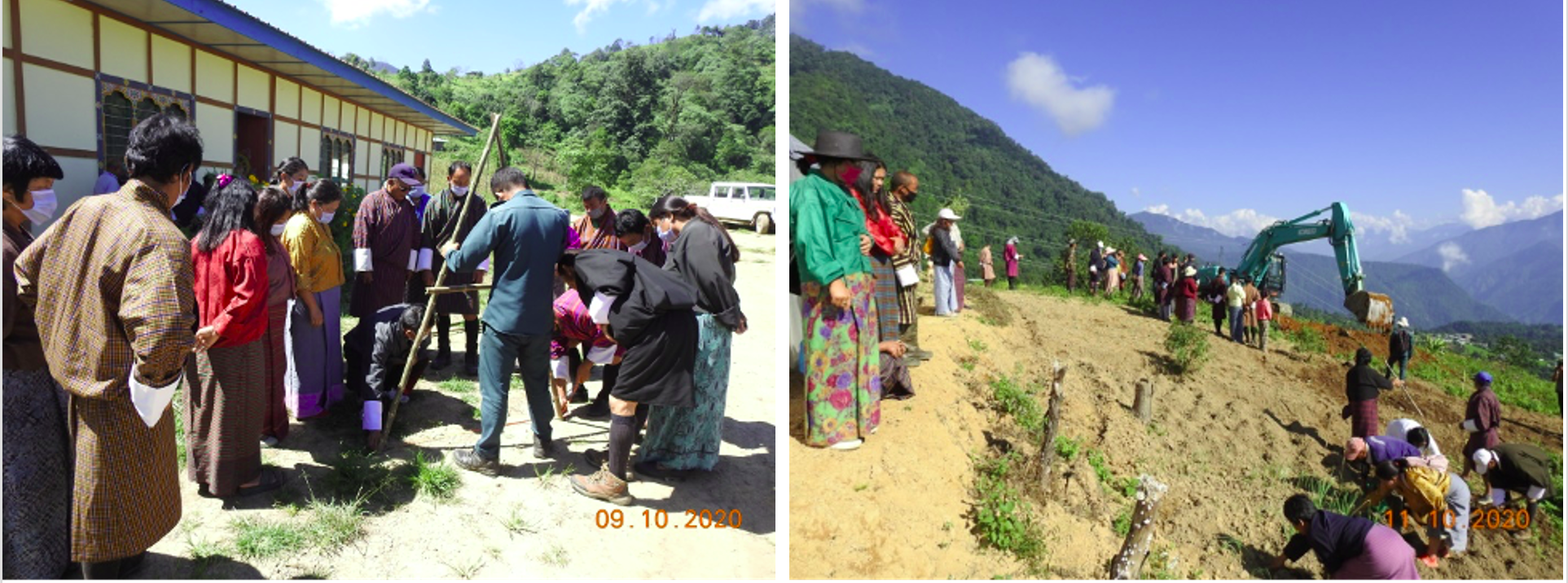
- 📍 Namlaythang village, Tsangkha Gewog, Dagana Dzongkhag
- 🗓 2020-09-10
- 📷 Tashi Wangdi