Peer to Peer Pass-on Approach with Women
Type: Approaches
Creation: 2016-11-30 17:38 Updated: 2017-10-31 15:29
Compilers: John Brogan
Reviewers: Alexandra Gavilano, Boris Orlowsky
Country/ region/ locations where the Approach has been applied
- Country: Bangladesh
- Region/ State/ Province: Kurigram District / Rajshahi Division and Barguna District / Barisal Division
- Further specification of location (e.g. municipality, town, etc.), if relevant: Kurigram municipality (Kurigram District), Patharghata Union (Barguna District)
- Map: View Map
Description of the SLM Approach
Short description of the Approach
Terre des hommes and Greendots introduced the Peer to Peer pass-on system to enable women's groups in Bangladesh to spread the Keyhole Garden technique within their communities with the aim of enabling year-round homestead vegetable production despite the risk of flooding and tidal surge.
Detailed description of the Approach
Keyhole Gardens, a type of small, productive homestead vegetable garden based on Low External Input Sustainable Agriculture (LEISA) techniques, have been used in various African countries for over 15 years and shown to increase the availability of food and dietary diversity (FAO). They were developed by gardeners and small-scale farmers (with the support of Send a Cow UK) to suit different situations, such as the cold, dry winters of Lesotho, the small backyards of Rwanda, and the humid heat of central Uganda. To improve year-round homestead nutritional self-sufficiency for vulnerable families in South Asia (where rates of acute malnutrition in young children regularly cross emergency thresholds), Keyhole gardens were adapted by Terre des hommes (Tdh) and Greendots to the conditions of river basin and coastal areas of Bangladesh (and eventually to India's Sundarbuns) . As a component to Tdh's maternal neonatal and child health (MNCH) programme, the technology is intended to support year-round homestead gardening despite weather extremes (flooding, tidal surge, cyclones).
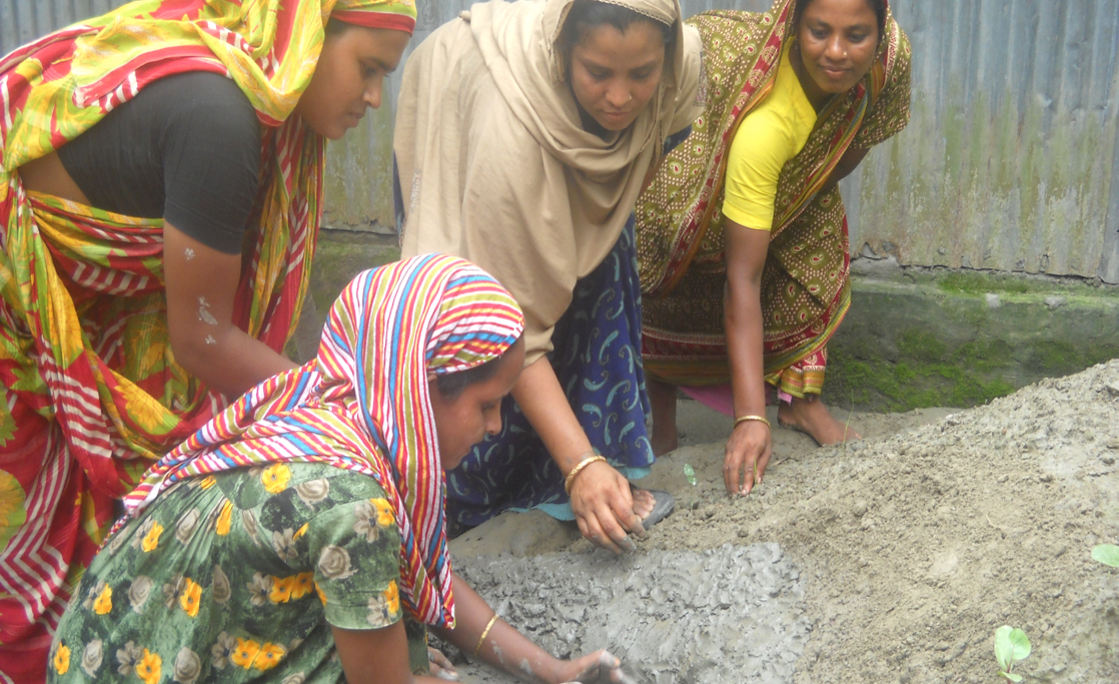
To promote spontaneous replication of the Keyhole gardening in the local communities, the programme initiated a Peer to Peer Pass-on system within 40 mothers' groups (having a total membership of nearly 800 women). Each mothers' group selected five representatives (200 women) to form a Garden Extension Group (GEG) and participate in the first round of training with the understanding that they would share knowledge with other women in the MNCH programme and the surrounding community. The project team trained each GEG on building gardens and LEISA small scale agriculture techniques (including integrated composting, water retention, use of local materials, natural pest and disease control techniques and soil fertility measures, proximity to the kitchen for optimal management and harvesting). GEG group members practiced garden construction by working together to build gardens at the homes of all five members. All 200 initial gardens were monitored by Tdh extension workers on a weekly basis. Tdh verified output, use and the capacity of gardens to withstand monsoon conditions, and the extent of the of the Peer to Peer Pass-on experience.
See the Chart in Section 3.3 for more information.
Photos of the Approach
- 📍 Kurigram
- 🗓 2012-01-05
- 📷 S Taylor