
Orchard-based Agroforestry (establishment of orchard)
Type: Technologies
Creation: 2011-03-08 13:18 Updated: 2021-11-02 15:03
Compilers: Erik Bühlmann
Reviewers: David Streiff, Alexandra Gavilano, Joana Eichenberger
Country/ region/ locations where the Technology has been applied and which are covered by this assessment
- Country: Tajikistan
- Region/ State/ Province: RRS
- Further specification of location (e.g. municipality, town, etc.), if relevant: Faizabad Rayon
- Map: View Map
Description of the SLM Technology
Short description of the Technology
Establishment of an orchard intercropping system on severely degraded cropland.
Detailed description of the Technology
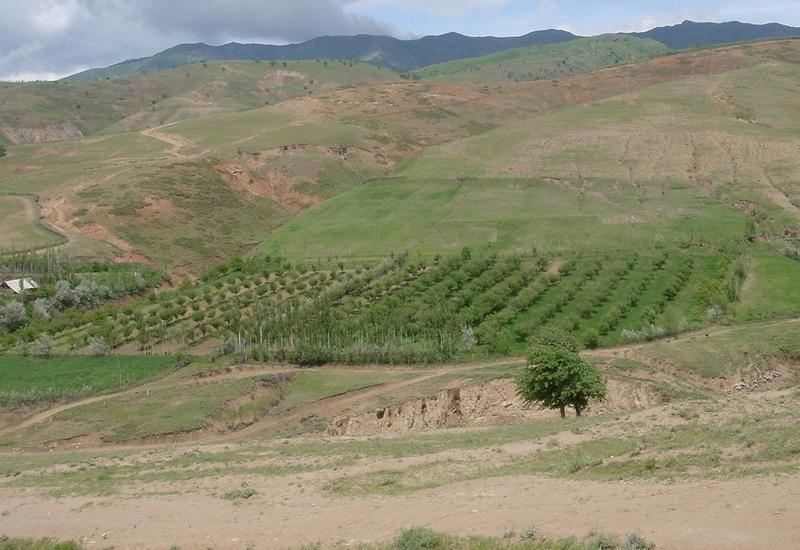
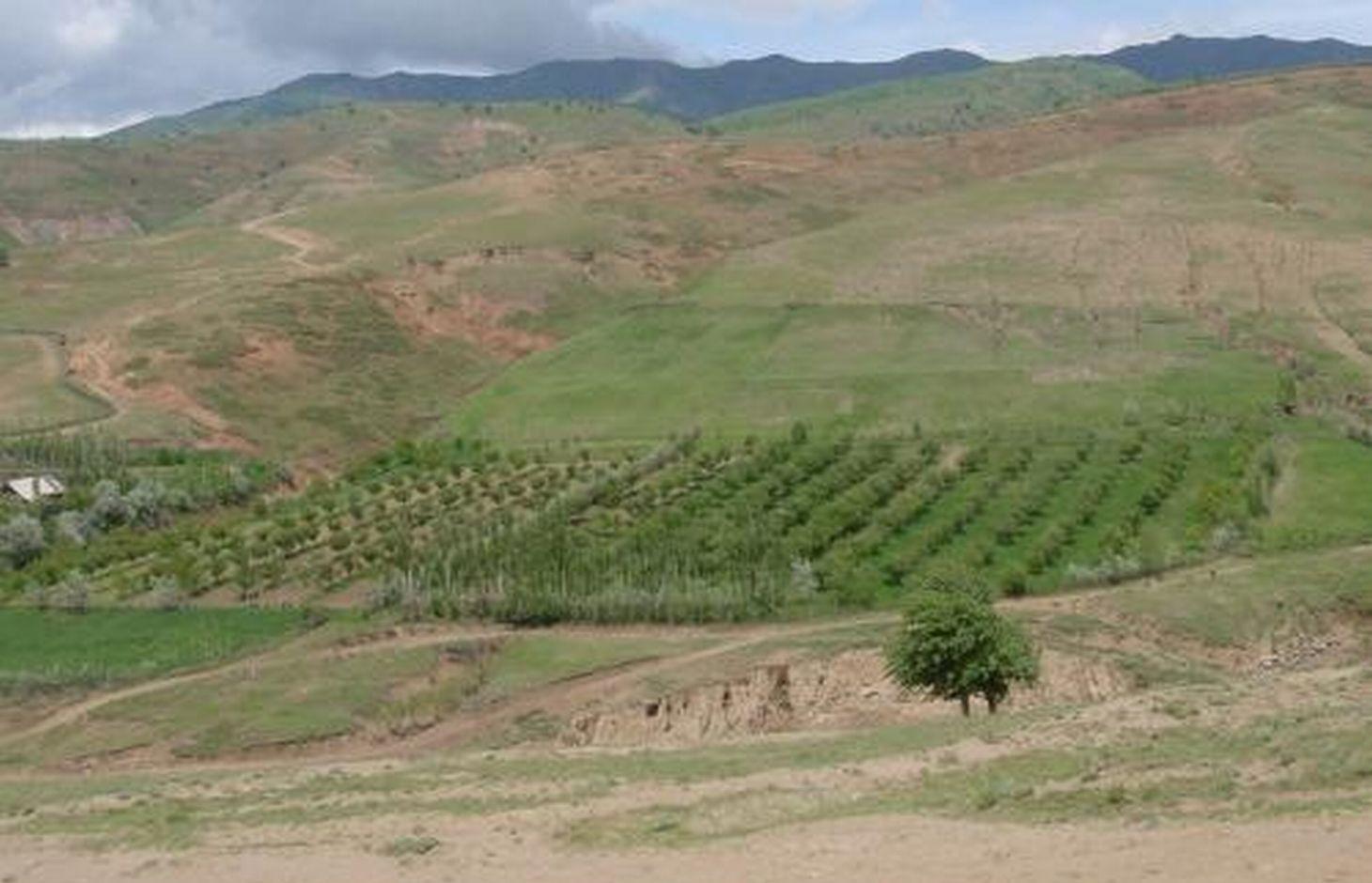
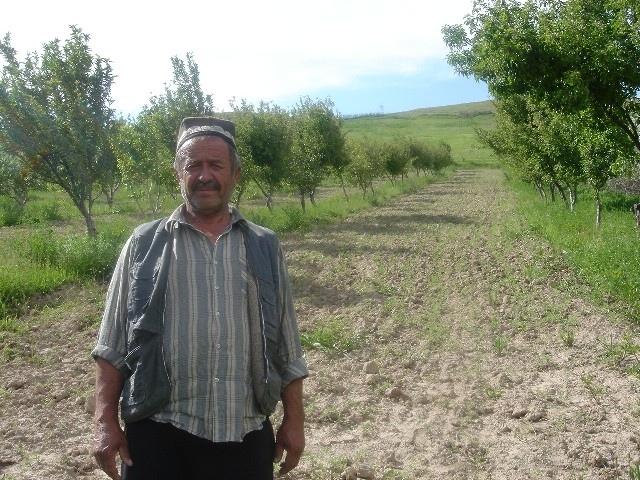
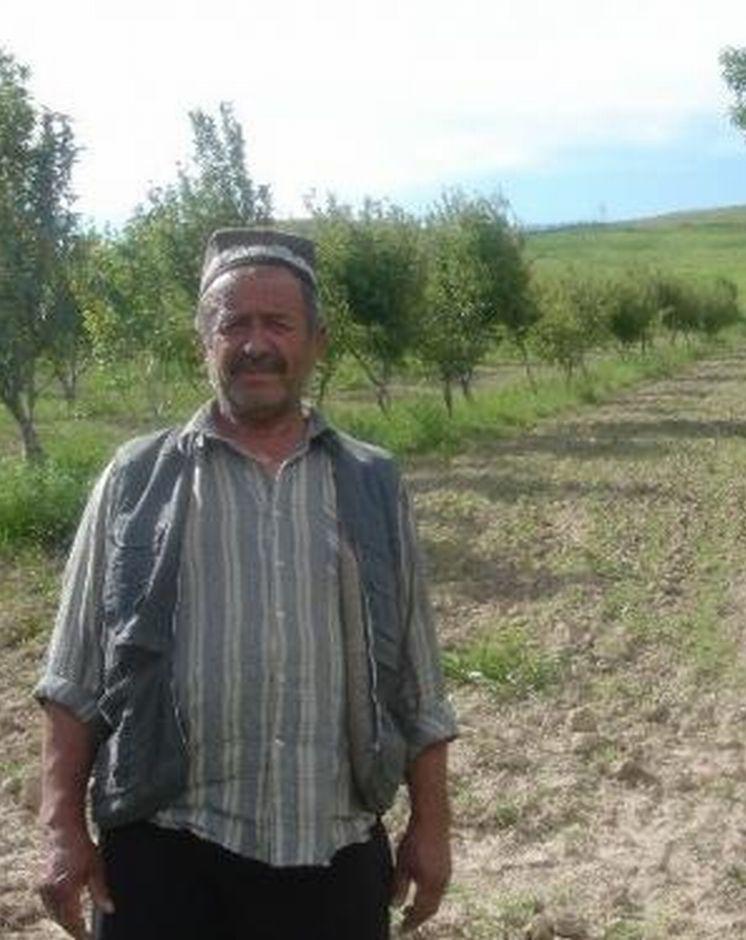
A fruit orchard (consisting of apples, apricots, cherries, pears and nut trees) was established on degraded cropland. Intercropping of annual crops such as wheat, flax, chick peas and vegetables as well as perennial herbaceous fodder plants (alfa-alfa and esparzet) were planted after the first year of the establishment of the orchard. Only the onion plot is rotated systematically since the farmer states that fertility declines due to heavy soil losses result from over-irrigation. Spacing of tree rows varies between 8-10m, the intercropping system is cultivated using a tractor. Fruit trees are aligned in the direction of the slope to facilitate irrigation. At the top of the field an irrigation channel (40cm wide, 15cm deep) stabilised with aligned poplar trees directs water onto the orchard system. During the rainy season the channel serves as a cut-off drain, protecting the land from water running on. Along the trees, a 2.5 m wide grass strip protects the ground from splash erosion.
Purpose of the Technology: The orchard system was established to increase farm production by integrating different resources, while simultaneously conserving soil and water resources and preventing development of gullies. Prior to tree planting, the area had been levelled with a bulldozer to restore the severely degraded cropland. The bought seedlings were planted in hand-dug pits. During summer, the orchard system is watered three days per week; manure is applied around the fruit trees on an annual basis. Pruning of the trees is done in early spring. Due to irrigation, the grass strips can be harvested twice a year for haymaking. Farming two crops at a time means gross farm production could be considerably increased, which is the reaon why the farmer considered the technology successful. However, establishment and maintenance of the technology is cost intensive and, in this case study, was only affordable due to the farmers off-farm income. Since the tree rows are aligned up and down the slope, soil erosion is solely reduced by the capability of the irrigation channel (and aligned tree barrier) to prevent the system from runon. Planting tree rows on the gradient would increase the technologies potential to reduce soil loss.
Photos of the Technology
- 📍 Chinoro, Faizabad Rayon, RRS
- 📷 Erik Bühlmann (Berne, Switzerland)
- 📍 Chinoro, Faizabad Rayon, RRS
- 📷 Erik Bühlmann (Berne, Switzerland)
- 📍 Chinoro, Faizabad Rayon, RRS
- 📷 Erik Bühlmann (Berne, Switzerland)
- 📍 Chinoro, Faizabad Rayon, RRS
- 📷 Erik Bühlmann (Berne, Switzerland)