Orchard-based agroforestry
Type: Technologies
Creation: 2011-01-17 06:08 Updated: 2021-11-02 15:00
Compilers: Loes Masselink
Reviewers: Deborah Niggli, Alexandra Gavilano, David Streiff, Lisa Soloveva, Olga Andreeva, Laura Ebneter, Joana Eichenberger
Country/ region/ locations where the Technology has been applied and which are covered by this assessment
- Country: Tajikistan
- Region/ State/ Province: Tajikistan, Faizabad
- Further specification of location (e.g. municipality, town, etc.), if relevant: Faizabad
- Map: View Map
Description of the SLM Technology
Short description of the Technology
An agroforestry system where legumes and cereals are planted in fruit orchards, giving simultaneous production and conservation benefits.
Detailed description of the Technology
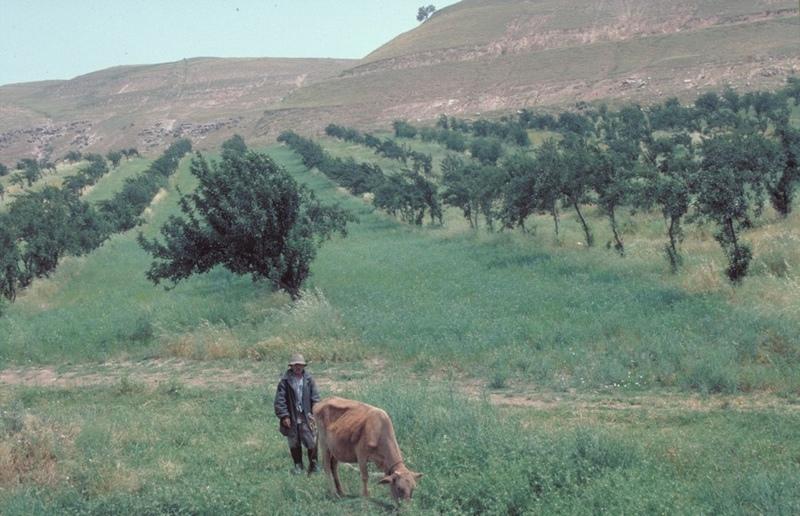
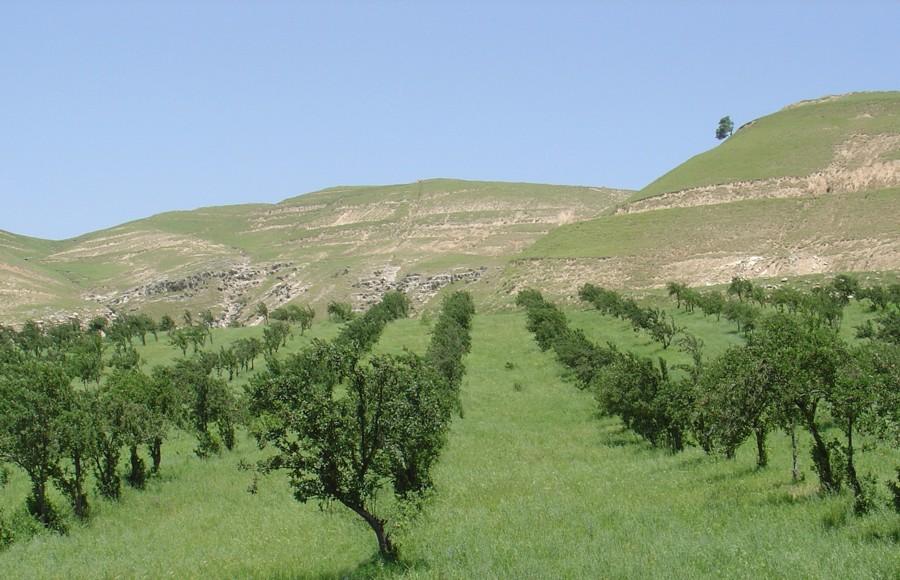
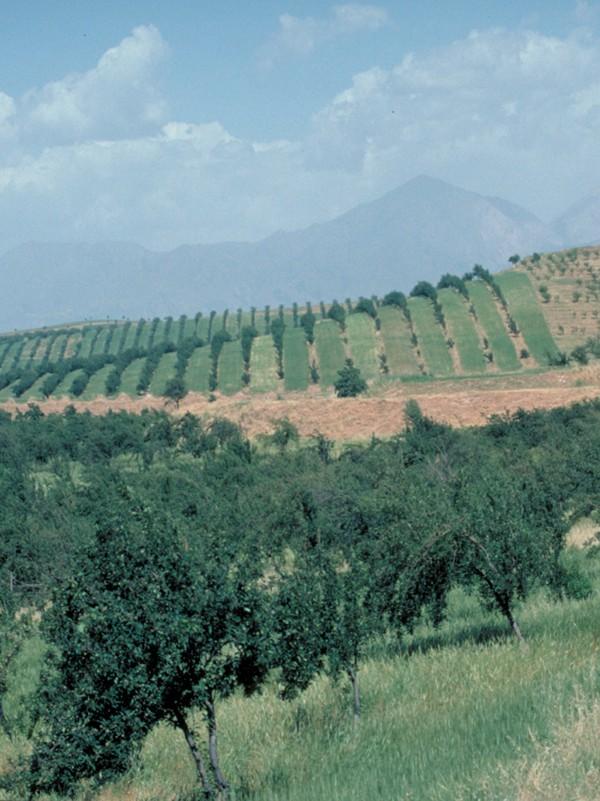
In the Faizabad region, Tajikistan, an area which is characterised by hilly topography, and deep but highly erodible loess soils, farmers traditionally cultivate beans and wheat in combination with fruit trees. This was a rather unsystematic agroforestry system, and during Soviet times (in the 1980s) fruit production was intensified. Pure-stand orchards were established: the land was levelled and on slopes exceeding 20%, terraces were constructed mechanically. The density of trees was increased, and the little space remaining between was used for hay production. Annual cropping was stopped.
Purpose of the Technology: After the Soviet era, farmers reduced the number of trees, allowing room for inter-cropping. They also established new orchards according to this same pattern. Those who farm rented land merely inter crop wheat, whereas the few farmers who own their land, rotate crops with two years of wheat, followed by one of legumes (beans or lucern). Crops are grown both for home consumption and sale.
Establishment / maintenance activities and inputs: The density of apples was reduced by expanding the spacing from approx 5 m to 10 m between rows, and from 2 m to 4 m within rows. Along each row of trees a 2-3 m strip of grass was left to grow. The layout of fruit trees in lines is a compromise between being along the contour, and against the prevailing wind. After harvesting of the fruit, between August and October, farmers sow their annual crops.
Natural / human environment: This agroforestry system provides protection against strong winds, heavy rains and flooding. Soil erosion (by water) has been reduced due to improved soil cover by the inter cropping, and through leaf litter, which is left to decompose on the ground. Furthermore, after harvesting, about three quarters of the crop residues are left on the field as mulch. The remainder is used as fodder. Soil organic matter within the current agroforestry system is considerably higher than in the surrounding grazing areas. Soil fertility has improved also: beans can fix 60-80 kg/ha/year of nitrogen. Compared with other crops, wheat provides the best erosion protection. Since the lateral rooting system of the apple trees reaches only 1-1.5 m from the trunk, competition for nutrients is not a major problem. Neither is there a problem with shade, since during the crop establishment period the trees have lose their leaves. In order to increase production, farmers plan to apply supplementary irrigation where possible.
Photos of the Technology
- 📍 Faizabad, Faizabad, Tajikistan
- 📷 Hanspeter Liniger (Centre for Development and Environment (CDE) Uneversity of Bern.)
- 📍 Faizabad, Faizabad, Tajikistan
- 📷 Hanspeter Liniger (Centre for Development and Environment (CDE) Uneversity of Bern.)