
Growing of fodder crops on steep slopes in arid highlands
Type: Technologies
Creation: 2011-03-31 09:30 Updated: 2021-11-02 15:42
Compilers: Gulniso Nekushoeva
Reviewers: David Streiff, Alexandra Gavilano, Joana Eichenberger
Country/ region/ locations where the Technology has been applied and which are covered by this assessment
- Country: Tajikistan
- Region/ State/ Province: Tajikistan / GBAO
- Further specification of location (e.g. municipality, town, etc.), if relevant: Vanch / Ravgada
- Map: View Map
Description of the SLM Technology
Short description of the Technology
Cultivation of fodder crops (alfa-аlfa) on irrigated slopes of 60% steepness in the arid mountainous area of the Western Pamirs (Vanj valley).
Detailed description of the Technology
In 1993, in the Vanj district all land suitable for tilling was already occupied, only steep slopes were uncultivated. However, one innovative land user began to set up on a slope with 60% steepness, a 3 ha plot for intensive grass / fodder production through his own initiative. By the application of irrigation, within 3-5 years the very low productive grazing land was converted into a highly productive and sustainable cut-and-carry system. The technology is very effective in these ecological conditions for rapid rehabilitation of degraded lands. Over the 18 years of on-going fodder production on the plot, the pure alfa-alfa culture transformed into a grass-bean mixture, which provides even better soil cover and soil conservation.
Purpose of the Technology: The main purpose is secured fodder production for keeping livestock in the winter time. Despite the steep slope of 60%, and low-productive soils, by applying irrigation, the farmer gets three harvests of hay per season, amounting to about 8-12 ton of high quality fodder. Thus, over all these years, the farmer has had no problems producing sufficient fodder for his livestock.
Establishment / maintenance activities and inputs: The establishment of such a plot is very labour-intensive. However, within 3-4 years the productivity of the land improves several times over. High yields of high quality hay can be obtained within the short term, and the labour intensive activities are mostly needed just within the first year of establishment. Thus, many farmers have been attracted to apply this technology.
Natural / human environment: The plot described is situated in the village of Ravgada, Jamoat Teharv in Vanj district. Vanj is one of the two districts of GBAO with favourable agro-climatic conditions. But even here the natural fertility of the stony soils is low, especially on pasture lands with sparse vegetation. Due to the high aridity, farming is not possible without irrigation. The main income of the population is from livestock and the sale of nuts and fruits. All families that have recently become independent farmers, had mostly lands on steep slopes allocated to them. These families have therefore been applying the described technology with minor variations depending on the topography of their land.
Photos of the Technology
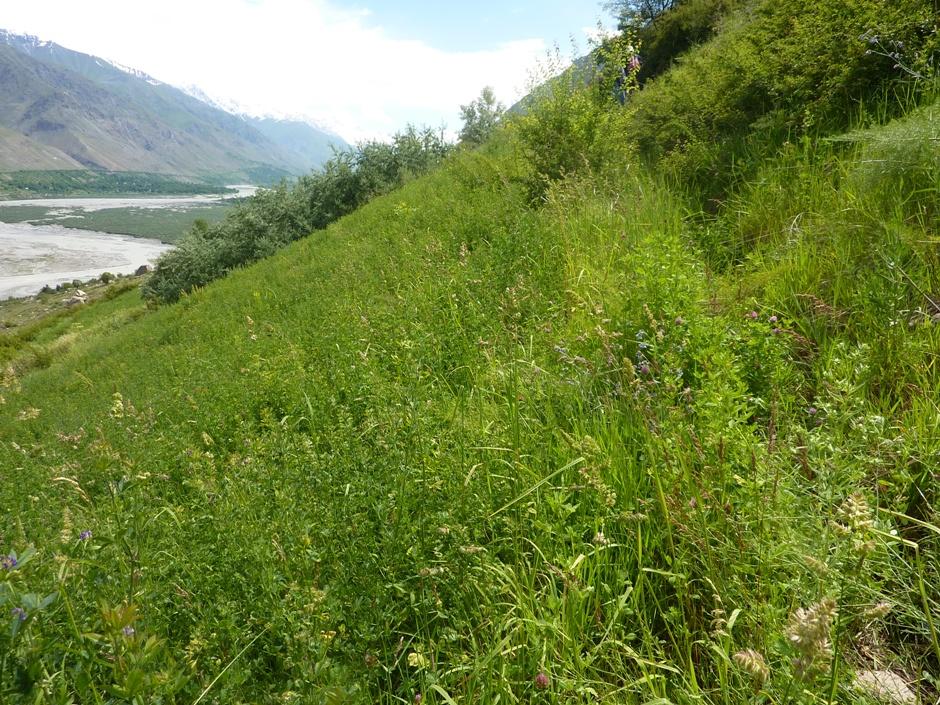
- 📍 Jamoat Teharv , v.Ravgada, Vanch/GBAO/Tajikistan
- 📷 Gulniso Nekushoeva (Dushanbe Tajikistan)
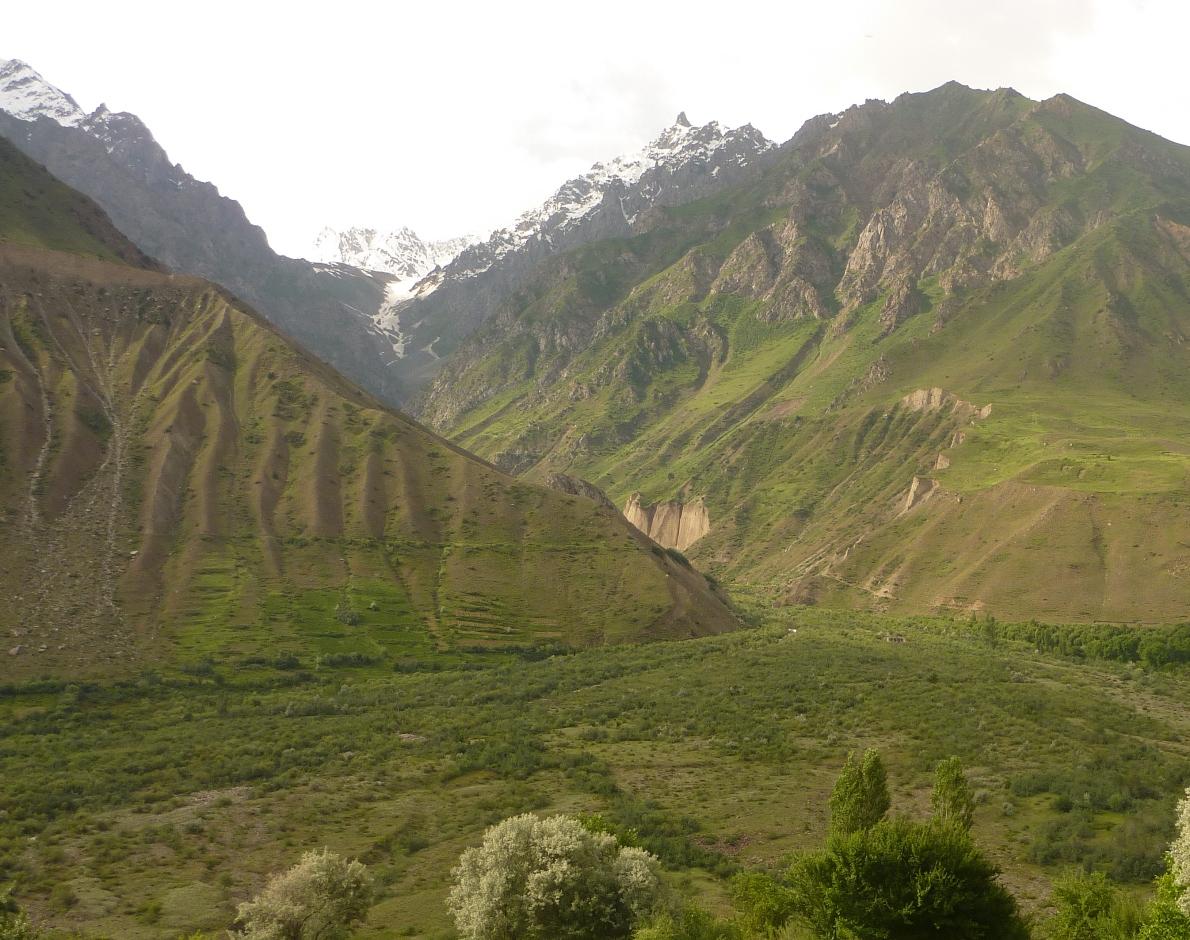
- 📍 jamoat Teharv , v.Ravgada, Vanch/GBAO/Tajikistan
- 📷 Gulniso Nekushoeva (Dushanbe Tajikistan)