
Rehabilitation of grazing areas through planting of Izen perennial shrubs
Type: Technologies
Creation: 2011-05-03 08:28 Updated: 2021-11-02 15:42
Compilers: Tuychiboy Safarov
Reviewers: Alexandra Gavilano, Fabian Ottiger, Joana Eichenberger
Country/ region/ locations where the Technology has been applied and which are covered by this assessment
- Country: Tajikistan
- Region/ State/ Province: Tajikistan
- Further specification of location (e.g. municipality, town, etc.), if relevant: Dangara, Lokhur
- Map: View Map
Description of the SLM Technology
Short description of the Technology
Development of grazing areas through plantation of Izen
Detailed description of the Technology
Improvement of grazing areas through plantation of izen in non-used areas for improvement of condition of grazing areas and to increase fodder basis.
In general, grazing territories located in Tohirsu watershed are severely degraded due to overgrazing and digression. Pastures that are located on mountain slopes have turned into paths, bare ground and tussocks. Soil is often washed out, it is quite stony; Pastures are located on steep slopes, pastures that located close to settlements are severely degraded and covered by noxious plants and burrs. Grazing areas suffer from non-regulated daily and annual grazing during spring-summer-autumn period or even all-year-round. Vegetation cover was severely damaged by overgrazing, couch grass can be seen in some places, soil suffer from water erosion, multiple gullies have formed and etc.
Non-regulated grazing causes damage to grass cover and changes ecological situation in the area. Continuous grazing compacts or destroys soil cover and causes specific forms of the so-called “grazing microtopography”. As a result, soil permeability is reduced, runoff level increases, pit-run fines, humus and mineral nutrients are washed out. This severely affects soil fertility. As a result, grass cover is reduced as well as the total number of animals that can be grazed there. Thus, additional measures for ecological optimization of grazing areas are needed.
With support of the project and local initiative group 5ha of non-used areas were selected in Lokhur Jamoat of Dangara region for plantation of izen (Kochia). The overall idea was to improve the condition of grazing areas, prevent wind and water erosion through plantation of izen. With 100% germination capacity 6-8kg of seeds are needed per one hectare. Seeds are selected with the use of laboratory analysis. Simultaneous tillage and harrowing at depth of 25-30cm allowed to save fuel and funds. Seeds of izen of “Kuikanak” sort were planted at the depth of 0,5-1,0cm. The area sown with izen was fenced. “Kuikanak” is tolerant to +40C temperature and is really good for climatic conditions of Dangara region. Its root system reaches 80-150cm per year.
Purpose of the Technology: The overall goal of the idea was to improve the condition of grazing areas, prevent wind and water erosion, rehabilitate saline soils, preserve moisture in soils, increase fodder basis, enrich soil organic matter with nitrates, harvest and sale seeds and improve rural livelihoods. Improve agricultural conditions, increase and create soils that can resist degradation. Create favorable socio-economic and ecologic conditions for rural population.
Establishment / maintenance activities and inputs: First of all, a group of common interest has been set up. Group members took part in a workshop on application of this technology. During the workshop it was suggested to improve productive capacity of grazing areas. Members of the group have selected a 5ha grazing area in Lokhur Jamoat. According to the project, the group has provided 20% of funding. At the initial stage land was prepared for tillage. Izen seeds were planted following the laboratory analysis. Average lifetime of izen is 25-30 years.
Natural / human environment: Izen is mainly used to enrich arid grazing areas. Biological value of izen is that it is tolerant to hot summer periods that are typical for south Tajikistan. At the same time, izen also grows in the eastern Pamir where winter temperatures vary from -40 down to -45C.
The selected land is the property of the group of common interest which has official land use certificate. The group consists of representatives of 10 households. They have equal access to fodder crops, seeds and have equal grazing opportunities.
Photos of the Technology
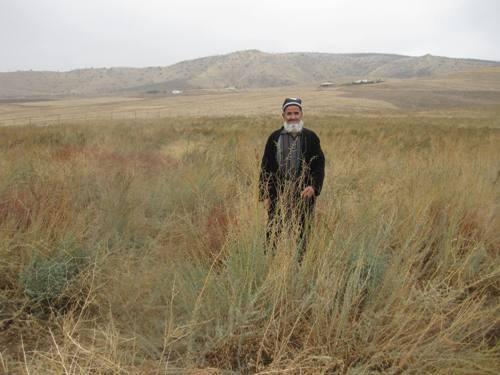
- 📍 Дангара, Лохур, Хатлон
- 📷 Сафаров