
Orchard terraces with bahia grass cover
Type: Technologies
Creation: 2010-11-30 13:38 Updated: 2019-03-14 12:40
Compilers: Zhanguo Bai
Reviewers: David Streiff, Deborah Niggli, Alexandra Gavilano
Country/ region/ locations where the Technology has been applied and which are covered by this assessment
- Country: China
- Region/ State/ Province: Fujian Province
- Further specification of location (e.g. municipality, town, etc.), if relevant: Yongchun County
- Map: View Map
Description of the SLM Technology
Short description of the Technology
Rehabilitation of degraded hillsides through the establishment of fruit trees on slope-separated orchard terraces, with bahia grass planted as protective groundcover.
Detailed description of the Technology
In this case study orchards were established between 1991 and 1992 on degraded and unproductive hillsides (wasteland), with slopes of 12-45%. This was achieved by constructing level beds on the contour, mainly as continuous slope-separated orchard terraces, but in some cases as individual planting platforms. Terrace construction was generally undertaken by hand using hoes and shovels.
Purpose of the Technology: A typical terrace has a 4-5 m wide bed and a 1.0-1.5 m high riser. Commonly, a raised earth lip (0.3 m high) is constructed on the terrace edge to retain rainwater. The terrace riser walls are not protected. Even before terrace construction there was little topsoil and in some places the upper subsoil had been lost to erosion. The establishment of fruit trees (lychee, Litchi chinensis and longan, Dimocarpus longan) therefore required deep planting holes (1 m3), filled with organic matter/manure, into which seedlings were planted. In subsequent years additional large quantities of organic matter/manure were applied in circular trenches to the side of the trees, succeeding trenches being gradually further away as the trees grew. Bahia grass (Paspalum notatum) was planted for SWC purposes as a cover crop, to stabilise terrace risers and to improve soil fertility. It has not been used for fodder in this case. The germination rate of bahia grass seeds is comparatively low; therefore instead of direct seeding, nurseries were established to produce seedlings. The bahia grass seedlings were transplanted onto the terrace risers and beds (leaving a space around each fruit tree) and on the hillside slopes between the terraces. The grass grew and spread quickly, restoring a protective vegetative cover following terrace construction.
Natural / human environment: The primary overall purpose of the technology was to rehabilitate degraded hillsides through the planting of economically valuable fruit trees. Terracing reduces soil erosion while retaining most of the rainwater. The application of organic matter creates improved rooting conditions, while restoring and maintaining soil fertility. The bahia grass further provides protective groundcover preventing splash erosion, increasing surface roughness, and thereby slowing down runoff velocity, while contributing to the restoration of the soil’s biological, chemical and physical properties. Irrigation ditches dug along the terraces help to reduce erosion further. This project was planned by SWC specialists: around 6,000 families were allocated orchard plots and provided with seedlings at a subsidised price.
Photos of the Technology
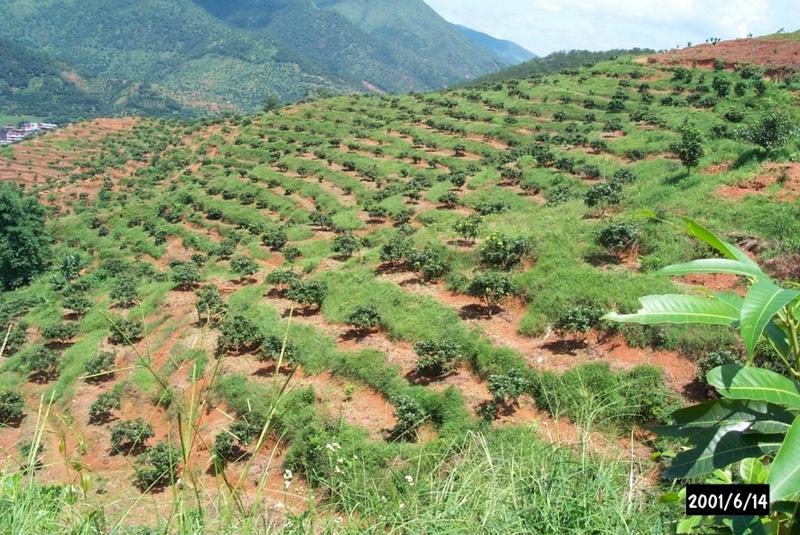
- 📍 Gu Shan Small Watershed, Yongchun County, Fujian
- 🗓 2001-01-06
- 📷 Huang Xinquan, Fuzhou, China
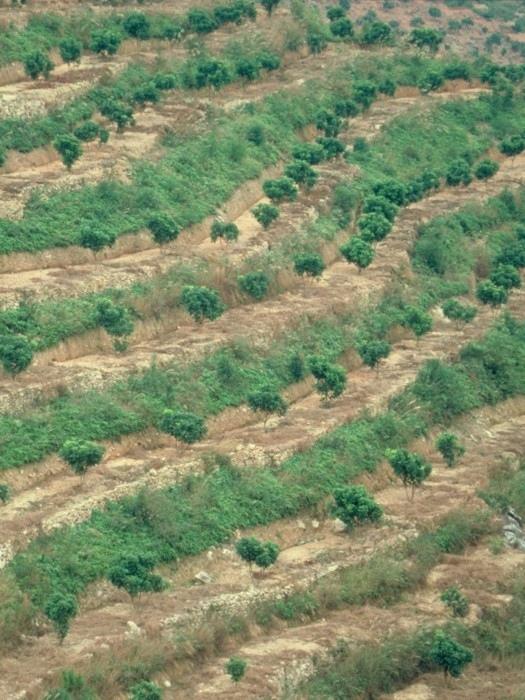
- 📷 Hanspeter Liniger