
Current agroforestry: orchard with wheat intercropping
Type: Technologies
Creation: 2013-01-14 10:26 Updated: 2019-08-21 11:13
Compilers: Malgorzata Conder
Reviewers: Fabian Ottiger, Alexandra Gavilano
Country/ region/ locations where the Technology has been applied and which are covered by this assessment
- Country: Tajikistan
- Region/ State/ Province: Khatlon, Tajikistan
- Further specification of location (e.g. municipality, town, etc.), if relevant: Muminabad
- Map: View Map
Description of the SLM Technology
Short description of the Technology
Current agroforestry of a degraded mulberry and apple orchard with wheat intercropping
Detailed description of the Technology
Since 1992 an area of around one ha has been owned by the farmer. He planted mulberry trees the same year. At that time, orchards were established in the whole surrounding area because the government decreed that a territory should have plenty of mulberry trees. Despite the government plan, all the land users of that area began to switch their orchards into wheat crops. Five years later the farmer planted apple trees within the mulberry orchard. The orchard had 200 mulberry and 100 apple trees. The motivation was to feed the working farmers of the fields around. Five years later the apple trees gave fruits. But only the first two years gave a good yield and income from selling them. Later on the fruits were just eaten by the farmer’s family. After another seven or eight years the farmer grew a wheat crop in between the tree lines. Nowadays it's the only remaining orchard in that area. Due to the lack of proper maintenance and water availability the orchard is degraded and the output is very low.
Purpose of the Technology: The government established a large territory of mulberry orchards, for three reasons: First to reduce the impact of natural hazards, second to increase silk production and last to improve fire wood availability. The planting of apple trees should be beneficial for farmers working in the surrounding crops and well as for the family, who sell the fruits and the mulberry leaves. As the yield started to decrease the wheat crop was established to have a bigger output for that crop.
Establishment / maintenance activities and inputs: Due to the government’s order to establish orchards, the local authorities provided the mulberry trees. Hence, it was in the responsibility of the farmer to plant the trees and to look after them by soil loosening and pruning. The latter activity must be done once in the first five years after planting. The farmer bought the apple trees himself as they were cheap at that time. To establish the wheat crop, ploughing, seeding, fertilizing and finally harvesting must be done. One person is supposed to guard the orchard and wheat crop every day. Yearly maintenance consists of soil loosening around the fruit trees and the above mentioned task for cropping. The maintenance of the orchard seems to be abandoned more and more, probably because the output decreases year by year.
Natural / human environment: The orchard is situated below Momandion village, on the very last foot slope before the valley plain begins and, hence, it has a slight slope,. In the past, orchards were numerous, but nowadays wheat crops have mostly replaced the orchard. As there is no fence and no one to control it regularly, livestock invades the property. During its first two years there was a water source, which had dried up by the time. The orchard is a relic being the only and last one in that area. Broken branches, unpruned trees and a trampled crop, show signs of insufficient control and maintenance and therefore of a gradual abandonment of the orchard.
Photos of the Technology
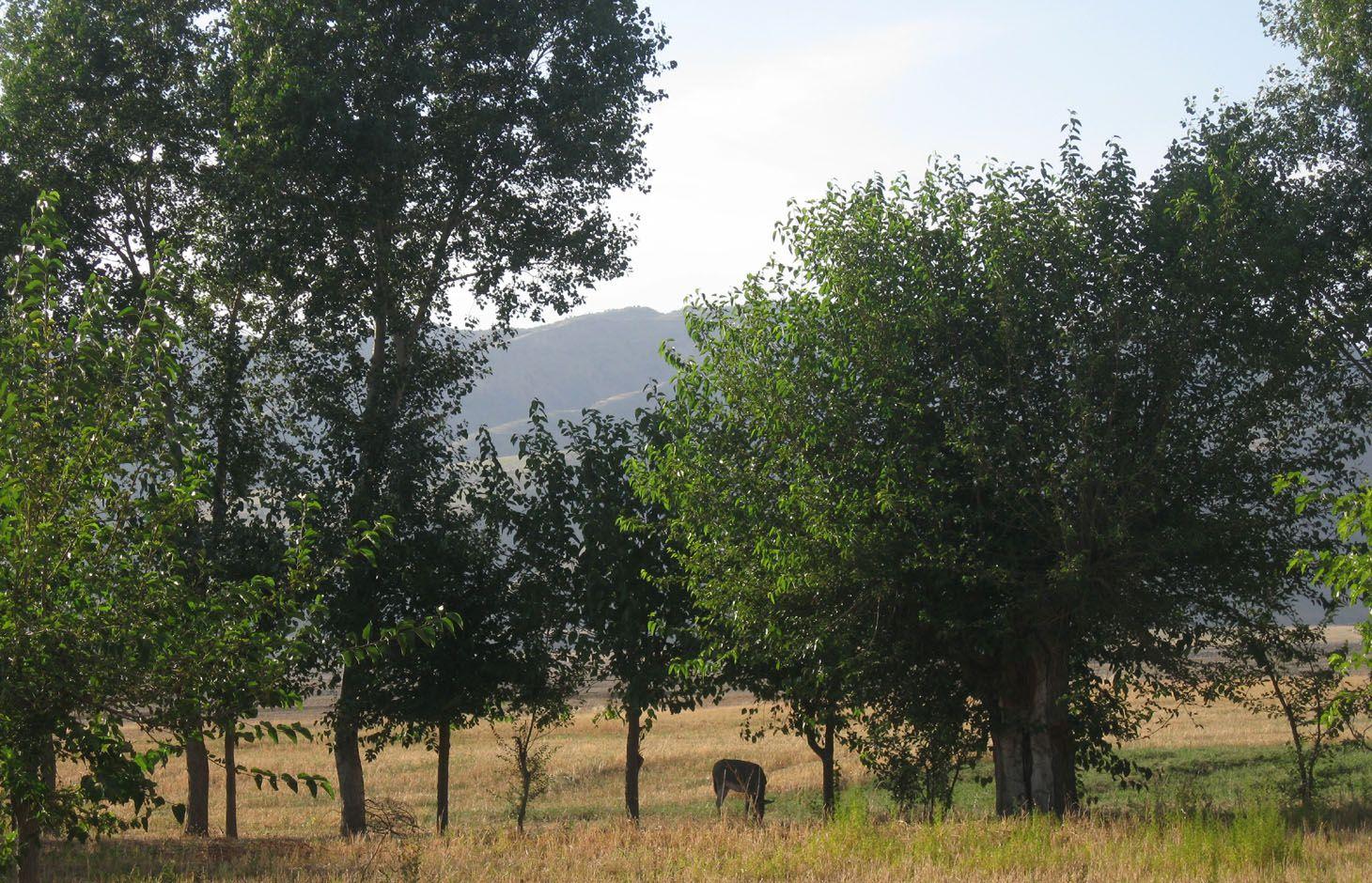
- 📍 Obishur Watershed, Momandion, Muminabad, Khatlon, Tajikistan
- 🗓 2012-07-08
- 📷 Malgorzata Conder
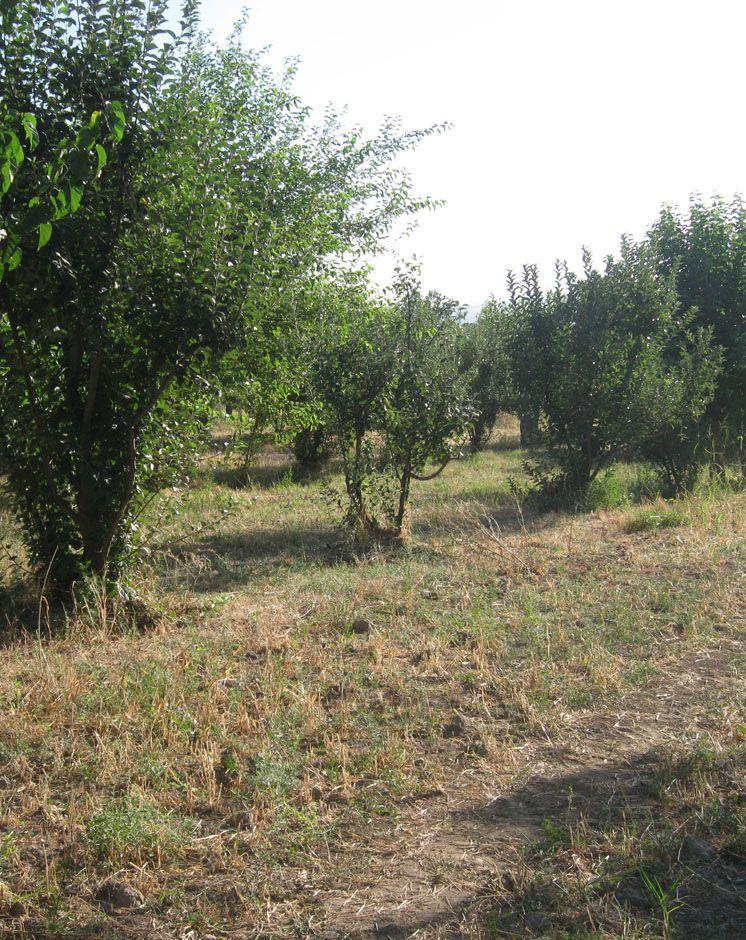
- 📍 Obishur Watershed, Momandion, Muminabad, Khatlon, Tajikistan
- 🗓 2012-07-08
- 📷 Malgorzata Conder