
Fallow restoration by no-tillage seeding
Type: Technologies
Creation: 2013-09-25 06:22 Updated: 2025-08-15 19:29
Compilers: Heino Hertel
Reviewers: Rima Mekdaschi Studer, David Streiff, Alexandra Gavilano
Country/ region/ locations where the Technology has been applied and which are covered by this assessment
- Country: Kazakhstan
- Region/ State/ Province: Almaty Oblast
- Further specification of location (e.g. municipality, town, etc.), if relevant: Zhambyl Rayon
- Map: View Map
Description of the SLM Technology
Short description of the Technology
Fallow land restoration for fodder production is combined with biodiversity conservation of natural steppe vegetation by no-tillage disc-harrowing and seeding of forage grass in low density.
Detailed description of the Technology
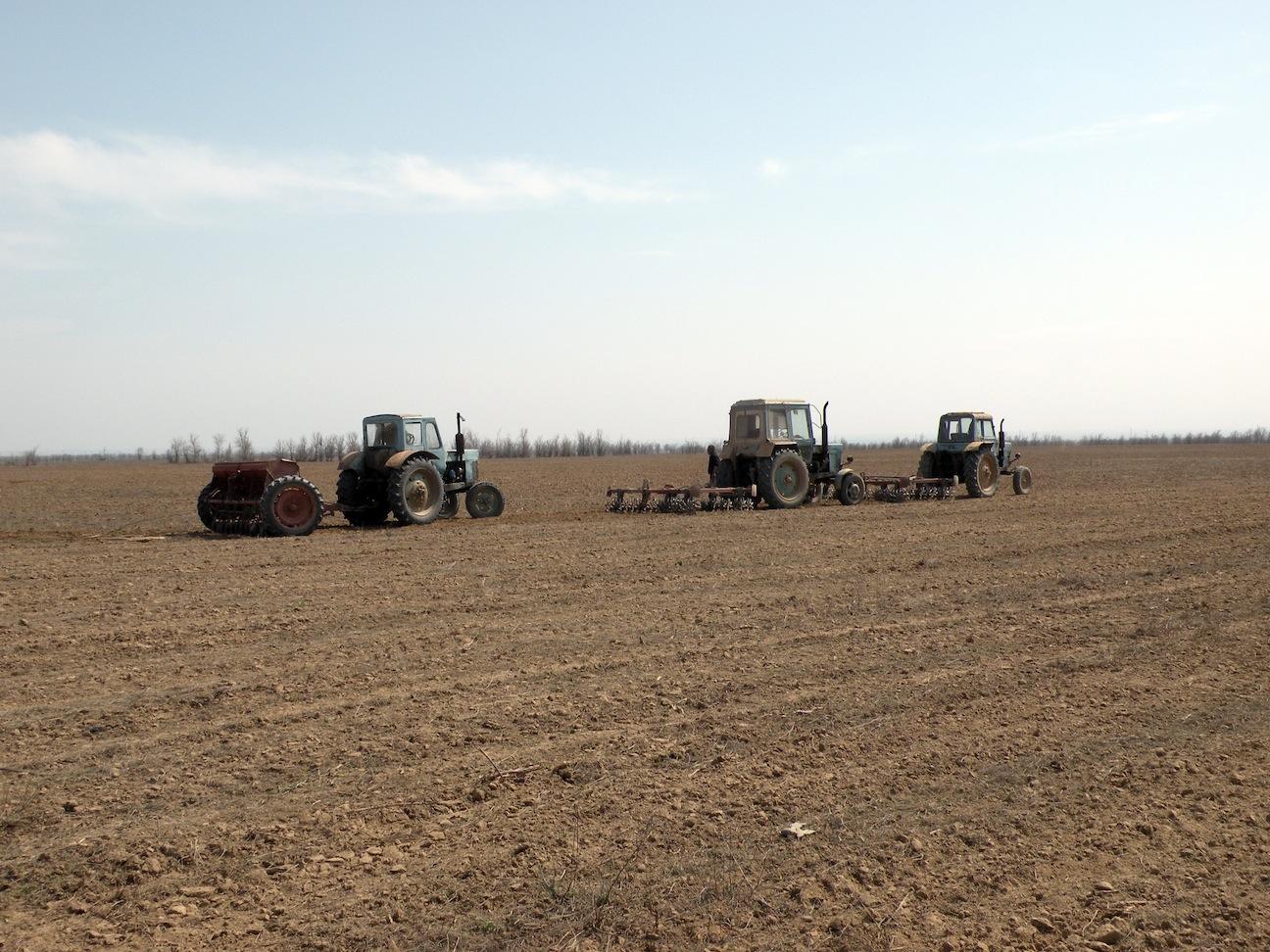
In March a plot of 380 ha twenty years abandoned wheat fields with stable perennial weed stadium, dominated by Artemisia lessingiana was cultivated by shallow disc-harrowing and seeding with A. cristatum. Agropyron cristata is a useful pasture grass, but it is invasive and tends to dominate an area for more than 15 years. For this reason, the seeding was done in half density then usual during Soviet time (10 kg/ha instead or more than 20 kg/ha) to avoid the strong dominance of the fodder grass and to maintain a balance between already established steppe vegetation and fodder grass. By disc-harrowing the dry inflorescens of Artemisia were destroyed and the dominance of this species diminished. This leads to a more species-balanced vegetation, which can provide fodder and hay and reduces the risk of locust mass development.
Purpose of the Technology: The fallow land in Kazakhstan comprises more than 10 million ha. With the climate change the agro-ecological zones will shift northwards, greatly reducing the area of the country in which cereals may be produced. As a result, more fields will be abandoned and the area of fallow land will further increase. After a few years, at most fallows a stable perennial weed stadium dominated by Artemisia lessingiana develops, which is not well eaten by livestock and promotes the mass development of locust.
Plowing and seeding with forage grass Agropyrum cristatum is the common method to minimize the risk of locust mass development and the production of fodder. But the seeding with A. cristatum has negative effects on soil structure and humus content and leads to a permanent vegetation strongly dominated by the forage grass and reduction of biodiversity.
With no-tillage cultivation and seeding in low density the biodiversity of steppe vegetation will remain and enriched with forage grass for utilization.
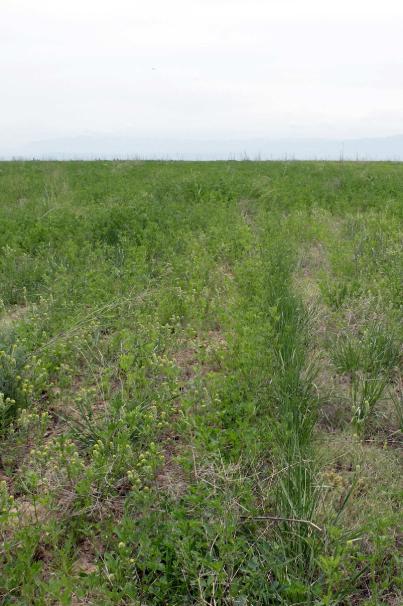
Establishment / maintenance activities and inputs: The cultivation was carried out in March 2010 by the farmer and his staff and his own machinery. The project provided the costs for seeds and fuel. After 1,5 years, in September 2011 the results were evaluated by botanists, project staff and the farmer. The field shows a balanced vegetation structure of natural steppe vegetation and sown forage grass with a moderate dominance of grass. The goal was fully achieved.
Natural / human environment: The technology of plowing and seeding with forage grass is well known by all local stakeholders, including the farmer. The adaptation to use no-tillage cultivation and half density of seeding was introduced by the project staff and is based on the results of an other project.
The farmer was ready to try the new technology on his farmland and provided land, machinery and staff. Other farmers, local and regional authorities, and the Ministry of Agriculture were interested in the results, which were published and used in other areas.
Photos of the Technology
- 📍 Matybulak Selskij Okrug, Zhanbyl Rayon, Almaty Oblast, Kazakhstan
- 📷 Heino Hertel (22, Erkindik Blv. 720040 Bishkek, Kyrgyzstan)
- 📍 Matybulak Selskij Okrug, Zhanbyl Rayon, Almaty Oblast, Kazakhstan
- 📷 Heino Hertel (22, Erkindik Blv. 720040 Bishkek, Kyrgyzstan)