
Fodder cultivation
Type: Technologies
Creation: 2014-01-17 12:25 Updated: 2019-06-04 11:21
Compilers: Sabita Aryal
Reviewers: David Streiff, Alexandra Gavilano
Country/ region/ locations where the Technology has been applied and which are covered by this assessment
- Country: Nepal
- Region/ State/ Province: Chyamrang besi
- Further specification of location (e.g. municipality, town, etc.), if relevant: Kavre
- Map: View Map
Description of the SLM Technology
Short description of the Technology
It is a technology where slope, waste land, remains of crop land, marginal lands, rising terraces are protected by fodder cultivation.
Detailed description of the Technology
This technology involves the cultivation of various trees, grasses, legumes and shrubs that can be used as livestock feed. The slopes in the hills, rising terraces, waste and barren land and other land types with many limitations that cannot be used for agriculture are used for fodder cultivation. In this way, the land is protected from landslide, erosion by wind and water and the loss of soil fertility due to over-compaction of soil and overgrazing is reduced. In addition, the feed quality and quantity of the livestock is improved and their productivity consequently is also increased.
Purpose of the Technology: This technology is practiced:
-mainly for protection of land from erosion or landslide,to protect from over-compaction and overgrazing leading to soil fertility loss i.e. for land management
-for the purpose of providing food for livestock even during the winter months.
-for increasing the quality of feed for livestock and thus, improve their productivity.
Establishment / maintenance activities and inputs: This technology involves the plantation of trees, legumes, shrubs and grasses in the wastelands and lands deemed unfit for agriculture. The suitable plant seedlings are planted at a particular season i.e during spring mainly in the month of Baisakh. Depending upon the amount of nourishment and the nutritional content requirement and availability of seedlings,the nutrient contents of feeds and fodders on the basis of soil composition, use of manures and fertilizers on the land, irrigation facilities, stage and speed of growth frequency of cutting the variety and strain of feed resources are determined. It needs watering and removal of unwanted weeds for some months and the plant needs no further caring. They grow by themselves. These plants are mostly rain-fed and have no other economical or aesthetic values as such and hence, these can be used only exclusively for fodder cultivation. The tree branches, leaves, twigs, shrubs, legume plant bodies used for feed can either be cut and harvest either from time to time when required or they may also be cut and stored in fodder storages for the winter months when other sources of feed are scarce or during the planting season (Asar) when labor is scarce.
Natural / human environment: We need not to create any human or artificial environment for cultivation. The trees grow naturally and create a pleasant environment in nature. Sometimes, for crop fodder cultivation, agricultural lands may come in use. For example, in maize crop used as fodder supplement, the main plots were sown with maize varieties, and the subplots were cutting of added rows of maize after different days after sowing. Thus, young maize plants were cut before drying out in the sun and may be used as fodder. Tropical grass species and improved grasses and legumes are also introduced in barren terrace landscape during the off season after harvesting.
Photos of the Technology

- 📍 Chyamrangnesi, Kavre
- 🗓 2012-01-12
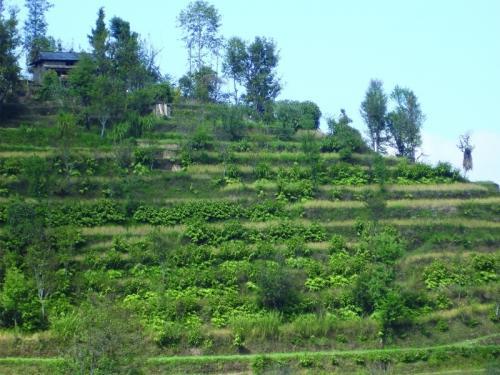
- 📍 Chyamrang besi, Kavre
- 🗓 2012-01-12