
Daily grazing of village-herds
Type: Technologies
Creation: 2011-03-08 09:29 Updated: 2019-08-04 17:38
Compilers: Christian Wirz
Reviewers: David Streiff, Alexandra Gavilano
Country/ region/ locations where the Technology has been applied and which are covered by this assessment
- Country: Tajikistan
- Region/ State/ Province: Region of Republican Subordination
- Further specification of location (e.g. municipality, town, etc.), if relevant: Faizabad
- Map: View Map
Description of the SLM Technology
Short description of the Technology
Rotational grazing on village pastures with heavy pressure with daily to weekly change of grazing places.
Detailed description of the Technology
The herding season is from the beginnning of March to the End of Octobre or even beginning of Decembre. Total area is between 10-20 km2, depending on how strictly the borders are understood. Cows, sheep, goats and donkeys compose the herds. Grazing begins when soil moisture begins to decreaset, first with the little animals, that are supposed to better cope with slippery conditions. After two weeks the cows are led to the pastures and in some cases they will be grazed alone, because sheep and goats disturb them. The grazing zone is situated between 1400 and 1700 m. Rotation begins on the lower pastures, at the beginning of summer the higher pastures are used and towards autumn the animals graze near the villages again, sometimes on cropland, feeding on crop residues. The herders are advised to change place after 2-3 days, but often stay in one place for a longer time. The animals are gathered on the way out of the village a little after dawn, than brought to the pastures. At noon-time they will be lead to a shady place close to a stream, if possible. The same places are visited three or more times per season.
Purpose of the Technology: The animals should be nourished and the cows should give milk. A land user kept his cow at home towards the end of summer, because it stopped giving milk, from the sparse and dry vegetation on the pastures.
Establishment / maintenance activities and inputs: The costs for this form of herding are lost days at school for the children. It largely works without external inputs (such as fertilisers). Other inputs such as salt for the animals are covered by the landowner.
Natural / human environment: These pasture-areas are heaviliy suffering from overuse on one hand and from droughts on the other side. They are in a generally well-conserved state. Fractional vegetation cover is low, especially tree cover, and the proportion non-palatable species relatively high. Erosion by water, including gullies, and crusting, are common phenomena, especially in low cover areas.
Photos of the Technology
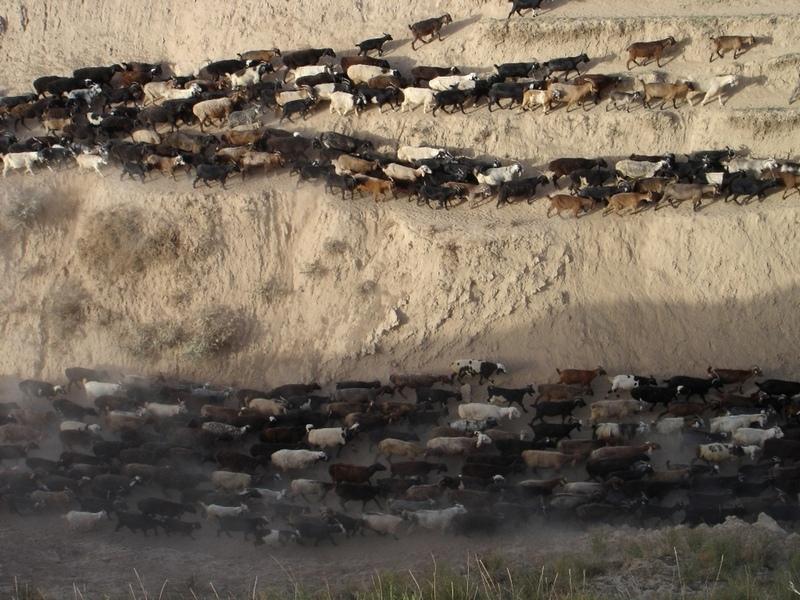
- 📍 Above Duoba, Faizabad / Tajikistan
- 📷 Christian Wirz (Switzerland)
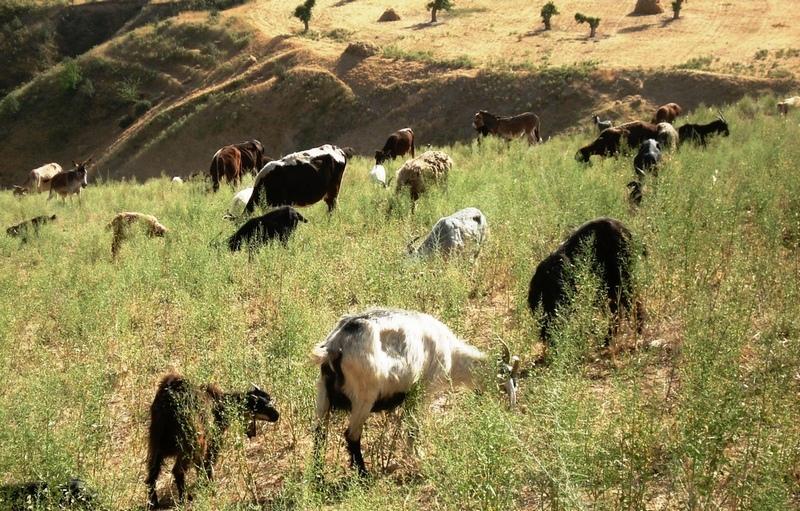
- 📍 Karsang, Faizabad / Tajikistan
- 📷 Christian Wirz (Switzerland)