
Zhuanglang loess terraces
Type: Technologies
Creation: 2010-12-09 13:36 Updated: 2019-03-13 14:59
Compilers: Yaolin Wang
Reviewers: David Streiff, Deborah Niggli, Alexandra Gavilano
Country/ region/ locations where the Technology has been applied and which are covered by this assessment
- Country: China
- Region/ State/ Province: Gansu Province (Loess Plateau Region)
- Further specification of location (e.g. municipality, town, etc.), if relevant: Zhuanglang County
- Map: View Map
Description of the SLM Technology
Short description of the Technology
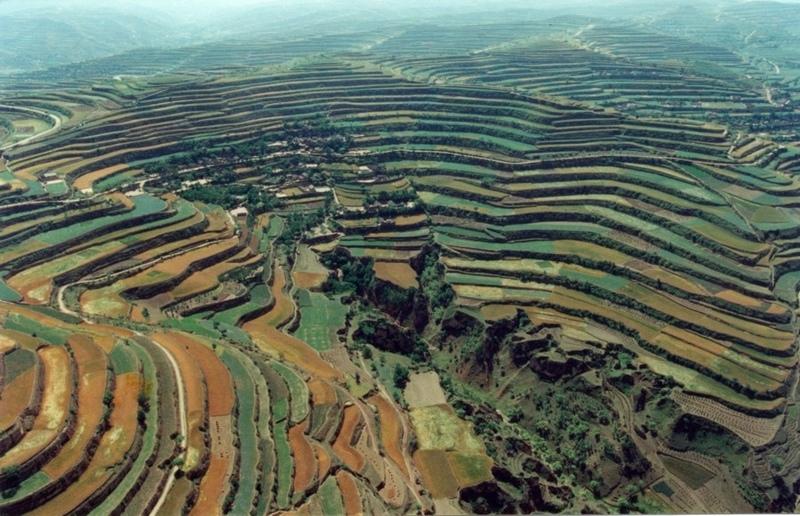
Level bench terraces on the Loess Plateau, converting eroded and degraded sloping land into a series of steps suitable for cultivation.
Detailed description of the Technology
The Loess Plateau in north-central China is characterised by very deep loess parent material (up to 200 m), that is highly erodible and the source of most of the sediment in the lower reaches of the Yellow River.
The plateau is highly dissected by deep gullied valleys and gorges. The steep slopes, occupying 30-40% of the plateau area, have been heavily degraded by severe top soil and gully erosion. Over the whole Loess Plateau approximately 73,350 km2 of these erosion prone slopes have been conserved by terraces.
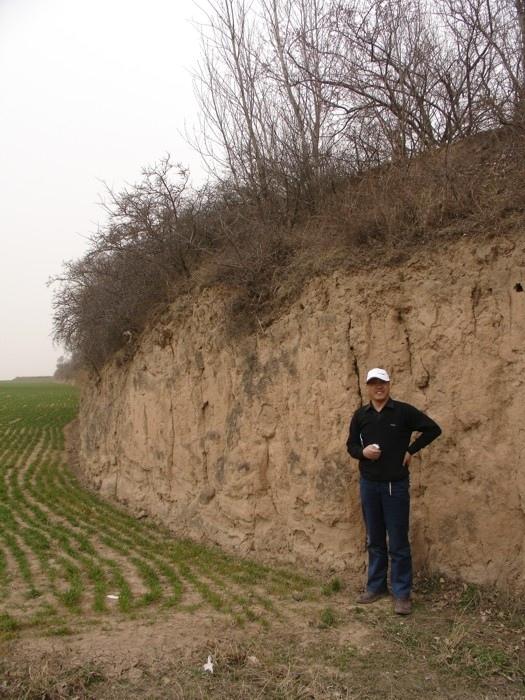
In the case study area (Zhuanglang County) the land that is suitable for terracing has been completely covered. The total terraced area is 1,088 km2, accounting for 90% of the hillsides. The terraces were constructed manually, starting at the bottom of the slopes and proceeding from valley to the ridge. The terraces comprise a riser of earth, with vertical or steeply sloping sides and an approximately flat bed (level bench). Depending on farmers preference some terrace beds are edged by a raised lip (a small earth ridge) which retains rainwater, others remain without lip. The semi-arid climate does not require a drainage system. For typical hillside terraces on slopes of 25-35% the bed width is about 3.5-5 metres with a 1-2 metre riser, involving moving about 2,000-2,500 cubic metres of soil (see table of technical specifications). Generally the risers are not specifically protected, but there may be some natural grasses growing on the upper part. The lower part of the riser is cut vertically into the original soil surface, and has no grass cover, being dry and compact. However it is not erosion-prone since it has a stable structure.
Over most of the Loess Plateau, the soil is very deep and therefore well suited to terrace construction. In addition to downstream benefits, the purpose is to create a better environment for crop production through improved moisture conservation, and improved ease of farming operations. In an average rainfall year, crop yields on terraced land are more than three times higher than they used to be on unterraced, sloping land. The implication is that terrace construction - though labour intensive - pays back in only three to four years when combined with agronomic improvements (such as applying farm yard manure and planting green manure). Some farmers try to make the best use of the upper part of terrace risers by planting cash trees or forage crops - including Hippophae rhamnoides (seabuckthorn), Caragana korshinskii (peashrub) and some leguminous grass. This is locally termed ‘terrace bund economy’. The plants stabilise the risers and at the same time provides extra benefits.
Photos of the Technology
- 📷 He Yu
- 📷 Hanspeter Liniger