
Infilling of gullies with vegetative structures
Type: Technologies
Creation: 2011-05-01 17:58 Updated: 2021-11-02 15:23
Compilers: Daler Domullojonov
Reviewers: Alexandra Gavilano, David Streiff, Joana Eichenberger
Country/ region/ locations where the Technology has been applied and which are covered by this assessment
- Country: Tajikistan
- Region/ State/ Province: Tajikistan / Khatlon
- Further specification of location (e.g. municipality, town, etc.), if relevant: Khovaling / Dorobi
- Map: View Map
Description of the SLM Technology
Short description of the Technology
Reclamation and infilling of eroded gullies using barriers of willow branches and live mulberry cuttings to trap loess soil from surface water runoff.
Detailed description of the Technology
Due to many different factors and mechanisms, soil erosion is at an advanced stage in many of the hilly and mountainous parts of Tajikistan. After disrupting the soil cover in steep areas, starting the process of soil detachment and transportation water runoff gets concentrated into specific areas. As a result, rills develop on the steep areas, and eventually enlarge into gullies.
Purpose of the Technology: To address this problem, low cost barriers are constructed from flexible living branches of a sprouting variety of tree, such as willow. These branches are placed along the gulley at intervals of 3-10 metres, so that they slow down the flow of surface water and trap the sediment, thus eventually filling in the gulley over a period of several years.
Establishment / maintenance activities and inputs: The barriers are designed to slowly help infill eroded gullies by trapping the sediment from muddy surface water runoff. This helps prevent further erosion, increases the amount of land available for pasture, and reduces the risk of mud flows or floods further down the slope.
In gullies no wider than 1-2m, live cuttings from local tree varieties with a diameter of 3-5cm and 1 metre in length can be used to establish horizontal woven barriers across the gulley. The barriers are placed at 3-5m intervals along the gulley, starting at the base.
These barriers are constructed from cuttings that are woven in narrow sections with 5-6cm intervals between them. Enforcement and strengthening of these plugs can be achieved through the use of long branches of locally available mulberry. The height of the plug should not exceed 0.5m. The construction activities start in the spring and within several weeks some of the cuttings begin to sprout and grow. To avoid erosion at the sides of the structure, the cut offs are embedded into the sides of the gulley.
Natural / human environment: Gulley plugging is used in pasture land that suffers from overgrazing, deforestation and trampling, which has resulted in the degradation of the soil. Subsequently, the soil has become more vulnerable to the impact of heavy rain in the spring and autumn months, and is prone to erosion from surface water runoff.
Photos of the Technology
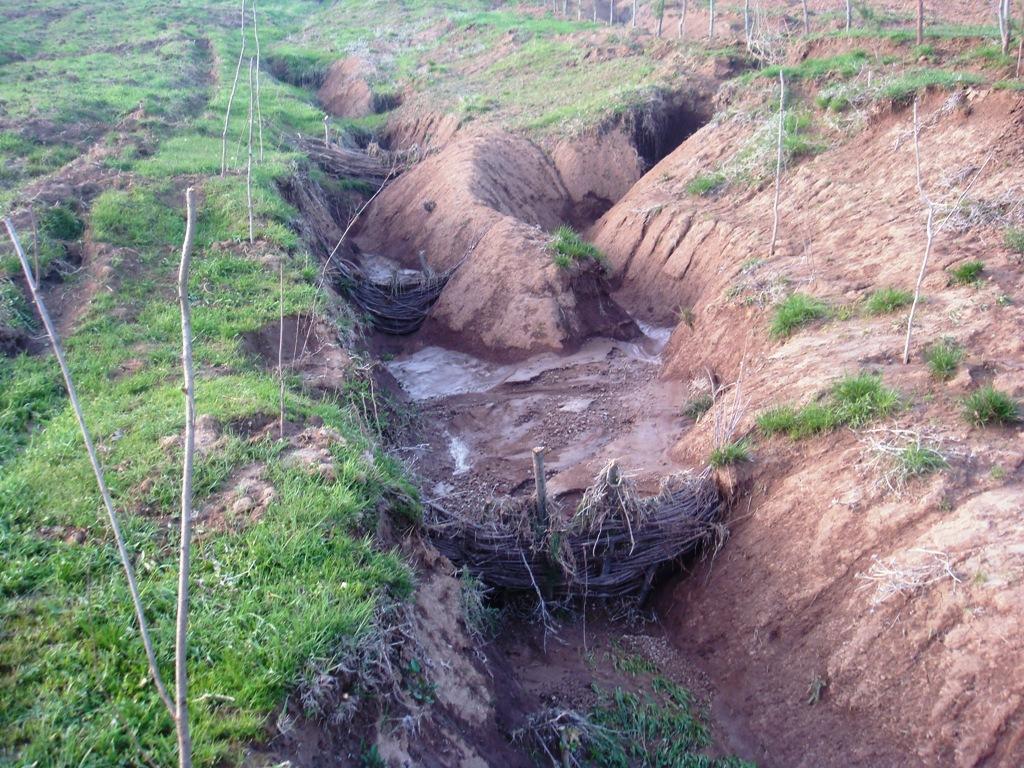
- 📍 Dorobi village, Khovaling / Khatlon / Tajikistan
- 📷 Daler Domullojonov (14, Giprozem st., Dushanbe, Tajikistan)
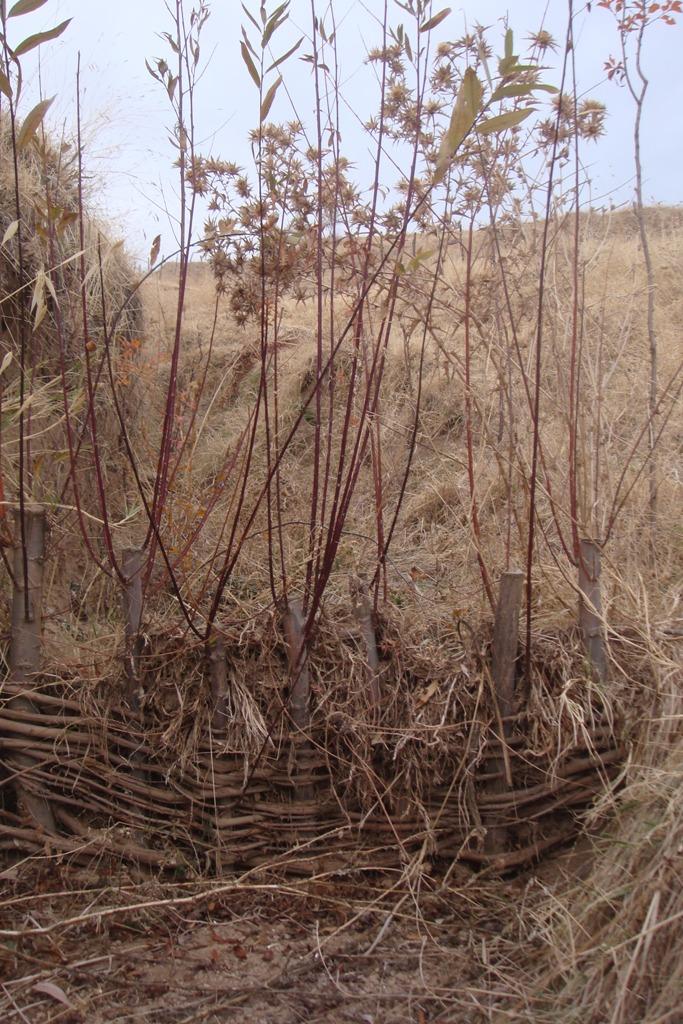
- 📍 Dorobi village, Khovaling / Khatlon / Tajikistan
- 📷 Daler Domullojonov (14, Giprozem st., Dushanbe, Tajikistan)