System of Rice Intensification
Type: Technologies
Creation: 2011-06-06 23:55 Updated: 2019-06-04 11:00
Compilers: Madhav Dhakal
Reviewers: David Streiff, Alexandra Gavilano
Country/ region/ locations where the Technology has been applied and which are covered by this assessment
- Country: Nepal
- Further specification of location (e.g. municipality, town, etc.), if relevant: Kavre palanchowk/Jhikhu Khola watershed
- Map: View Map
Description of the SLM Technology
Short description of the Technology
A method for increasing the productivity of rice by changing the management of plants, soil, water, and nutrients.
Detailed description of the Technology
The System of Rice Intensification (SRI) was developed in Madagascar by Henri de Laulanie, in the 1980s. He worked with Malagasy farmers and colleagues to improve the possibilities of rice production. The practice contributes to both healthier soil and healthier plants, supported by greater root growth and the nurturing of soil microbial abundance and diversity. It is based on a number of well-founded agro-ecological principles. SRI concepts and practices have also been successfully adapted to upland rice.
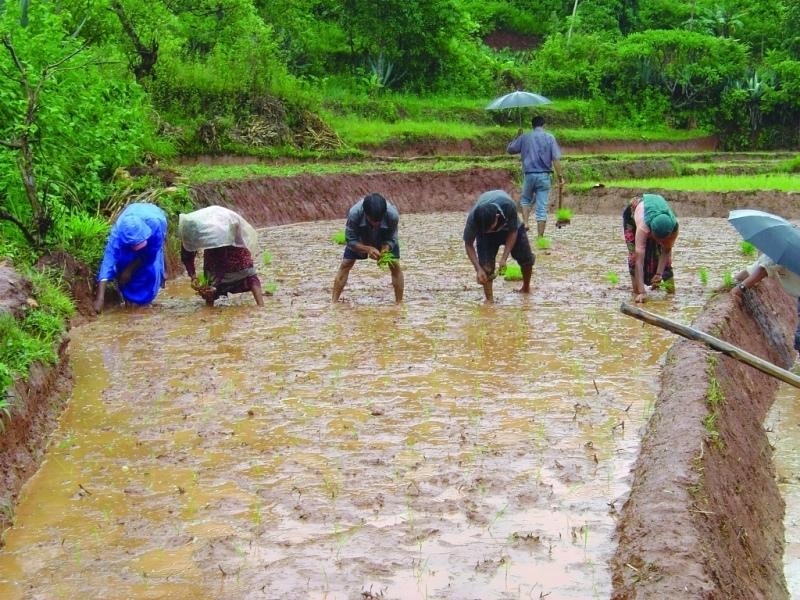
SRI involves transplanting very young rice seedlings (usually 8-12 days old with just two small leaves) carefully and quickly so as to cause minimum disturbance to the roots. The seedlings are planted individually, in contrast to the traditional method where clumps of 3-4 are planted together, minimising root competition between the seedlings. The seedlings are kept widely spaced to allow better root and canopy growth, in a square grid pattern at a spacing of at least 25 x 25 cm. Planting can be done even wider at 30 x 30 or 40 x 40 cm and even up to 50 x 50 cm in the best quality soils.
The soil is kept moist but well drained and aerated to support increased biological activity. A small quantity of water is applied during the vegetative growth period following which a thin layer of water is maintained on the fields only during the flowering and grain-filling stages. Better quality compost, such as well decomposed farmyard manure, can be applied to achieve additional yield increases. Since weed growth will be more abundant and will be a problem in fields that are not kept flooded (and because of the wider spacing), weeding needs to be done at least once or twice in the first 10-12 days and a total of three or four times altogether before the canopy closes.
SRI does not require additional inputs like new seeds, chemical fertiliser or pesticides, but it does require the skilful management of the factors in production and, at least initially, 25-50% more labour inputs, particularly for the transplanting and weeding. As farmers become more skilled and confident in SRI, the amount of labour needed decreases and can eventually become the same or even less than with conventional methods.
SRI is being tried out by farmers in many areas of Nepal’s middle mountains including in the Jhikhu Khola watershed. This area has an altitude of 800-2200 masl, and receives about 1200 mm annual rainfall, about 70-80% in the monsoon months (June to September).
Photos of the Technology
- 📷 Madhav Dhakal (Kathmandu, Nepal)