
Drinking water quality improvement through conservation measures
Type: Technologies
Creation: 2011-06-07 00:31 Updated: 2019-06-04 13:59
Compilers: Madhav Dhakal
Reviewers: David Streiff, Alexandra Gavilano
Country/ region/ locations where the Technology has been applied and which are covered by this assessment
- Country: Nepal
- Region/ State/ Province: Kavrepalanchowk district/ Jhikhu Khola watershed
- Map: View Map
Description of the SLM Technology
Short description of the Technology
Structural and vegetative measures to improve the quality of drinking water contaminated due to poor sanitation and seepage
Detailed description of the Technology
This technology combines structural and vegetative measures to improve the quality of drinking water in an open spring. The quality of water was deteriorating due to poor sanitation and seepage around the spring. The spring was located near to Dhotra village at Barbot sub-settlement, Kabhrepalanchok district. About five households depended on the spring for their drinking water supplies with a further 10 using it regularly and 10-15 using it occasionally during the dry season.
The main purpose of implementing the technology was to improve the quality of drinking water in the spring by preventing it from being contaminated by surface runoff during the rainy season. This technology has long been implemented across Nepal’s midhills. In this case a development project (PARDYP) mobilised the users and provided them with technical and material support to make the improvements.
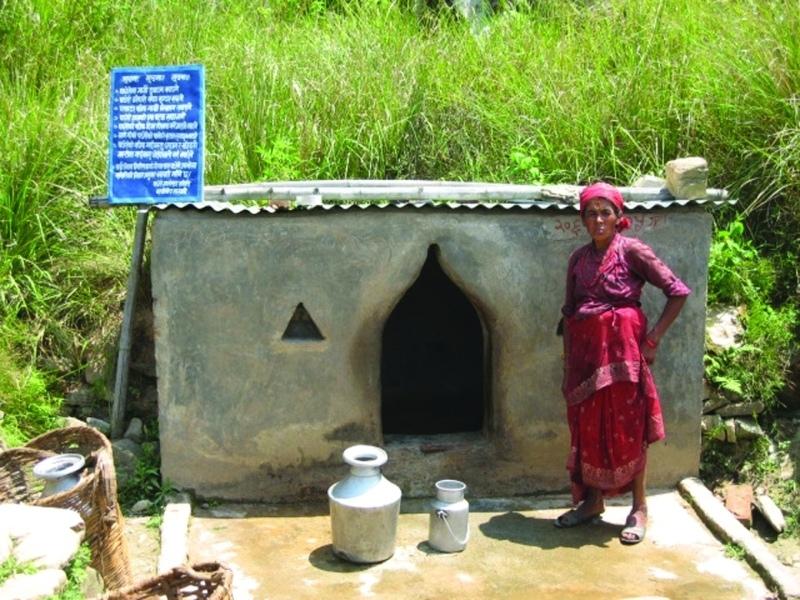
A spring user group was formed. With project help, it built a walled structure (a spring box) over the spring and check dams around the spring, and planted grasses around the spring box and trees in the catchment. These measures prevented the direct flow of surface water into the spring thus reducing contamination and turbidity. Users built a 1.8m long, 1m wide and 1.5m high spring box with a zinc sheeted roof. Check dams were built across the surrounding gullies and rills. A main 2.5m long, 0.5m wide, and 1m high check dam was constructed near the source to prevent surface runoff from entering the spring. A drainage channel was made to drain off wastewater. Vetiver grass seedlings were planted around the spring box and trees were planted in the adjoining catchment. These activities were carried out at the beginning of the rainy season.
This technology is simple and durable and the only maintenance needed is to keep the surroundings clean and to repair any damage.
The case study area receives about 1200 mm of annual precipitation of which about 80% occurs during the monsoon season (June to September). The area mostly has red soils which are highly weathered and, if not managed properly, are very susceptible to erosive processes.
Photos of the Technology
- 📷 Sanjeev Bhuchar