
Rooftop rainwater harvesting system
Type: Technologies
Creation: 2011-06-07 00:40 Updated: 2019-06-03 16:52
Compilers: Madhav Dhakal
Reviewers: David Streiff, Deborah Niggli, Alexandra Gavilano
Country/ region/ locations where the Technology has been applied and which are covered by this assessment
- Country: Nepal
- Region/ State/ Province: Kharelthok, Sathighar, Panchkhal, Hokse and Patalekhet VDCs of the Jhikhu Khola watershed
- Further specification of location (e.g. municipality, town, etc.), if relevant: Kavrepalanchowk district
- Map: View Map
Description of the SLM Technology
Short description of the Technology
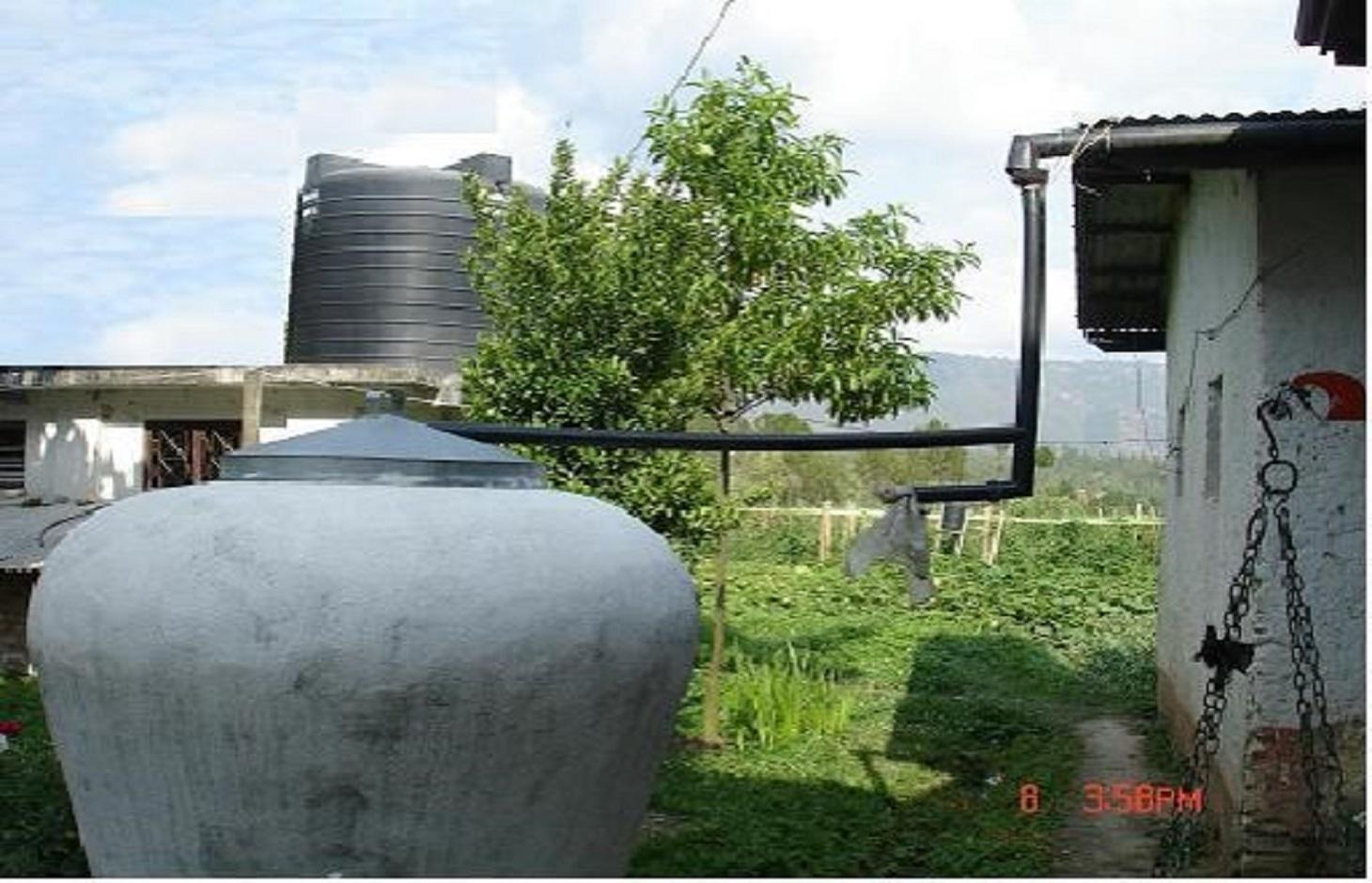
A water harvesting system in which rain falling on a roof is led through connecting pipes into a ferro-cement water collecting jar.
Detailed description of the Technology
Many households in Nepal’s midhills suffer from water shortages during the pronounced dry season. The technology described here - harvesting roofwater during times of heavy rainfall for later use - is a promising way of improving people’s access to water for household use, especially for households with no or only limited access to spring or stream water. The technology has yet to be extensively adopted in Nepal’s midhills.
Purpose of the Technology: The technology was introduced in the Jhikhu Khola watershed to demonstrate an alternative source of water for domestic use (mainly drinking water). This technology is appropriate for scattered rural households in mountaineous areas. The harvesting system consists of a catchment roof, conveyance pipes, and a storage jar. The pipes include a gutter system made from longitudinally split polythene pipe which has a flushing system that allows the system to be periodically flushed clean.
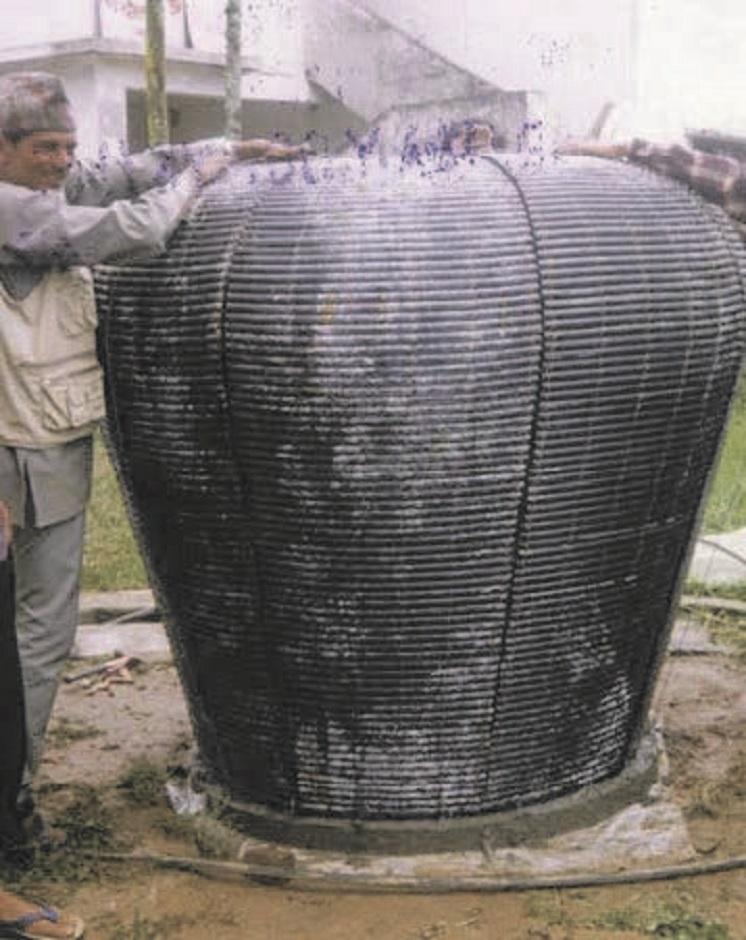
The collected water enters a 500 or 2000 litre capacity ferro-cement jar made using a mould (see photo). A preconstructed mould made from iron rods and polythene pipes is installed on a concrete base plate. Metal wires are extended from the base plate over the main mould to the top. Chicken mesh is then wrapped over the mould and tied securely with thin wire. A cement coating is applied over the metal structure. The jar is finished with three coatings of cement and the opening is covered with a fine nylon mesh to filter out undesired coarse matter. A tin lid is placed over the top.
Establishment / maintenance activities and inputs: A tap is fixed about 20 cm above the ground. This height allows for water to be collected in the typical 15 litre local water vessels (gagri) and avoids collection of too much water in bigger vessels as well as minimising the dead storage of water (Nakarmi et al. 2003). Trained masons can easily install the entire system. Provided all the materials and the mould are available, the entire system can be put together in about a week. The main maintenance task is to keep the roof clean, especially after long dry periods. This is done using the gutter pipe flushing system in which the first dirty water from the roof is diverted away from the jar.
Photos of the Technology
- 📷 K.M. Sthapit
- 📷 PARDYP