
Polypit nursery
Type: Technologies
Creation: 2011-06-07 00:49 Updated: 2019-06-04 13:50
Compilers: Madhav Dhakal
Reviewers: David Streiff, Alexandra Gavilano
Country/ region/ locations where the Technology has been applied and which are covered by this assessment
- Country: Nepal
- Further specification of location (e.g. municipality, town, etc.), if relevant: Kavrepalanchowk district/Jhikhu Khola watershed
- Map: View Map
Description of the SLM Technology
Short description of the Technology
A simple, inexpensive and practical method for raising healthy plant seedlings
Detailed description of the Technology
During the winter in Nepal’s middle mountains, the soil temperature generally remains at 5-10 degree celsius above the ambient air temperature. This principle was used to design a simple, inexpensive, and effective nursery technology for raising vegetable and horticulture seedlings in colder regions. The polypit technology allows seedlings to be raised by protecting them from the freezing temperatures that occur mostly at night.
Polypits are about 1m deep pits dug into the ground and covered with semitransparent polythene sheets, preferably UV stabilised and supported on bamboo frames. A 30 cm high mud wall is built across the slope on the upper side of the pit. The polythene sheet is sealed on the upper side of the pit, leaving three sides unsealed but held down with stones that can be lifted to access the pit. The base and sides of the polypit are left as they are with no form of plastering.
The polythene sheet covering the pit reduces the photosynthetic photon flux (PPF) by around 30% inside the pit, still allowing sufficient sunlight to reach the plants inside. The polythene is usually removed during the day from 11 am to 4 pm to allow full sunlight to reach the plants except on rainy and very cold days. A modified version of these polypits - only 70 cm deep - were used in the Jhikhu Khola watershed to grow vegetable seedlings during the winter. The pits can be made of any reasonable size depending on the number of seedlings to be grown and the layout of the land. The Jhikhu Khola pits were about 3m long, 1.5m wide, and 0.7m deep.
Since the polypits are closed at night, the CO2 released by the plants and soil microbes accumulates and increases to well above levels outside the pit. In a completely sealed polypit, the CO2 concentration could reach up to 3000 ppm during the night which would be harmful for plants. Thus the polythene cover is only loosely sealed along the edges at night to regulate and maintain the concentration of CO2 at about two to four times the ambient concentration.
The warmer protected conditions and CO2 enrichment leads to extra growth and biomass gain for plants grown inside the pits during the winter. This technology is easy to maintain with the only maintenance costs being to repair damaged polythene sheets and frames.
The polypit technology is useful for mountain farmers where water scarcity and low temperatures limit the potential to raise quality seedlings. The technology is being promoted in the northwest Indian state of Uttarakhand, although only a few farmers have adopted it so far. It is a very promising technology and its use should be encouraged by hill farmers and research and development organisations engaged in raising seedlings. The technology needs more participatory action research to improve it and to encourage more farmers to adopt it spontaneously.
Photos of the Technology
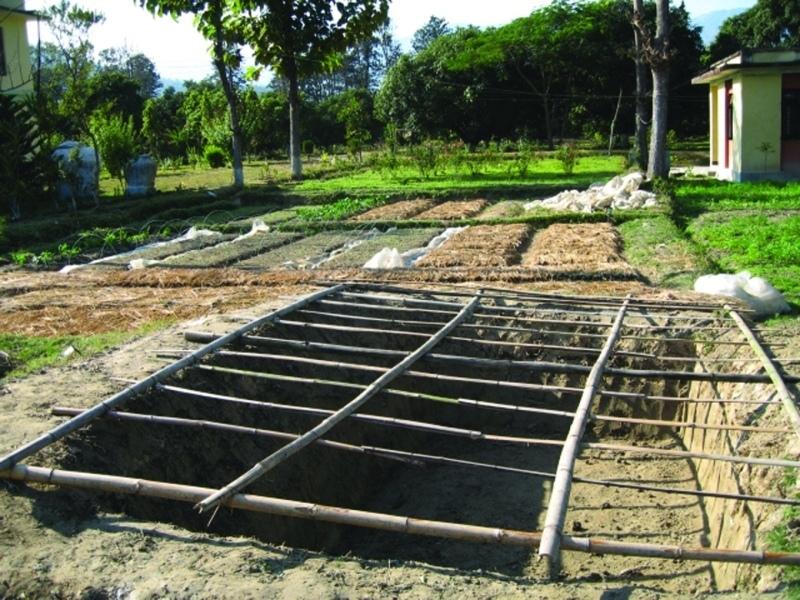
- 📍 Tamaghat, Jhikhu Khola watershed, Kavrepalanchowk
- 📷 Sanjeev Bhuchar