
Low cost micro-sprinkler irrigation
Type: Technologies
Creation: 2011-06-07 11:07 Updated: 2019-09-05 12:36
Compilers: Madhav Dhakal
Reviewers: David Streiff, Alexandra Gavilano
Country/ region/ locations where the Technology has been applied and which are covered by this assessment
- Country: Nepal
- Further specification of location (e.g. municipality, town, etc.), if relevant: Kavrepalanchowk/ Jhikhu Khola watershed
- Map: View Map
Description of the SLM Technology
Short description of the Technology
An irrigation system that delivers small-sized water droplets through a rotating head allowing longer watering time with less runoff
Detailed description of the Technology
Micro-sprinkler irrigation is an efficient and alternative method of irrigation for high value cash crops. It has been demonstrated in the Jhikhu Khola watershed (JKW) in Nepal’s middle mountains by the People and Resource Dynamics in Mountain Watersheds of the Hindu Kush-Himalayas Project (PARDYP). The NGO International Development Enterprises (IDE-Nepal) has assisted private companies to assemble and market micro-irrigation systems.
Micro sprinklers are available in a variety of configurations. They operate at a low-pressure, with water delivered at a pressure equivalent to 10-20m of head, and at a low discharge rate of 0.1-0.2 lps - equivalent to the average discharge of a 1/2 inch size public tap. A pre-assembled micro-irrigation system generally consists of 4 to 8 sprinkler heads at 4m intervals connected by half inch piping. Micro sprinklers are most suitable for closely cropped vegetables like onion and garlic. PARDYP demonstrated, tested, and promoted the system to show land users the potential to use irrigation water very efficiently, which is important because water is in short supply for much of the year after the monsoon finishes in September. In the test area, much of the land is left fallow after the monsoon crops have been harvested as it is difficult to grow winter crops because of the lack of irrigation
water.
The system is easy to install and move around. It needs a reliable source of water, such as a water harvesting tank or a tap, located about 10-20m above the field to be irrigated. A water tank can be installed at the appropriate height to give an adequate water head. The preassembled micro-sprinkler heads are inserted into the ground on a support stand and are connected to the water source via a conveyance pipe. The water passes through a filter before entering the sprinkler heads to prevent the sprinklers becoming clogged up; the system needs regular cleaning.
Photos of the Technology
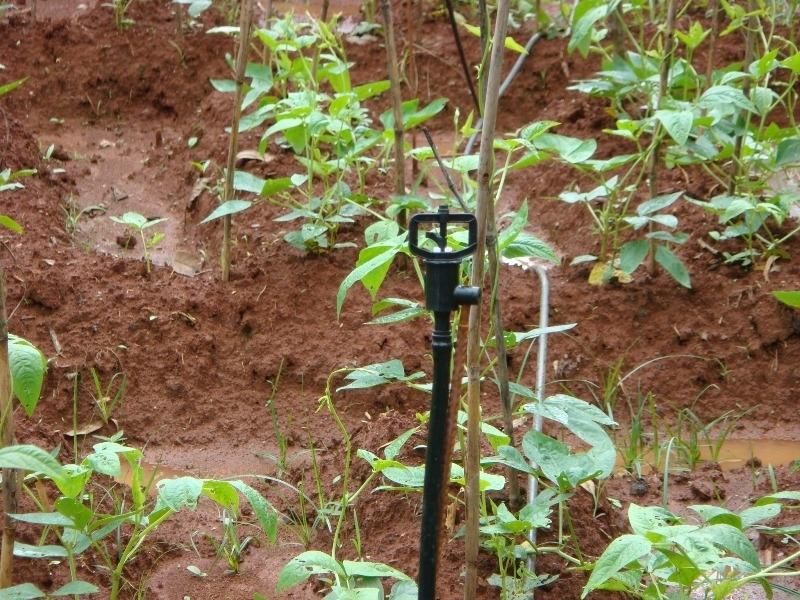
- 📍 JKW, Kavrepalanchowk
- 📷 Madhav Dhakal