
Reafforestation of Tugai floodplain ecosystem
Type: Technologies
Creation: 2011-05-04 06:00 Updated: 2019-08-21 17:56
Compilers: Rustam Nugmanov
Reviewers: Fabian Ottiger, Alexandra Gavilano
Country/ region/ locations where the Technology has been applied and which are covered by this assessment
- Country: Tajikistan
- Region/ State/ Province: Khatlon
- Further specification of location (e.g. municipality, town, etc.), if relevant: MSA Hamadoni
- Map: View Map
Description of the SLM Technology
Short description of the Technology
Reforestation of the Tugai floodplain ecosystem with reed stands, poplars, djigda, and tamarisk thickets to strengthen the river bank area along the Pyanj river.
Detailed description of the Technology
Reforestation works are being carried out in an area of 18.2 km2 in four demarcated zones each measuring 4.55 km2. ACTED and CAREC have entered into labour agreements with household representatives of villages near the riparian area to carry out the plantation of seedlings and bushes. 520 household representatives will plant a variety of 150,000 seedlings and bushes in the floodplain area (prone to flooding).
Reforestation works will help to reinforce the river bank area and protect it against potentially large scale floods. It will also diminish the effect of river bank erosion caused by flood waters. The activity will also protect the natural ecosystem in the target area and provide greater security for both the animal and human habitat. As a secondary purpose the reforestation works will also encourage local communities to be more aware of, and to hopefully motivate them to address some of the serious environmental and socio-economical problems affecting them.
The area was preselected by an expert as an area that was a degraded Tugai floodplain forest ecosystem. The area was assessed to ensure it still maintained a Tugai ecosystem. The extensive area was broken into smaller manageable parts of 3.5 h.a., these areas were then allocated to Jamoats who then further reassigned the responsibility to households. The next step is the development of a planting plan and schedule that includes fruit trees, timber and thickets.
The seedlings are obtained from the National Park area in collaboration with the state forestry department. The households are taught basic planting techniques, and supervised during the planting from November to March. A maintenance plan was established to ensure the upkeep of the ecosystem including watering, composting, and pruning.
The issue was that the Pyanj river was encroaching towards villages and cultivated lands that are essential to the livelihood of the local inhabitants. There is a lack of natural resources and increasing pressure on the available land for subsistence farming.
Photos of the Technology
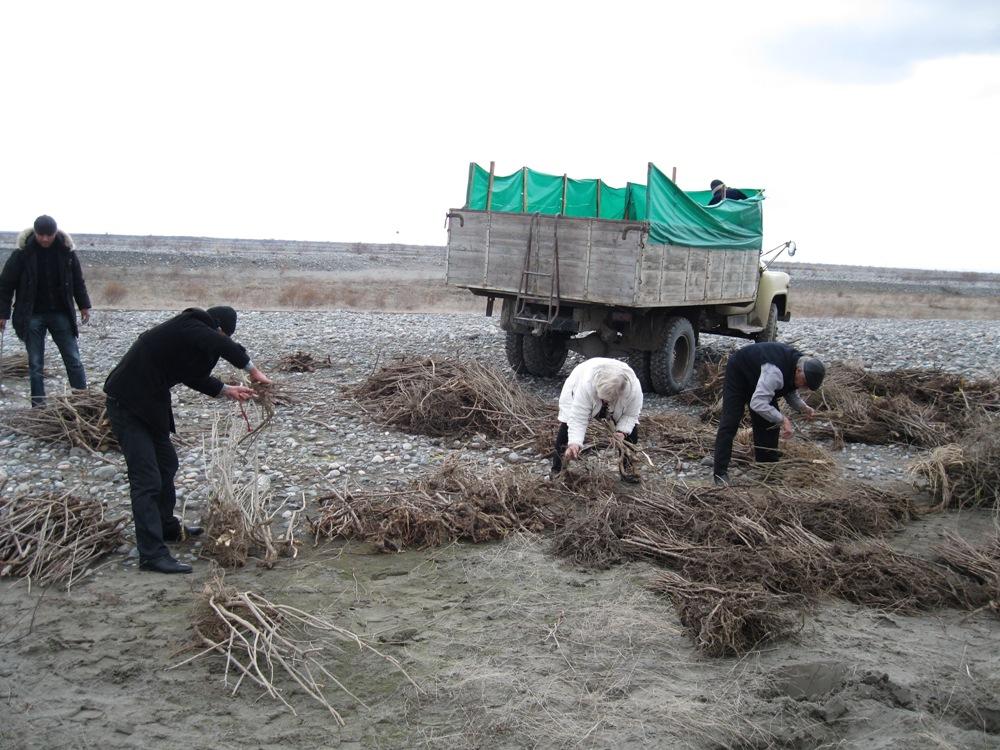
- 📍 MSA Hamadoni, Khatlon
- 📷 Tom Nickalls (ACTED/CAREC)
- 📍 Hamadoni, Khatlon
- 🗓 2011-10-06
- 📷 Rustam Nugmanov (ACTED/CAREC)