
Stabilization and afforestation of sand dunes around settlements in the Karakum Desert (CACILM)
Type: Technologies
Creation: 2012-01-31 09:14 Updated: 2019-08-22 00:09
Compilers: Nikolay Zverev
Reviewers: David Streiff, Alexandra Gavilano
Country/ region/ locations where the Technology has been applied and which are covered by this assessment
- Country: Turkmenistan
- Region/ State/ Province: Turkmenistan, Akhal velayat
- Further specification of location (e.g. municipality, town, etc.), if relevant: Ruhabadsky etrap, Bokurdak village
- Map: View Map
Description of the SLM Technology
Short description of the Technology
The stabilization of shifting sands by installing means of mechanical protection and planting shrubs around settlements in the Central Karakum
Detailed description of the Technology
As a result of overgrazing, the pastures surrounding Bokurdok village have been transformed into bare sand dunes which now threaten infrastructure. Families are forced to spend up to 25% of the family savings for the construction of new houses.
This problem was solved using the technology of sand dune stabilization which includes the installation of mechanical sand dune fixation devices (MSDFs) and planting vegetation adapted to desert environments. MSDFs were made using bundles of reed (of 1-1.2m length), which widely grows along the channel banks. The bundles, 0.02-0.03m in diameter, were bent in the middle (0.5m) and placed vertically into the sand in 25-30cm depth. In this way they are used to establish quadratic parcels with typically 25cm high sidewalls. The optimum grid size is 2x2m and depends on local wind and sand transport conditions. 2x2m MSDFs are used when winds of different directions dominate, otherwise MSDFs are set formed by rows perpendicular to the predominant sand transport direction
The MSDFs assure sand dune stabilization for 2 years. In subsequent years, the stabilization of the sandy surface is achieved by planting seedlings of local desert trees and shrubs and their natural reproduction. 3500-4000 seedlings per ha should be planted if the dunes are to be successfully stabilized without irrigation. If the plants are watered three times in the first season, then the standard for seedling planting is 1200-1300 plants per ha. The planting scheme is as follows: the distance between the plants in the row is 2m, and the spacing between the rows is 4m. Plants are planted 20-40cm deep after the sand has been soaked by rainfall in January-February once temperatures are above 0 ºC
Purpose of the Technology: The purpose of this technology is to improve environmental conditions and the sustainability of farms in the village in general. This can only be achieved if vegetation on degraded pastures near the village is restored and infrastructure is protected against the advance of the desert
Establishment / maintenance activities and inputs: The GTZ project “Participatory management of natural resources in 3 biogeographic regions of Turkmenistan” has provided funds for activities aimed at stabilizing sands in the Bukordak village. 7 families from the village have been involved in the work to stabilize 7 ha of sand dunes. In 2008-2010, within the framework of the CACILM project these activities have been continued. Currently, 50 ha of previously mobile sand dunes, which were threatening the hospital, the main road and houses, have been stabilized
Natural / human environment: The Bokurdak village is located 90 km north of Ashgabad in the Central Karakum Desert. The population is 4,200 people. The village’s water supply for irrigation and livestock is piped from the Karakum Canal. The plants grow on the stabilized sands: Haloxylon persicum, Calligonum sp, Salsola richter, Astragalus sp, Carex physodes perennial grass, and spring annuals. Annual precipitation is around 141mm. Maximum and minimum air temperatures are +47ºC (July) and -28 ºC (January)
Photos of the Technology
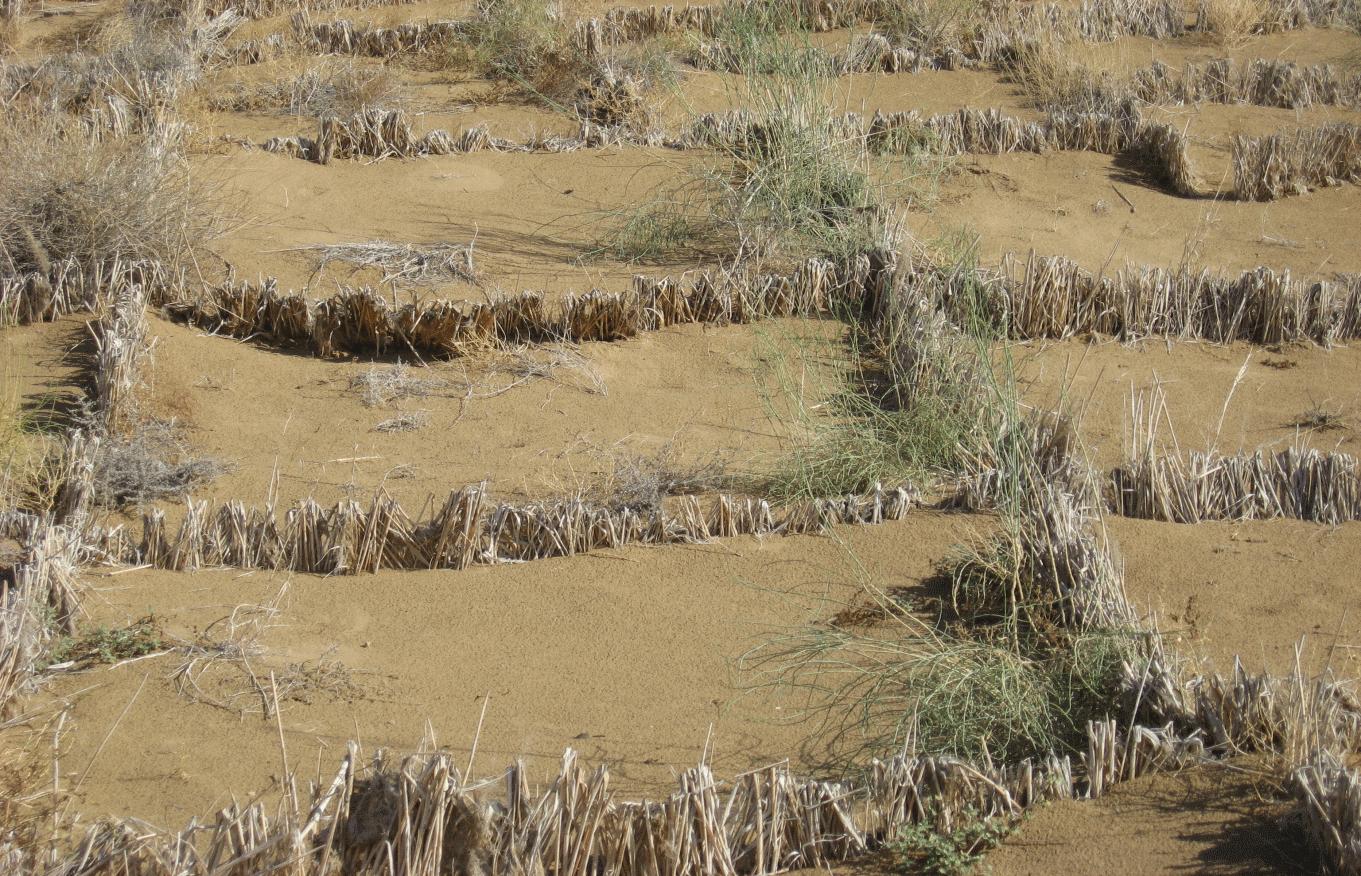
- 📍 Bokurdok village, Turkmenistan, Akhal velayat, Ruhabadsky etrap
- 📷 Nikolay Zverev, (65 Parahat-1 District, ap.26, 774019), e-mail:nikolay.zverev@gmail.com
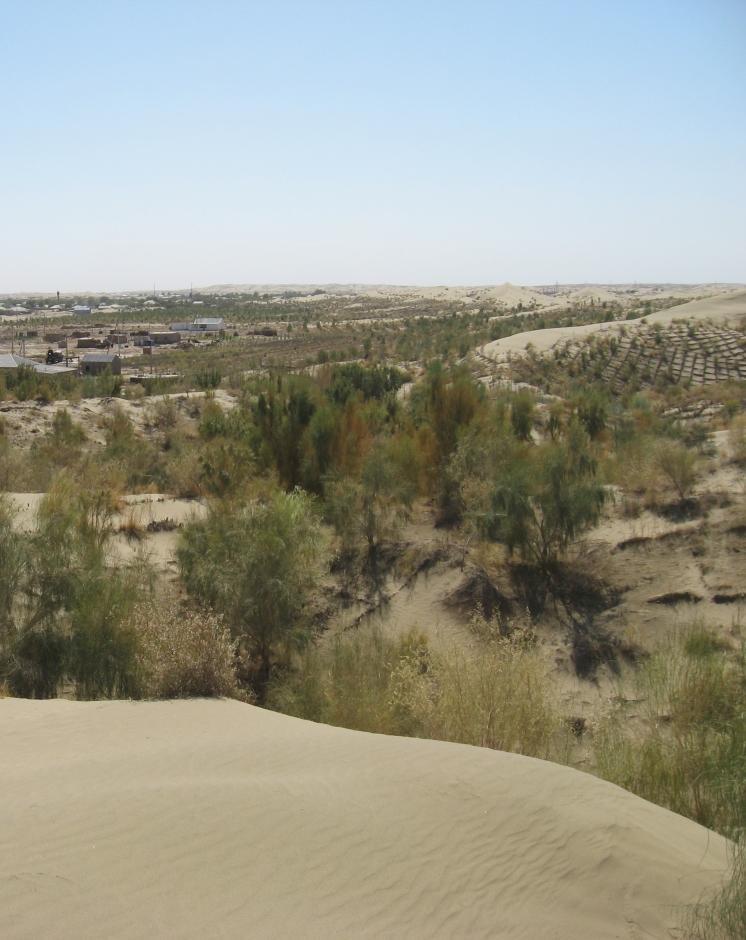
- 📍 Bokurdok village, Turkmenistan, Akhal velayat, Ruhabadsky etrap
- 📷 Nikolay Zverev, (65 Parahat-1 District, ap.26, 774019), e-mail:nikolay.zverev@gmail.com