
Growing Arundo reeds (Arundo donax L.) to create buffer zones around households (CACILM)
Type: Technologies
Creation: 2011-11-10 06:16 Updated: 2019-08-07 13:44
Compilers: Nikolay Zverev
Reviewers: David Streiff, Alexandra Gavilano
Country/ region/ locations where the Technology has been applied and which are covered by this assessment
- Country: Turkmenistan
- Region/ State/ Province: Turkmenistan, Akhal velayat
- Further specification of location (e.g. municipality, town, etc.), if relevant: Ruhabadsky etrap
- Map: View Map
Description of the SLM Technology
Short description of the Technology
Farming techniques for growing arundo reeds in order to protect households from wind and dust and other economic purposes.
Detailed description of the Technology
The Arundo reed (Arundo donax) is a 3-4 m tall perennial grass species. It grows wild in Central and South-West Kopetdag on river banks and as a cultivated plant in the gardens of rural areas of Turkmenistan, where it is grown with limited irrigation for economic purposes. Up to 200 t/ha of stems could be harvested. The growing technique is simple. One-off costs for planting Arundo will bring benefits to a farmer for at least 60 years without any additional costs. In the wild and on farmlands, the roots of arundo grow horizontally and in the fall they develop large growth buds in the form of a cone 0.03 m in height and 0.05 m in diameter. In the spring, these buds form above-ground sprouts. To plant the reeds, the roots together with the growth buds should be dug out from the wet soil and cut off with the pruning shears, so that each rootstock has a growth bud. The reeds are then planted in 3-8 m wide belts around the house (150-400m²). In autumn and winter, the planting area is fenced with an earth mound 25x25cm in height and filled with water. Then the land levelling takes place. The soil is spaded to a depth of 20cm, harrowed and planting furrows 15m in height are formed at with 60cm between each row. The area should then be fenced to keep out animals. The rootstocks and growth buds, prepared in advance, are planted perpendicular to the surface of the planting holes in furrows 0.4 m apart and covered with soil. Watering in the 1st year is carried out once every 8 days, and in subsequent years every 15 days.
Purpose of the Technology: The purpose of this technology is to protect farmers’ households from hot, dry winds and dust and to improve environmental conditions and economic livelihood of villagers living in the extremely hot conditions of the Karakum desert
Establishment / maintenance activities and inputs: Bokurdak village is a pilot village for the GIA project. Stages of implementation: 1) establish a public committee during the villagers’ meeting; 2) conduct a workshop to demonstrate the arundo planting techniques at the pilot plot and train local people and authorities; 3) provide financial assistance to 5 households who have expressed an interest in growing arundo with the aim to involve more people and demonstrate the effect of the technology. Currently, the number of farmers growing Arundo has increased to 40 households
Natural / human environment: Bokurdak village, the administrative center of “Karakum” Daikhans’ Association (DA), is located 90 km north of Ashkhabad in the Central Karakum Desert. The village has a population of 4,200 people and is equipped with a school and hospital. It is supplied with water piped from the Karakum Canal, using for irrigation and the watering of animals. Relief: honeycombed sand ridges with takyrs between them. The water table is located at a depth of 18-25 m. Soil types: sandy deserts, takyr-like soils and typical takyrs and solonchaks. Perennial forage grasses and spring annuals grow on natural pastures. Summer is continental, dry and hot, and winters are cold. Precipitation is 141 mm/year.
Photos of the Technology
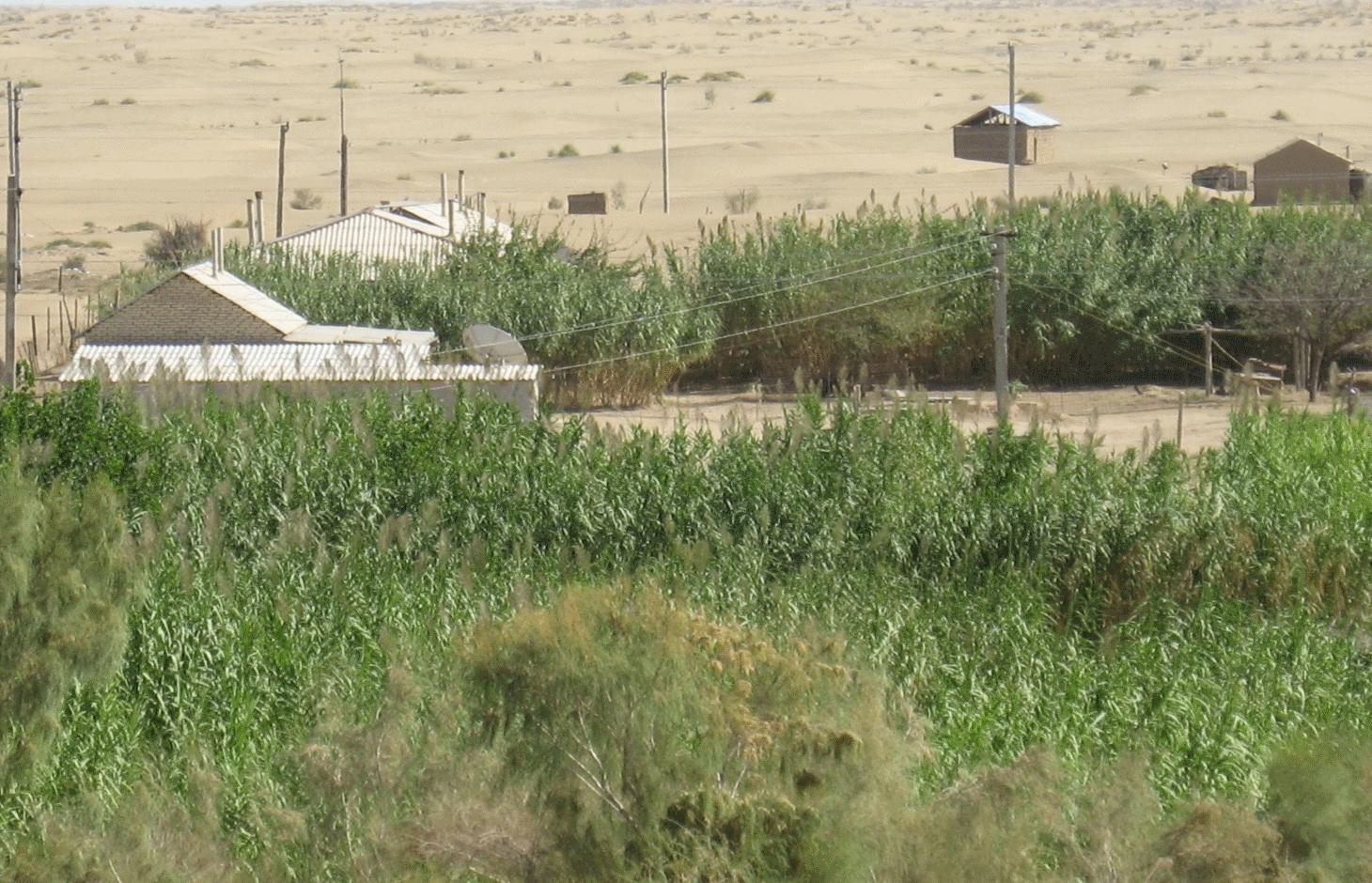
- 📍 Bokurdok village, Turkmenistan, Akhal velayat, Ruhabadsky etrap
- 📷 Nikolay Zverev, (65 Parahat-1 District, ap.26, 774019), e-mail:nikolay.zverev@gmail.com
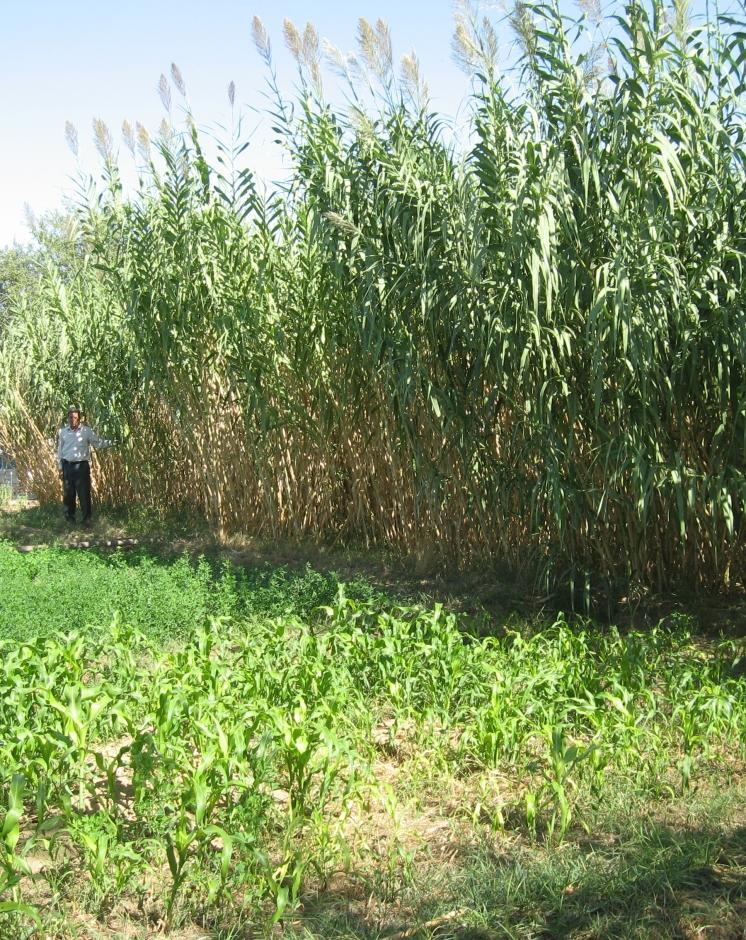
- 📍 Bokurdok village, Turkmenistan, Akhal velayat, Ruhabadsky etrap
- 📷 Nikolay Zverev, (65 Parahat-1 District, ap.26, 774019), e-mail:nikolay.zverev@gmail.com