
Irrigation and grassing of the high semi-desert grassland
Type: Technologies
Creation: 2012-06-11 08:39 Updated: 2019-08-14 16:50
Compilers: Gulniso Nekushoeva
Reviewers: David Streiff, Alexandra Gavilano
Country/ region/ locations where the Technology has been applied and which are covered by this assessment
- Country: Tajikistan
- Region/ State/ Province: Tajikistan
- Further specification of location (e.g. municipality, town, etc.), if relevant: GBAO, Shugnan
- Map: View Map
Description of the SLM Technology
Short description of the Technology
Irrigation of semi-arid highland pastures contributes to rapid growth of natural grass, whereas removing stones in the pastures improves the surface of the area and increases the available pasture area.
Detailed description of the Technology
Pastures in Vankal are mainly located on the stony mountain slopes, which are insuitable for farming. Poor and partually shrubby vegetation and overgrazing cause low productivity of the pastures. Residents of the Varshez village found a way to improve the pasture condition and to increase fodder production. They began to irrigate the entire land area within the village borders, i.e. lands between kitchen gardens, around the crop lands where grain, potatoes and fodder have been planted, and up until the big irrigation canal (located above the village). Irrigation canal has already existed, so extra work was not required. As a result, soon after, in addition to the usual pasture above the irrigated area, villagers could use the high productive spring and autumn pastures within their village. Irrigation and removing stones significantly improved the productivity of that land area and increase of vegetation types improved the quality of the fodder. Thus, gradually low-productive and stony pastures became high-productive pastures with high-quality natural grass.
Purpose of the Technology: Increasing the productivity of stony and slopy pastures near the village. Ensuring fodder for livestock in spring and autumn.
Establishment / maintenance activities and inputs: Financial and labour inputs were not required for the implementation of this technology (to establish an irrigation system). Available pasture area was divided by the number of the households, then stones in the area were removed and a small irrigation system was created below the irrigation canal to bring the water to particular areas.
Natural / human environment: Varshez village is located in the GBAO rayon, Vankala djamoat on the left bank of Gunt river. The highest spot reaches up to 3200-3300m asl. Summer period is short. Last years, night frosts have often been happening. Annual rainfall - 120-150 mm. Local people heavily depend on their own production. Their main occupation includes yak breeging. In autumn, yaks (or their meat) is exchanged for food, coal, kerosene and clothes. Non-grazing period last 6-7 months, therefore, saficient amount of fodder must be prepared. Since markets are located far away, there is also an urgent need for winter fodder for cattle. Pastures between the village and above the canal are heavily degraded: the area is stony with only xerophic half-shrubby vegetation growing on it (very few edibe vegetation). After implemeting this technolology, such land areas become productive spring-autumn pastures. In summer, when cattle is grazed in far away pastures, new grasses grow in spring-autumn pastures. Sometimes there can be even enough grass for hay preparation.
Photos of the Technology
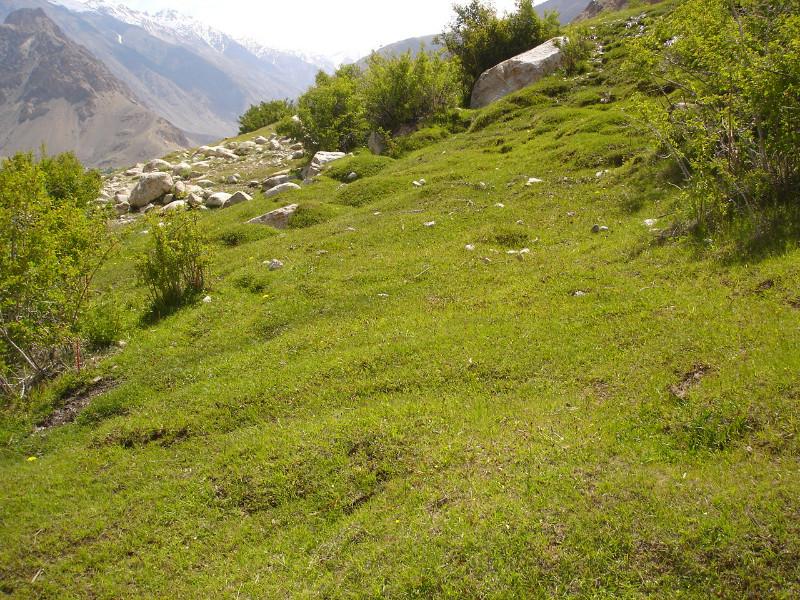
- 📍 Vankala djamoat, Varshez village, GBAO
- 🗓 2010-02-07
- 📷 Nekushoeva Gulniso (Dushanbe)