
Gully rehabilitation
Type: Technologies
Creation: 2011-04-28 07:47 Updated: 2019-08-02 17:33
Compilers: Qobiljon Shokirov
Reviewers: David Streiff, Alexandra Gavilano
Country/ region/ locations where the Technology has been applied and which are covered by this assessment
- Country: Tajikistan
- Region/ State/ Province: RRS
- Further specification of location (e.g. municipality, town, etc.), if relevant: Javanon, Karsang
- Map: View Map
Description of the SLM Technology
Short description of the Technology
Gullies are stabilized through the establishment of a gabion and the plantation of spanish drok (Spartium junceum L).
Detailed description of the Technology
The research station of the Soil Science Institute tested the stabilisation of large gullies created by water erosion through the plantation of Spanish drok (Spartium junceum L). The plantation of Spanish drok was introduced in 1972 for the first time in the research field station. Spanish drok is a perennial plant and has the ability of spreading fast through its roots and also via seeds. Most of the gullies are covered with Spanish drok by now. In total 150,000 seedlings were planted at the research station.
Purpose of the Technology: Water erosion is highly threatening croplands by washing away the fertile topsoil. Severe gullies have formed on the hilly slopes. The research station of the soil institute therefore selected a number of gullies to test different techniques of rehabilitation.
Establishment / maintenance activities and inputs: In a first step a survey of gullies in the vicinity of the research station was conducted in order to determine an appropriate place for testing the stabilization. Spanish drok was planted and spread very fast through vegetative underground reproduction until the whole gully was covered. A gabion made out of stone and concrete was constructed at the foot of the gully. It contains a pipe to allow for outflow of excess water. Maintenance of the technology is less cost efficient and doesn't involve much cost associated activities.
Natural / human environment: The positive results of the implementation of this technology are very important as there is a great need for spreading it to other areas suffering from the same problems in Tajikistan. Spanish drok is generally not available in Tajikistan. Nowadays, the research station is providing seedlings for sale to interested farmers with a cost of roughly $ 0.40 per seedling.
Photos of the Technology
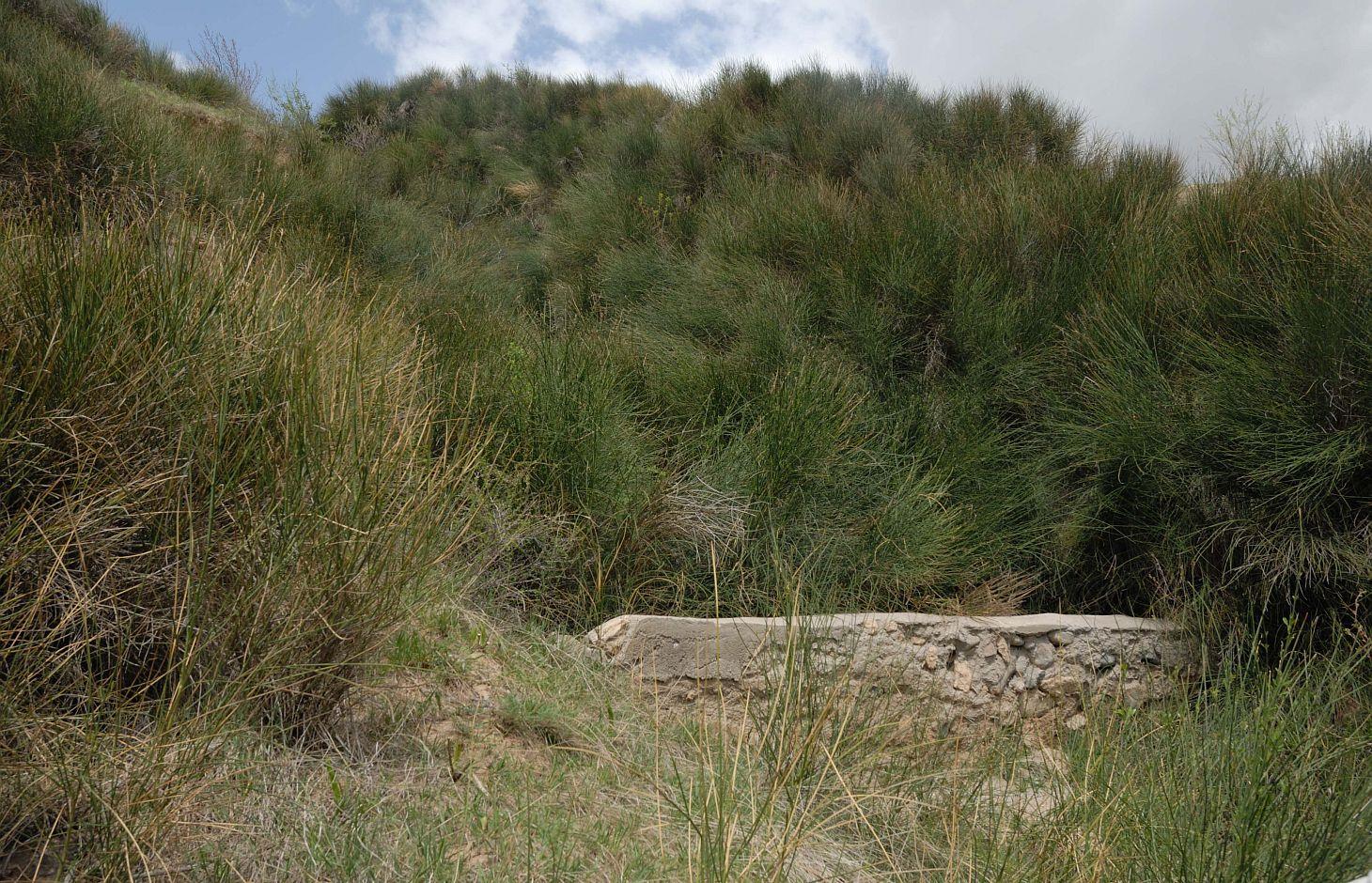
- 📍 Javonon, Karsang, RRS
- 📷 Julie Zähringer (PPCR Component A5, 131 Rudaki Avenue, Dushanbe, Tajikistan)
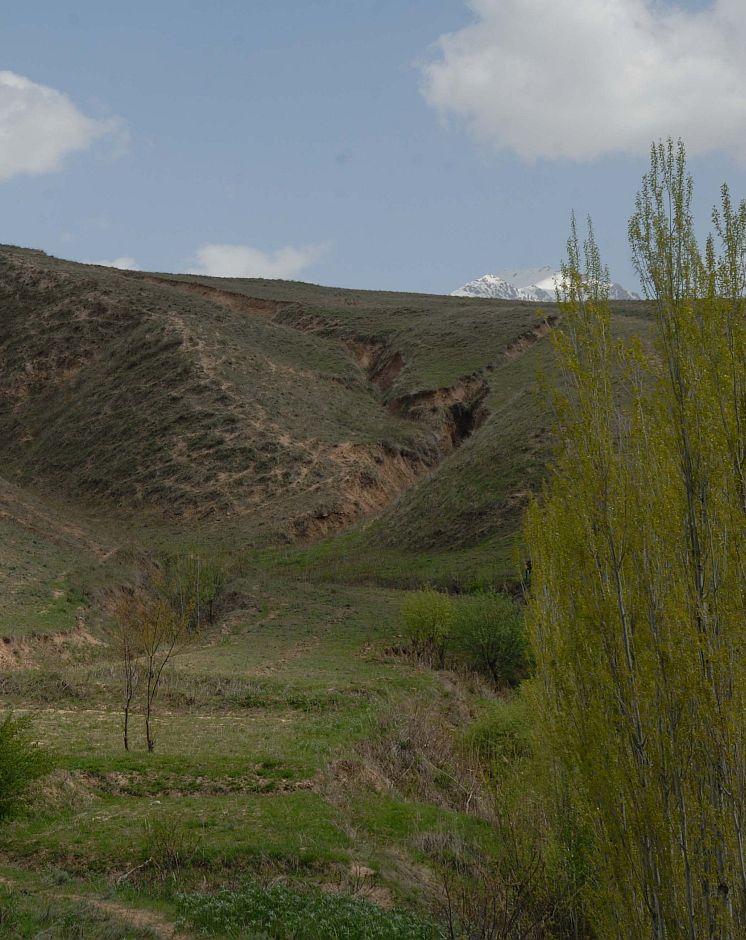
- 📍 Javonon, Karsang, RRS
- 📷 Julie Zähringer (PPCR Component A5, 131 Rudaki Avenue, Dushanbe, Tajikistan)