
Improved cattleshed for urine collection
Type: Technologies
Creation: 2011-06-06 21:22 Updated: 2019-06-05 14:13
Compilers: Richard Allen
Reviewers: David Streiff, Alexandra Gavilano
Country/ region/ locations where the Technology has been applied and which are covered by this assessment
- Country: Nepal
- Further specification of location (e.g. municipality, town, etc.), if relevant: Midhill districts of Nepal
- Map: View Map
Description of the SLM Technology
Short description of the Technology
Collection of cattle urine in improved cattle sheds for use as liquid manure and organic pesticide
Detailed description of the Technology
Nitrogen is the most important macronutrient for plants, and high crop productivity can only be achieved by making sufficient nitrogen available to crops. Nitrogen is also the most limiting nutrient in farms across Nepal’s midhills. Traditionally farmers applied farmyard manure to fertilise their needs. In many places this is being supplemented or even entirely replaced by inorganic fertiliser - mainly urea. The price of inorganic fertiliser has increased continuously in recent years and it is only available in limited quantities in areas far from the roadheads. On the other hand, cultivation practices are intensifying with increased cropping intensities and more nutrient-demanding crops as, for example, local varieties are replaced by hybrids and new crops are grown. This can easily lead to declining soil fertility and nutrient mining if it is not compensated for by an equivalent increase in organic or mineral fertilisation.
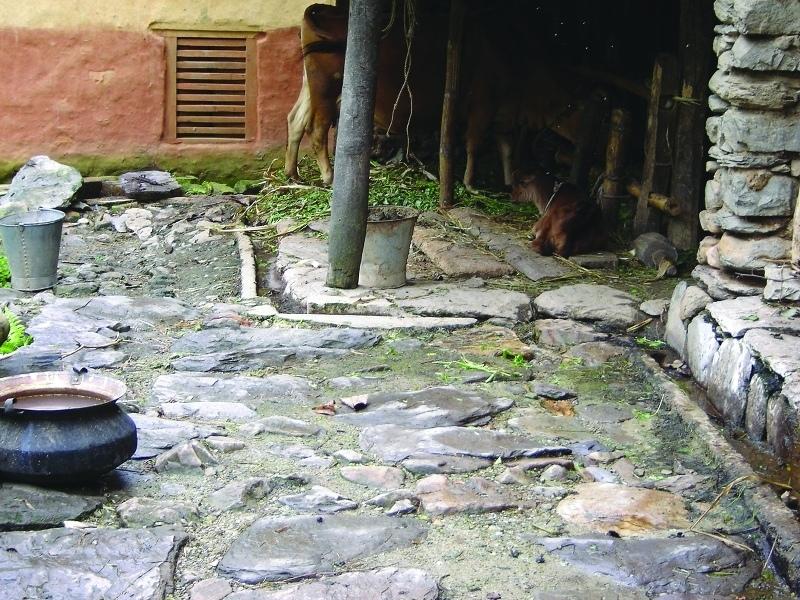
Cattle urine is a viable alternative to mineral fertiliser. Of the nitrogen excreted by cattle, 60% is found in the urine and only 40% in dung. In traditional sheds, urine is left to be absorbed in the bedding material, while excess urine is channelled out of the shed and disposed of. The technology described here - improved cattle sheds- are designed for collecting the urine in a pit or drum. This pit is generally located in the shed itself or just outside connected to the drainage channel through a pipe and protected from rain and runoff. Where urine is collected for incorporation in farmyard manure, the pit may be directly connected to the manure pit or heap. Urine that is going to be used as liquid manure or organic pesticide has to be stored in a drum for fermentation.
A household with two cattle can save the equivalent of purchasing about 100 kg of urea over one year by applying urine either directly as liquid fertiliser or as a component in improved farmyard manure.
Photos of the Technology
- 📷 Kiran Ghising