
Better quality farmyard manure through improved decomposition
Type: Technologies
Creation: 2011-06-07 19:04 Updated: 2019-06-03 15:45
Compilers: Richard Allen
Reviewers: David Streiff, Alexandra Gavilano
Country/ region/ locations where the Technology has been applied and which are covered by this assessment
- Country: Nepal
- Further specification of location (e.g. municipality, town, etc.), if relevant: Midhills districts of Nepal
- Map: View Map
Description of the SLM Technology
Short description of the Technology
Collection and proper storage of farmyard manure in heaps or pits
Detailed description of the Technology
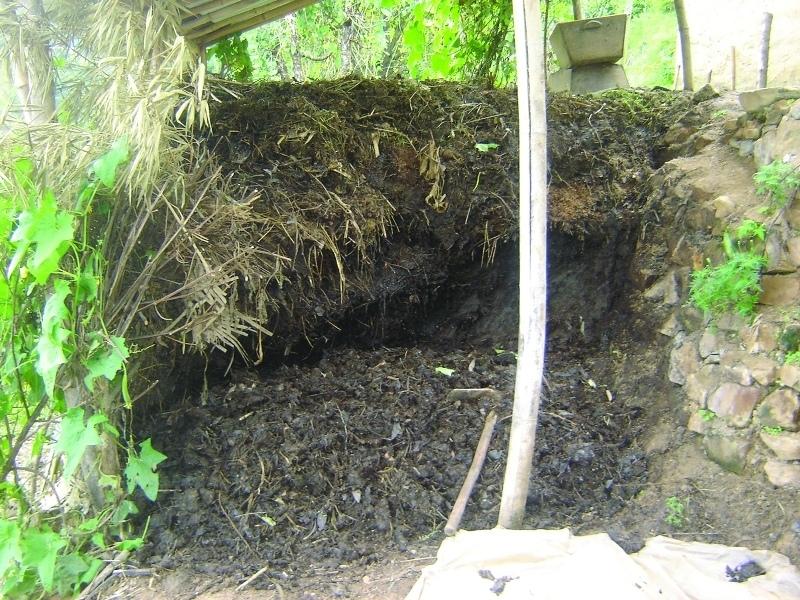
Farmyard manure - a varying mixture of animal manure, urine, bedding material, fodder residues, and other components - is the most common form of organic manure applied in the midhills of Nepal. Farmyard manure has a high proportion of organic material which nurtures soil organisms and is essential in maintaining an active soil life. Only about half of the nutrient content of farmyard manure becomes available for crop growth during the first year after it has been applied to the soil - the rest is channeled through soil biotic processes and the nutrients are released in the following years. The high organic matter content and the active soil life improve or maintain friable soil structures, increase the cation exchange capacity, water holding capacity, and infiltration rate, and reducing the risk of soil pests building up.
Indigenous methods of preparing and using farmyard manure vary widely depending on the ecological zone, access to bedding material from crop or forest land, access to crop residues and fodder, labour availability, and other factors. A prerequisite for the manure having a positive impact on soil fertility is that it is properly decomposed. The application of partially decomposed manure can increase the number of white grubs, red ants and other soil pests.
Decomposition is enhanced and the time it takes to happen is reduced if the manure is kept warm and moist (but not wet) at all times. Heaping the manure up or storing it in a pit helps. Whether it is best to heap up the manure or put it in a pit depends on the local climate. Heaping has the advantage of being less costly, while the pit method reduces runoff and the loss of nutrient rich fluids. Adding nitrogen in the form of urine (N) improves the carbon to nitrogen ratio.
Photos of the Technology
- 📷 Juerg Merz