
Marshy land transformed into productive land
Type: Technologies
Creation: 2016-12-28 07:31 Updated: 2020-02-06 17:25
Compilers: Rahatul Islam
Reviewers: Alexandra Gavilano, Ursula Gaemperli, Donia Mühlematter
Country/ region/ locations where the Technology has been applied and which are covered by this assessment
- Country: Bangladesh
- Region/ State/ Province: Atghar Kuriana Union, Swarupkati, Pirojpur
- Further specification of location (e.g. municipality, town, etc.), if relevant: Barisal
- Map: View Map
Description of the SLM Technology
Short description of the Technology
Marshy land is transformed into a ridge and ditch area, where the ridges are wide enough for the nursery of diverse plants and seedlings and where after 6-8 years the yearly management practices the land got strong enough for various agricultural practices (i.e. guava, hog plum, plums and timber wood plantation).
Detailed description of the Technology
The technology of marshy land convert into ridge and ditch was taken by a community of southern of Bangladesh in order to make that area productive. Long year ago a continuous marshy land covered most of the area of southern Bangladesh like Pirjpur, Jhalokath. This area was flooded more than 9 month and remain perennial wet, that were totally unproductive. So, that technology not only increases agricultural production or economical benefits but also creates a green belt by developing agro-forest. The technology consists of ridge and ditch area. Ridges are elevated beds - land which is 4-6 feet high from surface and 7-9 feet wide. Length of each bed is variable according to size of the land. And ditches are canals - areas that are 5-6 feet wide and deeper than the normal surface area.
At initial stage elevated areas are not strong enough to start cultivating trees like guava, hug plum or other fruit plants. So they use it for nursery of diversified plants, fruit trees such as Banana and Papaya, vegetables, preparation of seedling sapling or as seedbed (rice). Management practices are running every year to develop the ridges and make them strong. Land users are putting soil/muck from the ditches on the ridges to make them higher and to give better protection from flooding water, to increase the fertility, to conserve moisture and reserve organic matter. Though eroded soil and other plant residues are accumulated in the ditches so ultimately they return over the ridge surface. Land become suitable after 4-5 year for planting various trees like guava hog plum, plums, lemons, Areca nuts and various timber producing tress like Teak (Tectona grandis), Mahogany (Swietenia mahagoni). Approximately 7 – 8 year after fruit trees are become appropriate and the physical and biological conditions of the sites have improved. Then land user start to cultivate various vegetables and other agricultural practices. Furthermore, sometime users set up a platform for creeper crops on the canal which works as support for Pumpkins and gourds. Trees and vegetables are irrigated from ditch/canal where water is reserve over the year, even in dry season if necessary. As a result of growing biomass, land degradation from the site has reduced and the fertility of the soil has increased. When fruit trees have reached its harvesting stage, the land users collect fruits for sale with expected income of about 1000USD. Vegetable also provide more than 500USD benefit from each site every year. Approximately 25 years after Mahogany, Teak, and other timber producing trees are getting mature and reach their harvesting stage. Land user cut the trees for selling with expected income of about 10000 USD from each site and size of approximately one hectare.
The technology is working well and is easily manageable by the land users. Nowadays not only farmers but also a large portion of population are interacting with that technology and their lifestyle have changed. Many people are also working to manufacture initial nursery products like seedling bag, earthen pot, creeping materials like bamboo, string, yarn, net, seedling and other material for preparing plant nursery, fruit garden, mixed agro-forest etc. Other people work to transport product from the area to the consumers and some people work to manufacture vehicles like boats, local vans etc. Also locale communities developed the largest floating market of Bangladesh.
The farmers are applying the technology without any extra financial support. According to the land users, they estimate about 200 – 300 family which have applied the technology. Approximately 350 person-day/ha were employed for construction and 50 person – day/ha sufficient for yearly maintenance work. 1600 USD was spending on the construction and most of the cost covered by owner. Farmers have faced some drawback such as undeveloped communication infrastructure and insufficiently developed market places. On the other hand, if they get support from government and related authority, this technology even become more beneficial for them.
Photos of the Technology
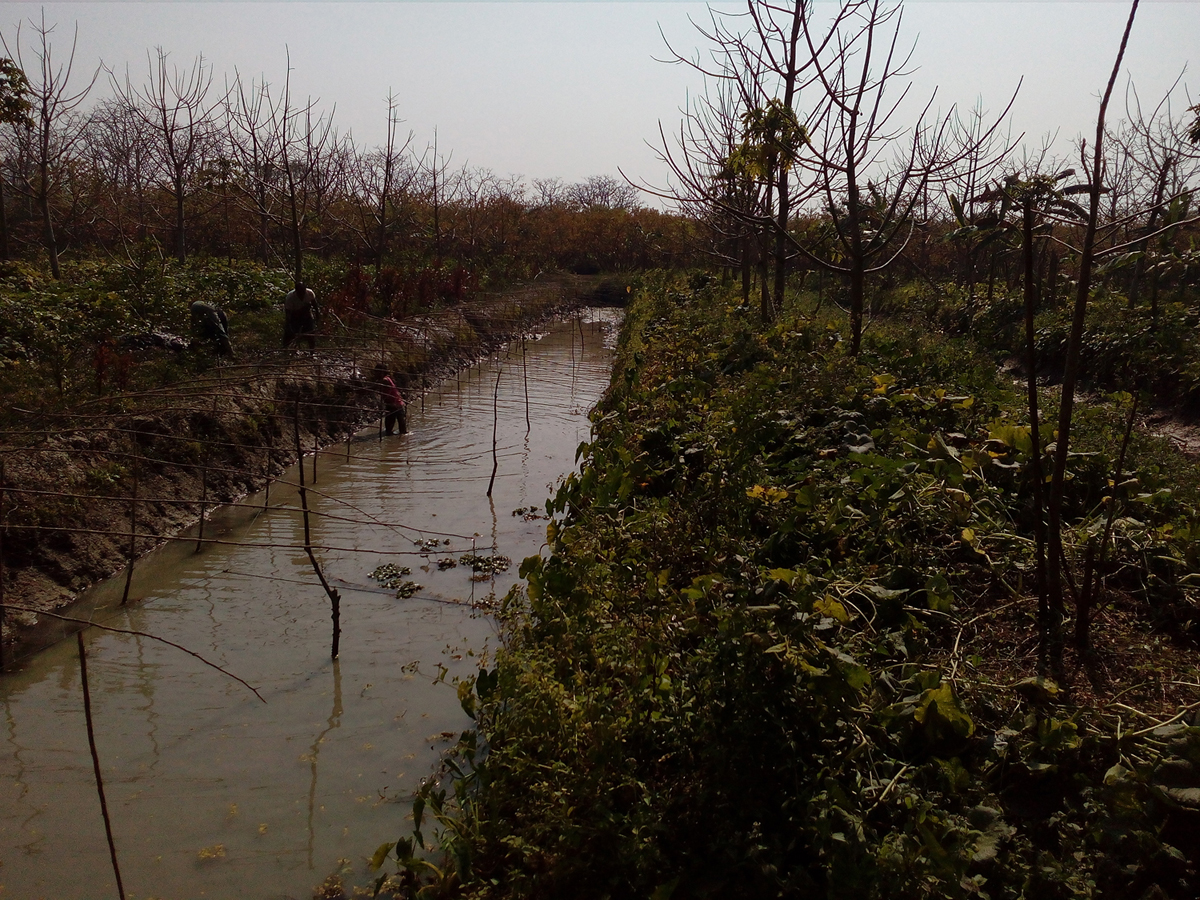
- 📍 Nesarabad (Swarupkati)
- 📷 Jalal Uddin Md. Shoaib