
Intercropping of eggplants between mango trees using rice straw mulching to reduce evaporation
Type: Technologies
Creation: 2017-05-17 04:16 Updated: 2019-09-02 08:36
Compilers: Navin Chea
Reviewers: TOM SAY, SO Than, Nicole Harari, Alexandra Gavilano
Country/ region/ locations where the Technology has been applied and which are covered by this assessment
- Country: Cambodia
- Region/ State/ Province: Kamboa village, Kou Loab commune, Chetr Borei district, Kratie
- Further specification of location (e.g. municipality, town, etc.), if relevant: Field
- Map: View Map
Description of the SLM Technology
Short description of the Technology
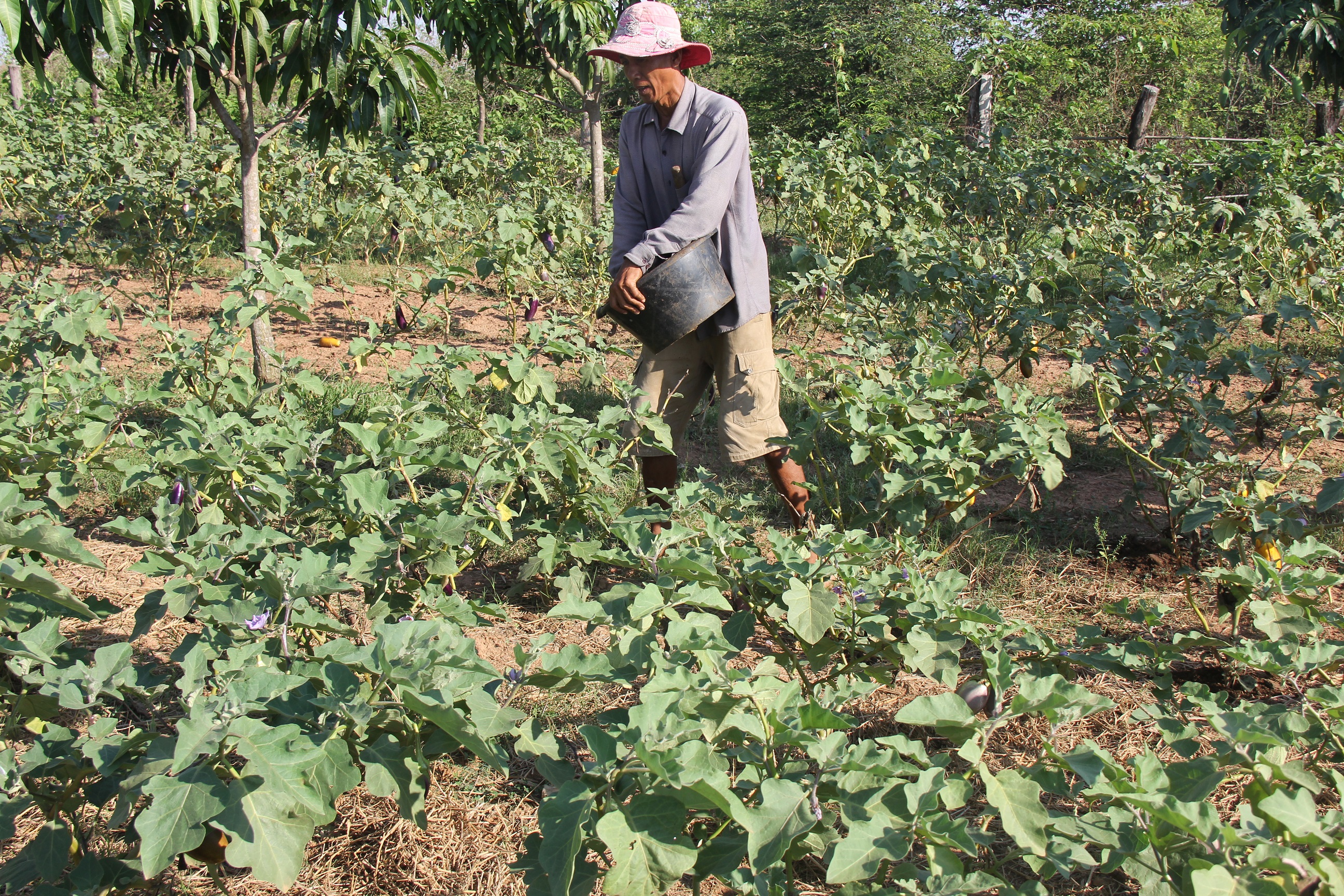
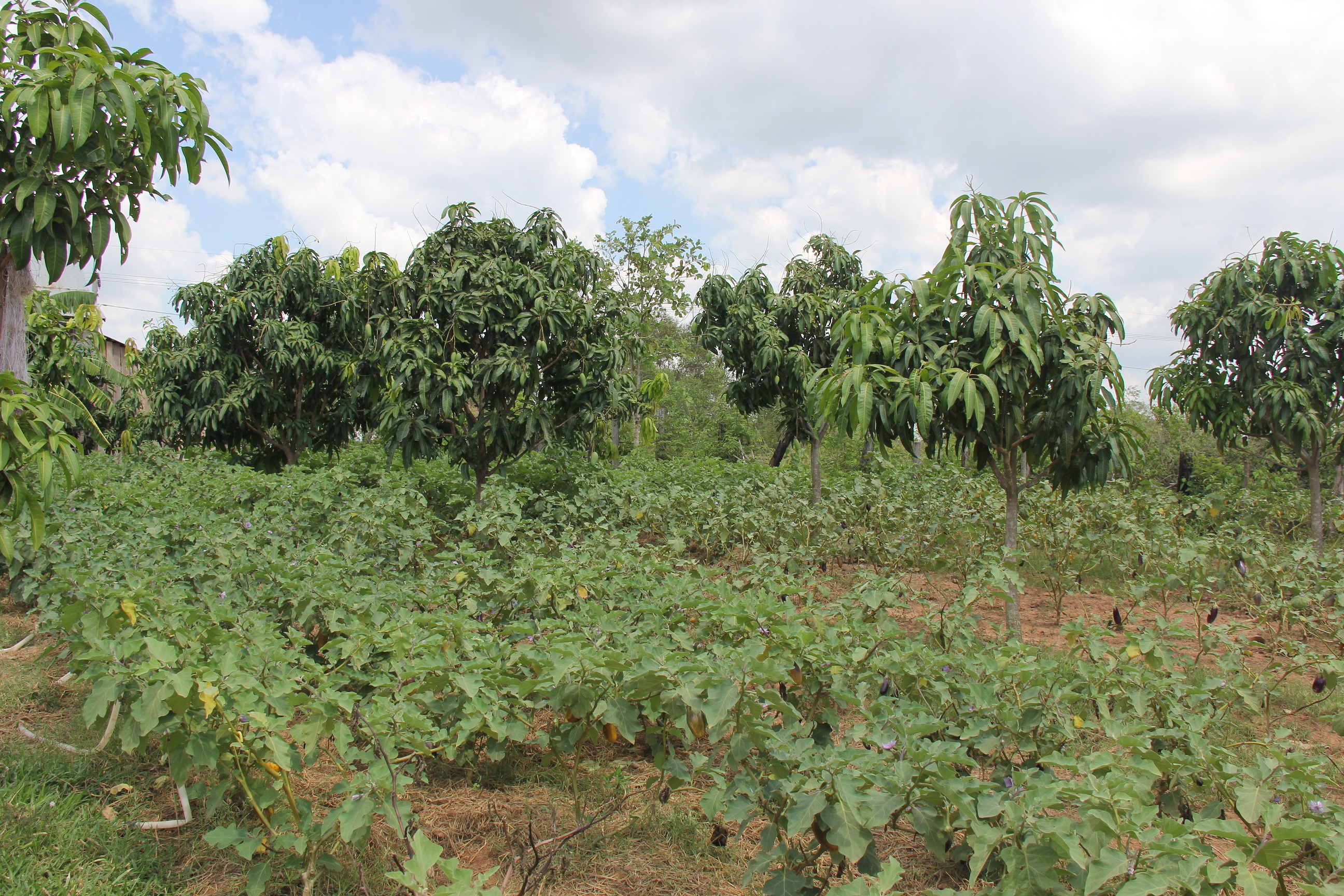
Intercropping of eggplants between mango trees and the application of straw mulching on the plants’ roots and the land so as to retain soil moisture by reducing heat-induced evaporation. When the rice straw rots, it provides organic matter and makes soil less compact. The farmer can benefit from the short-term crop for a period of three years before the mango trees fully produce fruits.
Detailed description of the Technology
Intercropping of a short term crop between the fruit trees which are the long term crop (mango trees which will provide fruit in their third year depending on the species variety and maintenance) is a best agroforestry practice which provides both economic and environmental benefits. When the mango trees are still young and have not yet produced fruit, there is also free space between the trees. In order to gain additional benefits and to avoid weeds growing that could be harmful to the mango trees, the growing of eggplants with rice straw mulching could provide co-benefits in the form of maintaining, weed control, watering, and the application of fertilizer for the mango trees. The eggplants could produce fruit within three months after having been planted and they can be harvested for several months in a year. In this way farmers can generate income for their daily expenditure before the mango trees produce fruit. By using this technology, farmers are able to improve their livelihoods compared with before.
In this SLM technology, the mango trees, eggplants and mulched rice straw interact beneficially. In the dry season, the trees provide some shade for the eggplants and the rice straw on the eggplants' roots and land helps retain soil moisture reducing evaporation, and this prevents the crops from withering during hot days. In addition, when the farmer waters the eggplant,it also provides water to the trees. In rainy season, the rice straw and the eggplants act as an important vegetation cover for the prevention of soil erosion through surface run-off during heavy rainfall. Besides the rice straw and its decayed materials are a crucial food source for micro-organisms in the soil that improve the cycling of nutrients and the soil less compact, enabling a better growth of the crops.
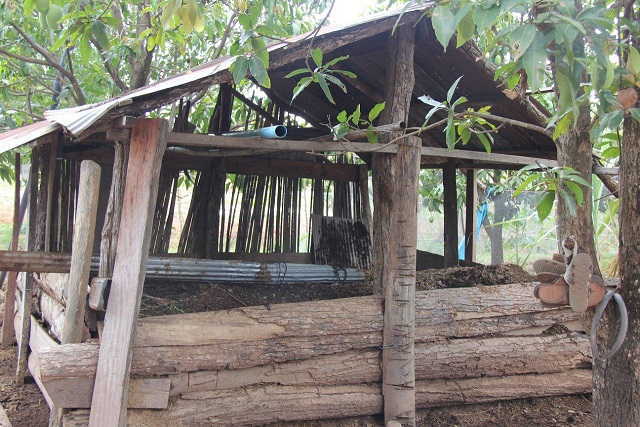
In this technology, the mango trees are planted in row with an interval of six metres and the eggplants are transplanted among the rows of trees ensuring that there is a distance of one metre between each plant within a row, and a distance of 1.5 metres between one row and another. The pit for each mango tree is 70x70x70cm and a mixture of burned rice husk, cow manure and woody herb is added as fertilizer in the bottom of the pit. When planting, the compost or slurry from the of the bio-digester is also mixed in with the soil. Eggplant seedlings are transplanted in 10-cm holes using 20-30 day-old seedlings. Then the farmer applied rice straw mulching on the roots of eggplant and mango trees' roots and applied on the free space of the land. The transplanted eggplants are watered on a daily basis, while the watering of the mango trees is carried out twice per week.
Weeding is done regularly so that the weeds do not absorb too many nutrients from the soil even there is no much weed. The farmer applies compost twice a year, usually once at the beginning of the rainy season in May, and also in October.
When the eggplants start to produce fruit, it takes around one hour for the farmer to harvest the crop on a daily basis. Weeding is sometimes carried out during the harvest. It is suggested that one should consider a rotation of short-term crops in order to maximize the benefits of this SLM technology, because growing one type of crop could absorb exact the same nutrients from the soil so the second crop growing are not very good and could cause disease outbreak on the crop. The rotation of crops in this case could include eggplants, mung beans, sweet corn or cucumbers. However it should examining the market demands as well.
Photos of the Technology
- 📍 Kamboa village, Kou Loab commune, Chetr Borei district, Kratie
- 🗓 2017-09-04
- 📷 Sophea Tim
- 📍 Kamboa village, Kou Loab commune, Chetr Borei district, Kratie
- 🗓 2017-09-04
- 📷 Sophea Tim
- 📍 Kamboa village, Kou Loab commune, Chetr Borei district, Kratie
- 🗓 2017-09-04
- 📷 Mr. Sophea Tim