
Growing corn using drip irrigation system
Type: Technologies
Creation: 2017-08-22 09:35 Updated: 2019-03-01 13:51
Compilers: Nary Lay
Reviewers: SO Than, Alexandra Gavilano, Ursula Gaemperli
Country/ region/ locations where the Technology has been applied and which are covered by this assessment
- Country: Cambodia
- Region/ State/ Province: Kampong Krasang Kraom village, Kandieng commune, Kandieng district, Pursat province.
- Further specification of location (e.g. municipality, town, etc.), if relevant: The farm is near the village.
- Map: View Map
Description of the SLM Technology
Short description of the Technology
The cultivation of corn with the use of a drip irrigation system is an efficient technique that saves water and is suitable for irrigation in areas where there is a scarce water supply. Farmers using the drip irrigation system with their corn crops is an adaptation to climate change, in periods such as during the drought period. It’s reduces unnecessary evaporation, saves labor and time, improves crop growth and makes it possible to produce a high yield because of a sufficient water supply.
Detailed description of the Technology
The use of a drip irrigation system is an efficient method that saves water by letting it seep through the drainage network directly into the corn clumps at regular intervals (the seepage rate is 6 liters/hour and the pressure of the water flow is between 1.2 to 2 bar). Moreover, the drip system helps to maintain moisture around the roots of a crop and does not distribute water to superfluous areas at a distance from the crop (John, 2018). In doing so it reduces the weed proficiency and also insures that enough water is provided for the crop especially during the flowering phase. This is essential because a lack of water during this phase can have a significant impact on crop yields. At the same time the use of this drip system enables farmers to adapt to climate change through the efficient use of water especially in areas that experience the adverse impacts of climate change like droughts. Furthermore, a liquid fertilizer can also be directly fed into the drip irrigation system.
In order to cultivate corn one should first scatter cow manure on the ground and then plow the soil three times after which it should be left to dry for seven days. After that it should be plowed again and then the soil is prepared for the ridging of the rows. Once the ridges have been created the drip irrigation system should be installed. This technology was applied on a plot of land with an area of 2301.5 square meters.
In order to nurse the seedlings, the farmer should mix the soil from a termite mound (or other fertile soil) with other materials. The ratio should be 1 portion of fertile soil, with 2 portions of rice husk embers and 2 portions of animal manure. Then this mixture is put into trays and then one corn seed is embedded into each cell. After the seedlings are one week old they should be transplanted. The farmer should use a bamboo stick to dig holes to a depth of 3 cm and then firstly apply D A P (18-46-0) fertilizer after which the seedlings are placed in the holes. Nursery seedlings are healthy and well-balanced as they grow, do not die easily, and produce a higher yield than seeds that are directly planted into the ground. These always have to be replanted as some seeds do not grow, and they tend to not germinate as well as the nursery seedlings. Farmers should plant two lines of seedlings in each row with a gap of 55cm between the lines. Along each of the lines there should be a gap of 30cm between one plant and the next. Farmers are able to grow corn twice a year, once from July to September and the other from February to April.
During the rainy season farmers only need to use the irrigation system for about 10 to 15 minutes in the morning or evening once the land is dry, such as when there has been no rainfall for many days or also on occasions of inadequate rainfall. In the dry season farmers water the corn twice a day for about 30 minutes each time, once in the morning and once in the evening. During the dry season 6 to 7 litters of water are used to irrigate the corn, thereby the water flow rate being 6 liters per hour. Depending on the variation in water pressure the flow rate of this drip irrigation system can range between 1 to 4 gallons per hour (1 gallon = 3,785 liters).
The farmers were supported financially by the HARVEST project in 2014 to cover the costs of the drip irrigation system and so their only expenses included the preparation of the seeds, other agricultural inputs and maintenance costs. Regarding the water use for the dry season crop on this area of land, only 600-700 cubic meters of water were consumed, which the farmer sourced from a pond and a small river.
The use of the drip irrigation system helps to reduce the amount of labor necessary for the irrigation of the corn, saves time, is able to maintain unimpaired crop growth when there is not enough water, saves water, and also reduces the growth of weeds between the plants. Therefore, this system facilitates the efficient use of water, helps to adapt to conditions brought on by climate change such as droughts, and is especially beneficial in areas where there is a scarce supply of water.
Photos of the Technology
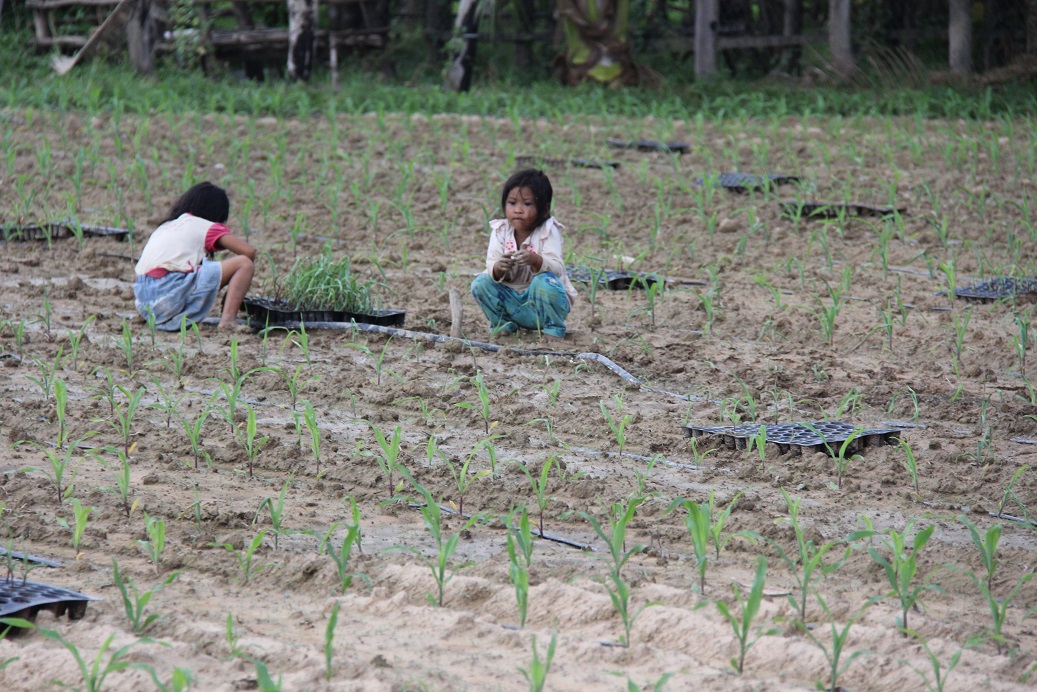
- 📍 Kampong Krasang Kraom village, Kandieng commune, Kandieng district, Pursat province.
- 📷 Mr. Kim Soben
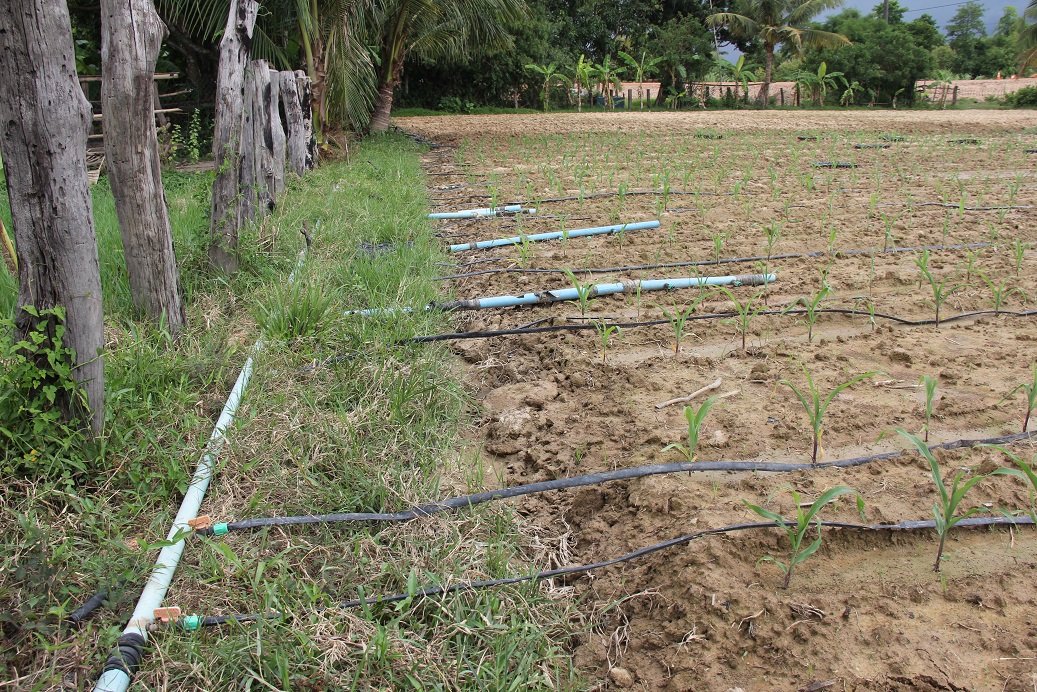
- 📍 Kampong Krasang Kraom village, Kandieng commune, Kandieng district, Pursat province
- 📷 Mr. Kim Soben