Cultivation of organic vegetables to improve the household economy and the soil quality
Type: Technologies
Creation: 2017-08-23 16:04 Updated: 2019-03-01 14:16
Compilers: Sok Pheak
Reviewers: Ursula Gaemperli, Stephanie Jaquet, SO Than, Nicole Harari, Alexandra Gavilano
Country/ region/ locations where the Technology has been applied and which are covered by this assessment
- Country: Cambodia
- Region/ State/ Province: Thma Reab village, Pongro Commune, Rolea B'ier District, Kampong Chhnang Province.
- Further specification of location (e.g. municipality, town, etc.), if relevant: Rural area
- Map: View Map
Description of the SLM Technology
Short description of the Technology
Cultivation of mixed organic vegetables utilizing natural fertilizers and homemade pesticides so as to reduce expenditure on external agriculture inputs, as well as produce organic vegetables that safeguard both the producers’ and consumers’ health. This practice is mainly suitable for the maintenance and improvement of the soil’s fertility.
Detailed description of the Technology
Cultivation of mixed organic vegetables or agriculture based on natural principles is a system which utilizes raw materials, including green plants, animal manure, farm wastes as well as medical plants. All of these materials can be found locally. It avoids the use of any chemical substances or insecticides for the elimination of insects. The implementation of this technology ensures the health of humans, animals, and organisms living in the soil, thereby also securing the soil’s fertility. Moreover, it helps to improve the household economy by reducing the costs of buying chemical fertilizers and other materials (MAFF, 2012, MoEYS & VVOB Cambodia, 2013, Social Compass, 2017).
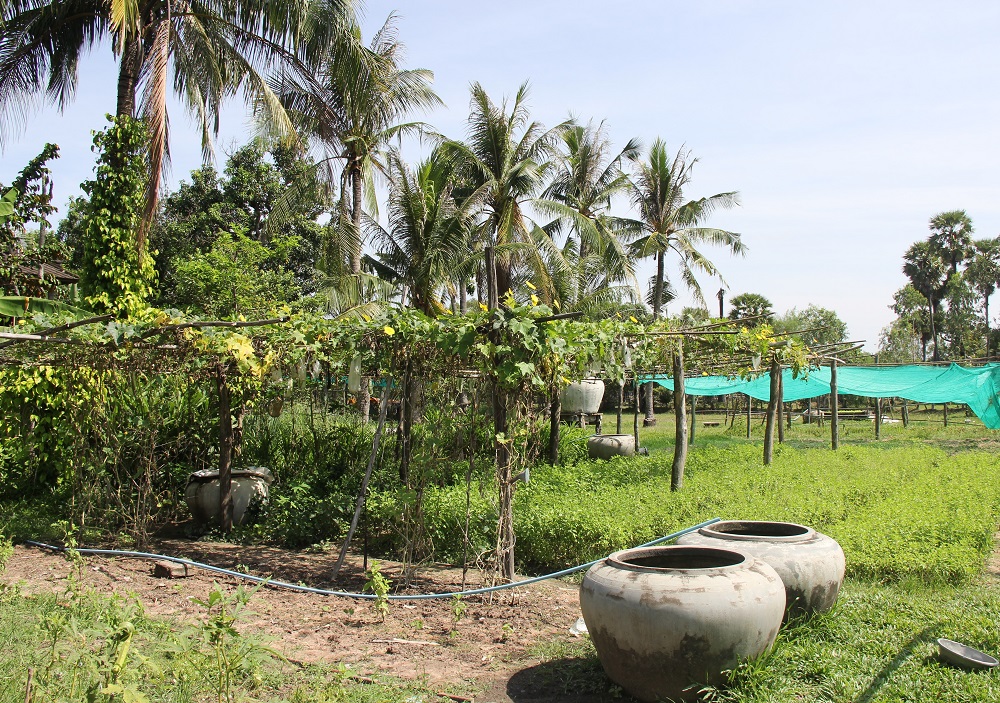
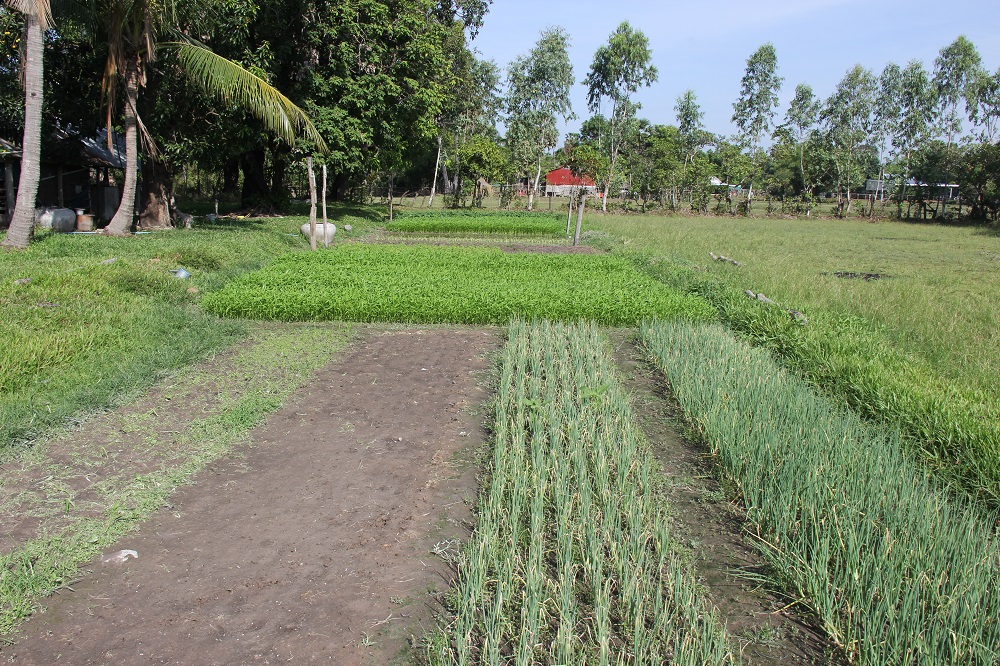
Ms. Teav Chat is one of the farmers growing organic vegetables who was selected to be interviewed for this case study. She has won the national award of best farmer in the production of organic vegetables. She lives in Thma Reab village, Pongro commune, Rolea B'ier district, Kompong Chhnang province, Cambodia. The production of mixed organic vegetables has been implemented since 2004, under the initiative of the Cambodia Center for Study and Development in Agriculture (CEDAC). Around her house she currently grows vegetables on 0.70 ha of land. During the study, she was cultivating mixed organic vegetables including lettuce, cucumbers, yard-long beans, Chinese mustard, pok choi, choy sum, morning glory, spring onions, luffa gourds, wax gourds, holy basil, sweet basil, lemon grassand okra. The most important vegetables out of this group are lettuce, cucumbers, yard-long beans, cabbage vegetables, morning glory and spring onions.
The fundamental components of this technology are the production, and utilization of natural fertilizers (cow manure, dry compost and liquid compost), the combination of medical plants containing natural poisons to combat pests, a natural irrigation source (such as digging a well or a pond), multi cropping, intercropping, as well as crop rotation. As she raises cows, only cow manure is used as fertilizer. Dry compost is made from fresh manure, the leaves of woody herbs or other green leafed plants, rice straw and biochar. Then, the liquid compost is mixed with cow manure, woody herbs, fish heads, boraphed, and cow’s urine. Remarkably, the farmer places these ingredients mixed together with cow’s urine that is collected daily without addition of water. Regarding the production of insecticide, she created a mixture of chili, galangal, together with the leaves or shells of the downy thorn apple.
The main purpose of this technology is to obtain mixed organic vegetables and generate a more regular household income by also reducing the expenses involved in buying chemical fertilizers and pesticides. In other words, organic vegetables have a solid domestic market, consisting of home-based buyers, and so the farmer spends less time for selling her production. The crop diversification respectively mixed organic vegetables supports the farmer also in reducing the exposure to market fluctuations. This means that she should have a wide range of organic vegetables in order to supply the market during all seasons, thereby being able to generate an income throughout the year. In this way the farmer earns a net income 3,330,000 Riel per year. Beside this, the cultivation of organic vegetables using natural fertilizers improves the soil’s fertility. In this way the soil gets rich in microorganisms such as earth worms and other micro-organisms (bacteria or fungi) which play a vital role in decaying organic matter which transform into nutrients for the plants.
In this case study, the natural fertilizer cow manure was used whilst drying the soil in the field or when ploughing the soil in order to expose it. The dry compost is generally applied at the base of the crop roots when the vegetable are planted. Furthermore the liquid compost is used as a fertilizer once the crop begins to grow by irrigating it every three days in the evenings. About 100 ml of liquid compost is mixed with 10 liters of water in order to irrigate the rows with a width of 0.5 meters and a length of 10 meters. For regular maintenance, the fertilizer is added to each of the vegetable crops depending also on the quantity of natural fertilizer that is available. Natural pesticides are also used to ward off insects or to prevent them from destroying the crop.
Photos of the Technology
- 📷 Ms. Chea Navin
- 📷 Ms.Chea Navin