Using dry compost on paddy rice fields
Type: Technologies
Creation: 2017-10-13 04:11 Updated: 2019-03-11 09:10
Compilers: Navin Chea
Reviewers: Nimul CHUN, Ursula Gaemperli, Alexandra Gavilano
Country/ region/ locations where the Technology has been applied and which are covered by this assessment
- Country: Cambodia
- Region/ State/ Province: Vat Chas village, Chrey Vien commune
- Map: View Map
Description of the SLM Technology
Short description of the Technology
Dry compost is made from raw materials of cow manure, rice straw, rice husks, ash, leaves, waste from kitchen and water for application on paddy rice field to improveof soil quality and reduce chemical fertilizers.
Detailed description of the Technology
Compost is a natural fertilizer derived from decayed organic materials, which helps plants grow better than using fresh manure or fresh vegetable residues because they are made up of many organic substances. Farmer could make compost within different periods, short term, medium term and long term. Compost can already be done in 14 to 18 days and it can be used, but the average maturation is 3-4 months and the long term , it can be used after 5 to 6 months (CEDAC, 2015).
Compost is made of manure (cow, buffaloes, pigs, poultry), household waste, fresh plant leaves (woody herb, water hyacinth, water lettuce, vegetable or fruit), etc. The compost brings significant benefits, such as: It provides quick nutrients to plants when compared with fresh manure or unburnt fertilizers. In addition, compost fertilizers bring many microorganisms to the soil, and these organisms help soil fertility. It doesn't exist any plants seed or weed, virus, disease on crop because most of them are killed while the fertilizer is decaying (CEDAC, 2015,YouTube, 2016).
Mr. Mam Mok, the examined farmer of this case study has been practicing this kind of fertilizer since 2008. His compost is made up of ingredients such as rice straw, cow manure, leaves, rice husks, biochar, kitchen waste, water etc. He uses dry compost mainly for his paddy rice fields.
The main purposes of making compost are to increase the rice yield and to get healthier produced rice (reduction in chemical fertilizer). Before he used dry compost his rice yield reached an amount of 4 tons per hectare by using a high amount of Urea (5 bags per hectare), now, though, his yield is about 5 to 6 tons per hectare. In addition, chemical fertilizer has been reduced to 1 to 2 bags per hectare. This means that the application of dry compost reduces as well the expenditure for chemical fertilizers. Another advantage is that the land user gets his manure on-site without spending money, as the most part of material can be found for free on his farm or nearby.
It is a very good SLM technology to improve soil fertility. The application of dry compost avoids compaction, increases the organic matter in soil, boosts the general activity of micro-organisms, and consequently stimulates the growth of rice plants. Then again, there are also some constraints as the amount of compost is not sufficient to feed the whole area of 1.30 hectares. Therefore, every year the farmer spreads the compost only on about an area of 0.50-0.60 hectares by shifting every year the application area. Moreover, the manufacturing requires labor force, which in the family of Mr. Mam Mok is rather decreasing. The duty consists e.g. of collecting raw material and the daily control over compost stage during the maturation process. At any time he has to control if water has to be added to the raw material. After three month he has to transfer the whole compost, partly decayed, from one basin to another, where final maturation takes place. However, the farmer is satisfied with the technology and because of multiple benefits he does not intend to give it up.
Before getting started with compost manufacturing, two compost basins (4 meter in length, 1 m in wide, 1 m in depth) have to be constructed. They are made of bricks, which guarantee a long life cycle. During the rainy season, the farmer uses a tent to cover the basins.
Following steps are necessary to get dry compost: Step 1: A layer of 30 cm of rice straw squashed and mixed with rice husks has to be filled on the bottom of the first basin. After, this mixture needs to be watered sufficiently. Step 3: 20 cm of cow manure has to be put over the first layer. After this, ash from rice husks or from the kitchen waste has to be added. Then it should be watered again. Last step is to bring the already pre-shredded woody herb or leaves (30 cm) on the previous layer. Preparation of layers takes place at the same time. It can be done at any time given, depending nothing but on available raw material and the labor force supporting the manufacturing.
Photos of the Technology
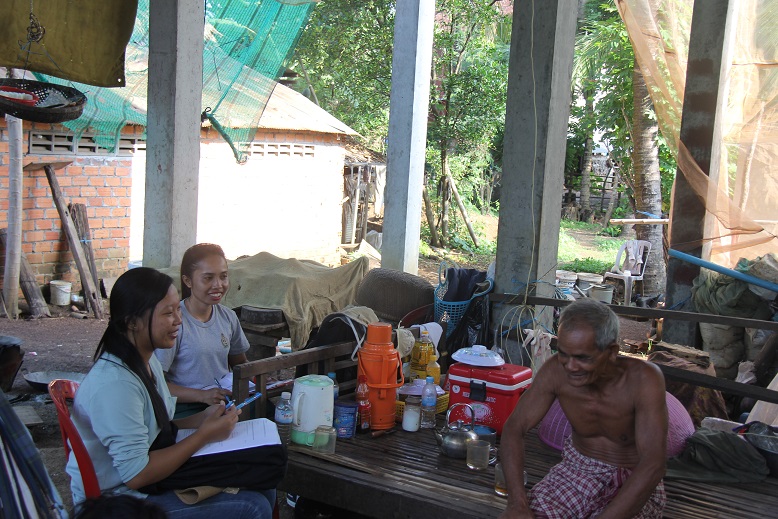
- 📍 Vat Chas village, Baray commune, Prey Chhor district, Kampong Cham province
- 🗓 2017-08-05
- 📷 Mr. Tim Sophea
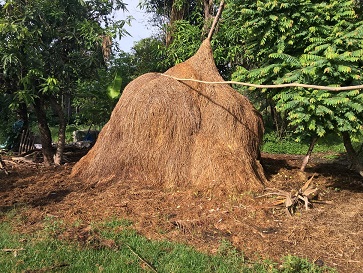
- 📍 Vat Chas village, Baray commune, Prey Chhor district, Kampong Cham province
- 🗓 2017-08-05
- 📷 Mr. Tim Sophea