
Drought-resistant crops to enhance forage production and prevent erosion in desert areas
Type: Technologies
Creation: 2018-04-16 10:25 Updated: 2020-01-21 06:28
Compilers: Rustam Ibragimov
Reviewers: Alexandra Gavilano, Elizaveta Soloveyva, Olga Andreeva
Country/ region/ locations where the Technology has been applied and which are covered by this assessment
- Country: Uzbekistan
- Region/ State/ Province: Kamashinsky district, Kashkadarya region
- Further specification of location (e.g. municipality, town, etc.), if relevant: Kamashi
- Map: View Map
Description of the SLM Technology
Short description of the Technology
Desert fodder plants cultivation in rainfed conditions provides adaptation to drought, creates feed reserves for livestock and prevents the water erosion development
Detailed description of the Technology
Animal husbandry is the main source of livelihoods and well-being for the population living in the rainfed zone (the share in the family budget is 80-95%). The creation of a stable fodder base capable of ensuring the livestoсk development and solving the problem of biodiversity conservation while meeting the vital needs of the population is the main task. The productivity of rainfed pastures in Uzbekistan is highly depend on weather conditions and varies sharply over years and seasons (from 1.5-2.0 to 5 centner / ha). Inefficient use of pastures, poor use of measures to restore degraded areas caused a significant increase in anthropogenic pressure on pastures, which contributed to their degradation. Cultivation of desert fodder plants on rainfed lands, such as Kochia prostrata, Halothamus subaphylla, Ceratoides ewersmanniana, Atriplex undulata, which are most adapted to soil and air drought, will create additional feed reserves, reduce the stocking level and ensure balanced nutrition of animals. In the first year of vegetation, the yield of desert plants is 1.5-1.6 C / ha of dry weight, in the second year-2.2-3.5 C / ha of dry fodder weight and about 0.4 C / ha of seeds; in the third year, 8-12 C / ha of dry weight and 1.0-1.2 C / ha of seeds. With proper use of seed crops and pasture agrophytocenoses, these plant communities are able to recover themselves within 20-35 years. Costs of inputs needed for establishment: in order to implement the technology on rainfed lands, it is necessary to establish primary seed nurseries to provide seeds to land users.
The technology of desert plants cultivation includes plowing to a depth of 20-22 cm, harrowing, levelling. Sowing is carried out in December - February with a seeding rate of 12-15 kg / ha, to a depth of 0.5-2 cm. Harvesting of seeds is carried out in October-November. Seeds are cleaned, dried and stored under the condition of humidity not more than 12%. With this storage method, the seeds do not lose their germination within 6-9 months after harvesting. To create primary seed nurseries in rainfed lands, about 700,000-850,000 Uzbek soum / ha is required (within the range of 100 USD/ ha).
Natural / social environment: low availability of precipitation and soil water and wind erosion are the features of rainfed lands. To increase land productivity, areas under drought-resistant crop species such as safflower are currently expanding . Finding alternative solutions and supporting the local community is the main task to improve living standards and well-being. Cultivation of perennial desert forage plants for forage production provides support to pastoralists and farmers. The technology provides environmental benefits, contributes to climate change mitigation by sequestering CO2 in plant biomass and soil (up to 480 kg / ha) and contributes to overall environmental health.
Photos of the Technology
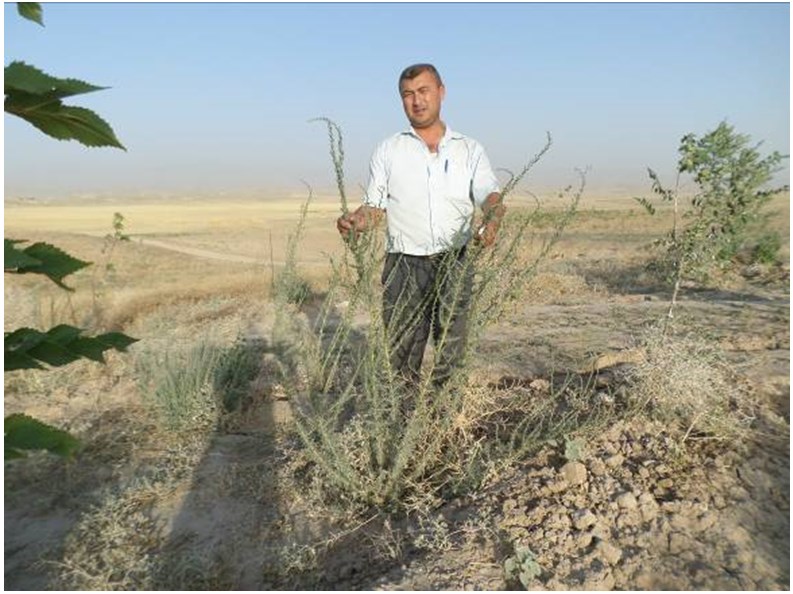
- 📍 Farm "Oltinbaev yeri" Kamashinsky district, Kashkadarya region
- 📷 T. Mukimov
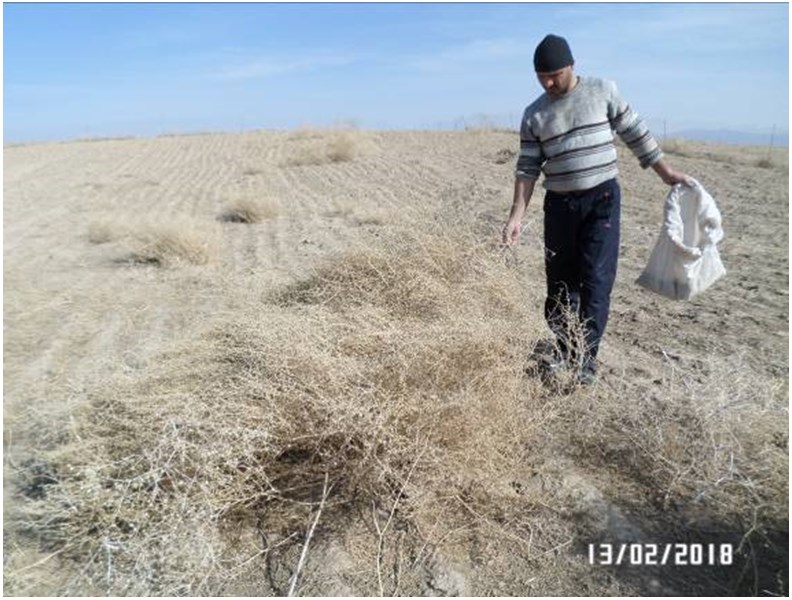
- 📍 Farm "Oltinbaev yeri" Kamashinsky district, Kashkadarya region
- 📷 Mukimov T.