Cultivation of Indigofera (Indigofera tinctoria) to restore marginal lands and to increase local communities incomes
Type: Technologies
Creation: 2018-09-05 08:34 Updated: 2020-01-20 22:30
Compilers: Rustam Ibragimov
Reviewers: Elizaveta Soloveyva, Olga Andreeva, Alexandra Gavilano
Country/ region/ locations where the Technology has been applied and which are covered by this assessment
- Country: Uzbekistan
- Region/ State/ Province: Khorezm region
- Further specification of location (e.g. municipality, town, etc.), if relevant: Educational-experimental Farm Urgentch State University and agricultural farm named after M. Kuvakova, Bagatsky District, Khorezm Region
- Map: View Map
Description of the SLM Technology
Short description of the Technology
Cultivation of Indigofera (Indigofera tinctoria) is one of the ways to restore degraded saline lands with low agricultural potential, as well as the ability to diversify and increase the income of local communities through the production and sale of natural indigo dye, which is synthesized in the aboveground biomass of the plant
Detailed description of the Technology
The land and crops cultivation without useing of appropriate technologies leads to soil degradation, which creats serious barriers to the sustainable development of agricultural sector. Land degradation due to salinization affects half of the irrigated lands of Uzbekistan. Due to insufficient measures to combat salinization, the most salted areas are being withdrawn from agricultural use, and the land use type changes to abandoned lands. The productivity of low agricultural potential lands could be improved by introducing new alternative crops. Indigofera (Indigofera tinctoria) is recommended as a way to restore and improve saline degraded lands. In addition, the natural indigo dye is synthesized in its aerial parts, which is in demand on the world market. Studies in the framework of the UNESCO / ZEF project Bonn / Urgench University (Urgench State University) have shown that the Indigofer successfully grows on saline degraded lands and helps to restore their fertility. A group of scientists led by prof. A. Ergashev investigated the issues of seed production and marketing, and worked out the technology of growing Indigophera on degraded and arable lands. With the support of the project, a highly productive salt-resistant variety “Firuz-1” was created. The new variety was tested under the ADB / CACILM / SLM project and convincing results were obtained. In the conditions of Karakalpakstan, this variety produces 35 t / ha of biomass, from which about 110 kg of indigo paste can be extracted. On the European market, 1 kg of indigo powder costs about 80-240 Euros, on the domestic market - 100-130 thousand soums. The benefits are a good motivation for farmers to use this crop to restore degraded soils. Plant residues from dye extraction can be used as a “green fertilizer” rich in nitrogen.
Agricultural technology for Indigofers cultivation includes:
1. Soil flushing (1-3 thousand m3 / ha)
2. Manure application (15–20 t / ha) and amophos application 200 kg / ha
3.Plowing to a depth of 25–35 cm, microplanning and surface leveling
4. Creation of ridges (30–40 cm high with aisle - 90 cm)
5. Sowing seeds manually to a depth of 1–1.5 cm with a norm of 5.5–6 kg / ha and water supply irrigation after sowing with a norm of 300–350 m3 / ha
6. Thinning plants to a distance of 5-7 cm between plants.
7. The ammonium nitrate application (100-110 kg / ha) with a plant height of 10-15 cm
8. Protection from aphids with Cypermethrin® (1 g per 1 liter of water)
9. Weed weeding 3-4 times during the vegetation season
10. Watering 5–6 times with a norm of 450–500 m3 / ha and loosening of row-spacing during the vegetation season
For the cultivation of indigofer, no change is required in the traditional agronomic methods used in the cultivation of legumes. The cost of Indigofers cultivation is the same as for growing other legumes, except for the difference in the seeds price. Total cost amount is 980 USD / ha (2012). The averadge income from the sale of indigo pigment is about 20 thousand USD/ ha, in case indigofer is grown on degraded lands, and about 6 thousand USD/ ha, in case of arable land. Due to the ability of the culture to fix nitrogen, the soil is enriched with natural nitrogen, respectively, the need for fertilizer is reduced. The process of obtaining dye does not require special equipment, special knowledge and high costs. Farmers can acquire the necessary technology information by attending a short training course.
Photos of the Technology
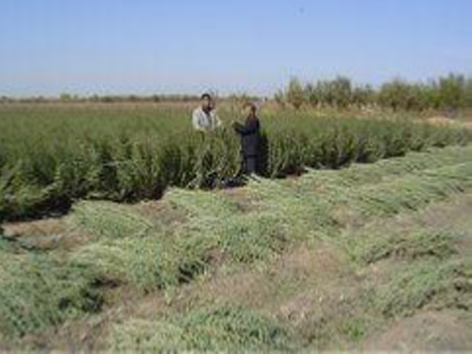
- 📍 Farmers Association M. Kuvakova, Bagatsky District, Khorezm Region.
- 🗓 2026-06-05
- 📷 Источник: ПМГ ГЭФ, ЕБРР, Программы СРБ (Япония) и ЮНЕСКО Учебно-практическое пособие для фермеров
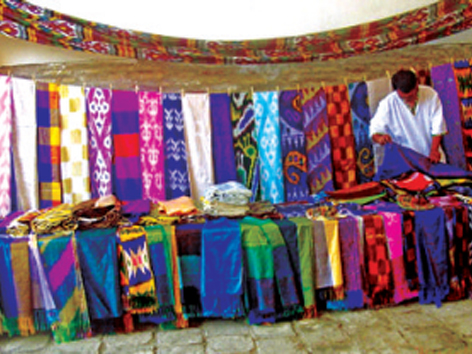
- 📍 Madrasah Allakulihon, Khiva
- 🗓 2018-04-09