
Pasture shelterbelts in the desert zone
Type: Technologies
Creation: 2018-09-06 14:47 Updated: 2020-02-04 21:58
Compilers: Rustam Ibragimov
Reviewers: Elizaveta Soloveyva, Olga Andreeva, Alexandra Gavilano
Country/ region/ locations where the Technology has been applied and which are covered by this assessment
- Country: Uzbekistan
- Region/ State/ Province: Nurabad district/Samarkand region, nuratinsky district/Navoi region
- Further specification of location (e.g. municipality, town, etc.), if relevant: Nurabad district/Carnaby, Nurata district/Nurata
- Map: View Map
Description of the SLM Technology
Short description of the Technology
Creation of pasture-protective forest shelterbelts promotes ecological and phytocenotic compatibility of natural vegetation and forage plants. The pasture plant community structure improves and the forage capacity of desert pastures increases.
Detailed description of the Technology
Pasture livestock in Uzbekistan is located in regions with low natural resource potential on an area of 21.2 million hectares, of which 81.4% are in the desert belt (chul). The desert climate is very hot, arid, with an average rainfall of about 100-250 mm / year. In summer, the air temperature rises to +45, + 50С, and the surface heats up to + 80С. The vegetation cover under these conditions is sparse, consists of ephemeral and semi-shrub vegetation adapted to a hot and dry climate. Ephemeral plants vegetate in a short wet period and die off in early summer. Disturbed vegetation is restored slowly for a long time. Currently, the pasture capacity is exceeded due to the total head of livestock, seasonal use of pastures, lack of pasture rotation. For the livestock farming development it is necessary to ensure the reproduction of pasture products to create a forage base. Pasture-protected forest shelterbelts are an effective method of improving natural pastures in the Chul zone. Shelterbelts create facilities for growth and development of native vegetation (soften the microclimate, contribute to the accumulation of soil moisture during the growing season, reduce the speed of winds, protect the soil from deflation). Pasture shelterbelts consist of large shrubs (saxaul, Circassian and kandym), their width is 25 m wide, density is 600-1200 pcs / ha. The bands are directed perpendicular to the direction of the prevailing winds on flat massifs, and across slopes and ridges on adyrs. Natural pastures are located between the strips, 200-250 m wide. With this arrangement, for every 100 hectares of pastures, there are 10.0-12.5 hectares of protective shelterbelts. Shrubs produce 10-12 kg / ha of phytomass and are a guaranteed autumn-winter feed for sheep and camels. The technology is developed and applied by the research Institute of Karakul breeding and desert ecology to restore and improve the natural ephemeral-ephemeroid vegetation cover on degraded pastures.
The creation of forest shelterbelts includes the following activities:
1. Autumn-winter plowing is carried out simultaneously with harrowing, rolling with ring rollers or leveling. The depth of plowing is 20-22 cm on slightly and medium saline sandy and loamy soils, on shallow gypsum soils – is 15 cm.
2. Sowing. It is recommended to sow black saxaul, Circassian, Kandym from mid-December to mid-February.
The sowing period depends on the meteorological conditions of the year, so the optimal timing is set on the basis of a long-term weather forecast, taking into account the specific weather conditions. Good crops are obtained in rainy weather, under snow or on snow. Sowing is performed by conventional grain and grass seeders, or by scattering seeds manually. To improve flowability, the seeds are mixed with manure and dry sand in a ratio of 1:5. Seeding in the soil is done by rolling ring rollers. The seeding rate is: Haloxylon aphyllum -10-12 kg /ha, Salsola Richteri 8-10 kg / ha, Calligonum 6-7 kg /ha. The technology provides benefits after 3-4 years, and farmers can distribute seeds and expand the area of crops without additional costs.
Photos of the Technology

- 📍 Karnabchul, Samarkand region
- 🗓 2026-06-05
- 📷 T. Mukimov
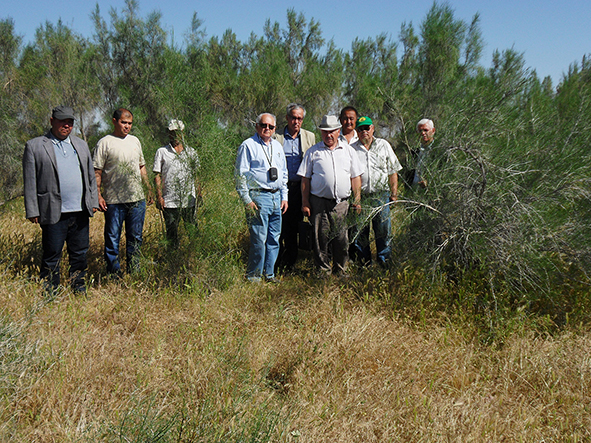
- 📍 Karnabchul, Samarkand region
- 🗓 2026-06-05
- 📷 T. Mukimov