
Creation of improved autumn-winter pastures in the foothill zone of Uzbekistan
Type: Technologies
Creation: 2018-09-07 13:02 Updated: 2020-02-04 22:15
Compilers: Rustam Ibragimov
Reviewers: Elizaveta Soloveyva, Olga Andreeva, Alexandra Gavilano
Country/ region/ locations where the Technology has been applied and which are covered by this assessment
- Country: Uzbekistan
- Region/ State/ Province: Kagan district Bukhara region, Zaamin district of Jizzakh region
- Further specification of location (e.g. municipality, town, etc.), if relevant: Kagan district/Zirobod, Zaamin district/region
- Map: View Map
Description of the SLM Technology
Short description of the Technology
The Technology allows to introduce new forage crops, to increase the grass density, to develop multicomponent pasture phytocenoses, that provide productivity increase of degraded pastures by 2-3 times without disturbing the vegetation cover
Detailed description of the Technology
Pasture lands in Uzbekistan are located in a desert and semi-desert zone with low resource potential and occupy about 20 million hectares. Unsustainable use of pastures is the main cause of pasture degradation. There is an imbalance in the stocking level: some places are undergrazed, others suffer from excessive grazing. The difference in the amount of summer and winter feed stocks leads to overgrazing of some winter pastures.
When creating improved autumn-winter pastures, the selected area is divided into alternating strips of 12 m and 25 m width. The 12 m width spaces are left in the case of poor grass, and the 25 m width spaces are left in case when the state of grass pastures is moderate, but it needs to be enriched with species for autumn-winter grazing. There are prospective varieties of desert forage plants used to increase pasture productivity: Haloxylon aphyllum, Kochia prostrata, Ceratoides eversmanniana, Salsola orientalis, Aellenia subaphylla, Agropyron desertorum, Atriplex undulata. Soil preparation includes plowing with simultaneous harrowing or rolling with ring rollers, or leveling. Plowing reduces the competitive ability of natural vegetation and stimulates soil moisture accumulation and conservation. The best time for plowing is the autumn-winter period after rainfall, when the soil is moistened to the depth of plowing. On light and medium-sized soils without strong swarding, plowing can also be carried out in summer. The sowing period is of particular importance in the conditions of deserts and semi-deserts. The following sowing periods are recommended for wild forage plants: Artemisia, Aellenia subaphylla - from late November to mid January; Kochia prostratа, Salsola оrientalis - mid December to mid February. It is recommended to sow in rainy weather, under snow or in the snow. Sowing is carried out by traditional grain seeders, as well as grain-grass seeders, with row spacing of 60 cm. To improve flowability, the seeds are mixed with manure and dry sand in a ratio of 1:5. Seeding in the soil is done by rolling ring rollers. The seeding rate is: Haloxylon aphyllum -5kg / Salsola Richteri 10-12kg / ha, Aellenia subaphylla 8-10kg/g, Kochia prostratа 3kg / ha, Salsola оrientalis 6-7 kg / ha, Artemisia 3-4 kg / ha, Camphorosma 3-4 kg / ha, Poa bulbosa 3 kg / ha. The additional sowing of perennial forage crops will increase the productivity of pastures by 2-3 times. In the first year of vegetation, plants of these species produce 1.5-1.6 C / ha of dry mass, in the second year-2.2-3.5 C / ha of dry mass and about 0.4 C / ha of seeds. Starting from the third year, the harvest is 8-12 kg / ha of dry fodder weight and 1.0-1.2 kg / ha of seeds. Kochia prostratа, Salsola оrientalis, Atriplex undulata can be mow down 2 times during the year. The sheep grazing at permissible load can be done in spring and autumn to get easy-to-eat forage by autumn. If the vegetation cover is used for 70-75% the possibility of self-regeneration of pastures remains and plant communities are able to regenerate themselves for a long time (20-25 years). Ripe seeds are carried by wind, animals and spread over large areas. The creation of improved long-term pasture agrophytocenoses for various purposes (pasture, hay) and terms of use (spring-summer, autumn-winter, year-round) will allow cattle grazing on such pastures throughout the year.
Photos of the Technology
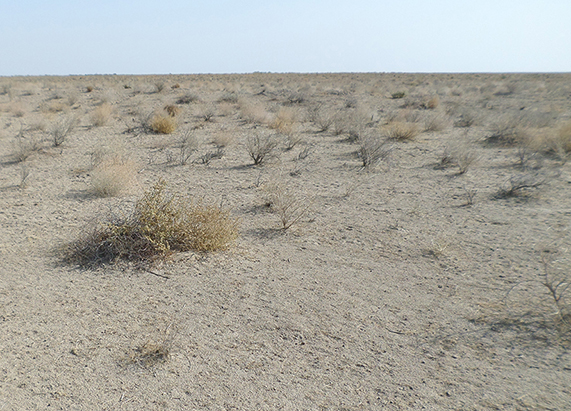
- 📍 plot Zirobod, Bukhara region, Kagan district
- 🗓 2015-11-10
- 📷 T. Mukimov