Use of Organic Fertilizers for Organic Crop Pproduction on Infertile Soil
Type: Technologies
Creation: 2018-11-02 10:32 Updated: 2019-05-21 01:28
Compilers: Suwannapa B00njongrak
Reviewers: Rima Mekdaschi Studer, Samran Sombatpanit
Country/ region/ locations where the Technology has been applied and which are covered by this assessment
- Country: Thailand
- Region/ State/ Province: Yasothon
- Further specification of location (e.g. municipality, town, etc.), if relevant: Ban Naso, Naso Sub-district, Kutchum District, Yasothon Province, Thailand
- Map: View Map
Description of the SLM Technology
Short description of the Technology
The organic farming was initiated by a group of Yasothon farmers since 1989 to produce organic rice and vegetables. The organic fertilizers used are the compost made from farm products and animal dungs, bio-fermented liquid from kitchen wastes and crotalaria as green manure.
Detailed description of the Technology
Organic farming has become a national agenda with cross collaboration among government organizations concerned, local community administration, private sectors and farmers. This technology has scaled up to 253 farmers on 6,000 rai (6.25 rai = 1 ha) at Ban Sokkompoon, Naso Sub-district, Kutchum District, Yasothon Province. The information has been received from Mr. Man Samsee, chief of the community and a farmer himself. The organic fertilizers used in the farmers’ fields are the compost from farm products and animal dungs, bio-fermented liquid from kitchen wastes, fermented liquid from neem (Azadirachta indica) for pest control, and green manure from Crotalaria juncia. The crops grown have been rice and vegetables, medicinal herbs and sesame, which are certified as organic products; they command higher prices (more than 20%). Compost is the main organic fertilizer compared to others.
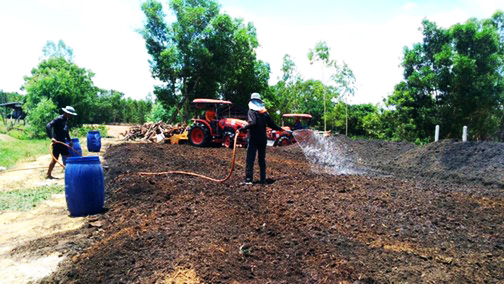
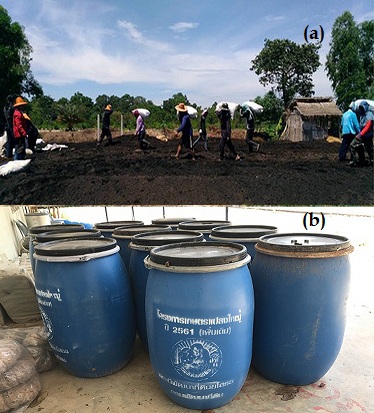
The objectives of organic farming are to produce organic crops, improve soil fertility, reduce wastes for friendly environment, get higher income and enhance good health for both producers and consumers. The procedure of making compost: The materials used for making compost are 1,000 kg of burnt rice husk, 3,000 kg of cattle manure/poultry manure, 3,000 kg of farm residues, 1,000 kg of coarse bran, 500 kg of fine bran, 1,000 kg of rice husk and 500 liters of organic-fermented liquid, all being thoroughly mixed by using a tractor. The allocation of compost: an amount of 300 kg of compost (20 bags) is given to each member to ferment at the farm by turning the bags occasionally before applying to a 3-rai land. There are several government organizations and private sectors that support this community of farmers, and a learning center was thus established. Up to now, the Land Development Department has been providing the knowledge of making compost and bio-fertilizer liquid; It also has been distributing green mature seeds and activators of bacteria and fungi. The Department of Agricultural Extension provided funding to establish the learning and training center and to produce materials used for training together with private sectors under CSR (Corporate Social Responsibility). The Cooperative Promotion Department supported by keeping household accounts. The local community administration set up several market places and promoted the products to be purchased by hospitals and restaurants. The organic crop products have been certified by OACT (Organic Agriculture Certification of Thailand) and IFOAM (International Federation of Organic Agriculture Movements). The Department of Groundwater provided groundwater by drilling holes at 30-40 m deep. The Department of Alternative Energy Development and Efficiency provided solar cells as the source of energy. The noticeable benefit of organic farming is that farmers have better health, the soil has become more fertile and the expenditure decreased. The farmers have been satisfied of their own lifestyle and did not migrate to the city. They have been committed to developing their land by using organic fertilizers continuously. The average income has increased from 7,500 THB/rai to 12,000 THB/rai. The main problem has been the transportation of the organic fertilizers which are bulky, but it can be overcome by producing them on site where needed.
Photos of the Technology
- 📍 Ban Naso, Naso Sub-district, Kutchum District, Yasothon Province, Thailand
- 🗓 2018-09-10
- 📷 Suwannapa Boonjongrak
- 📍 Ban Naso, Naso Sub-district, Kutchum District, Yasothon Province, Thailand
- 🗓 2018-09-10
- 📷 Suwannapa Boonjongrak