
Mound plantation in coastal area with non-mangrove plant species for land stabilization
Type: Technologies
Creation: 2019-04-25 12:58 Updated: 2020-04-06 11:17
Compilers: Fazlay Arafat
Reviewers: Nicole Harari, Rima Mekdaschi Studer, Ursula Gaemperli
Country/ region/ locations where the Technology has been applied and which are covered by this assessment
- Country: Bangladesh
- Region/ State/ Province: Chittagong district
- Further specification of location (e.g. municipality, town, etc.), if relevant: Kattoli coast area
- Map: View Map
Description of the SLM Technology
Short description of the Technology
Mound plantation with non-mangrove species to transform mono-culture plantations subsequently into more ecologically resilient, mixed species plantations and as well as to accelerate natural processes of accretion and land stabilization in coastal areas.
Detailed description of the Technology
Bangladesh has nearly five decades of experience of coastal afforestation and reforestation on offshore islands and newly accreted lands. Coastal plantations were originally planted mainly to protect coastal populations against tidal bores, cyclones and storm surges and as well as to speed up the stabilization of newly accreted lands that eventually protect interior agricultural land from saline intrusion. According to the historical approaches to coastal afforestation and reforestation in Bangladesh, only a few pioneer mangrove species are suitable for planting on newly accreted coastal lands. Mangrove plantations that were established with a handful of pioneer species require increasing levels of management to promote ‘artificial succession’. There is need to transform these predominantly monoculture plantations subsequently into more ecologically resilient, mixed species plantations. Mound plantation with non-mangrove species was introduced in some places to address this issue.
Under the ‘Climate Resilient Participatory Afforestation and Reforestation Project’ non-mangrove mound plantations were established in 2013 in South Salimpur area of Sitakundu upazila (administrative unit) in Chittagong district by the Forest Department. Earlier, in 1983 the newly accreted char land (river islands formed from sedimentation) was planted with mangrove species Keora (Sonneratia apetala). Mangroves are salt-tolerant trees that cope with salt water immersion and wave action and are adapted to life in waterlogged and harsh coastal conditions. Due to cyclones and illegal removal of trees the Keora plantations were destroyed in many spots. In the meantime, the mangroves had accumulated sediments and the land was raised as compared to the adjacent inland areas. This accreted and stabilized land is suitable for non-mangrove plantation as the water does not flood the raised land regularly.
However, the area is regularly inundated by the tide during the monsoon. In addition storm surges flood the land and cause waterlogged conditions, which are not suitable for the survival of non-mangrove species. To successfully plant non-mangrove species along the coast, mound plantation is practiced. The mound served as a raised bed to protect the seedlings from waterlogged conditions in monsoon seasons. Akashmoni (Acacia auriculiformis), Jhau (Casuarina equisetifolia), Arjun (Terminalia arjuna), Rain-tree (Albizia saman), Babla (Vachellia nilotica) tree species are planted in mound. The major activities of this practice are cleaning of site from weeds & making of round shaped mounds. The diameter of the mound in the base is 1m and in top is 0.6m with a height of 0.6m. The mound is prepared through soil heaps from the plantation site. Inter and intra row spacing is 2.6m x 2.6m center to center of the mounds. 1500 mounds per hectare are constructed and one bamboo stick put inside every mound to support the plated seedlings to stand firmly.
The dimension of pit in each mound is 0.3m x-0.3m s 0.3m and the pit needs to be kept open for two weeks for drying before the one year old seedling can be transplanted in the pits. The seedlings were raised in the nursery of Forest Department under the project. While planting seedlings 0.5 kg compost and 0.5 kg loamy soil are mixed in the pit to increase the fertility of the soil. Vacancy filling is required in the next year and weeding practice continues till 3rd year of plantation.
Advantage of mixed-species over monocultures is the promotion of diversifying production under different rotation periods. Mixed-species plantations are more resistant to damage caused by storms, insects or diseases. Mound plantation with non-mangrove mixed species increased the diversity and ecological services. Mound plantations are vulnerable to a variety of threats from livestock grazing, mainly buffalo, to extraction of timber and outright conversion of plantations to other land uses such as agriculture, aquaculture and salt production.
However, the mound plantation practice contributes in coastal greenbelt species diversification along with speed up the natural processes of accretion and land stabilization.
Photos of the Technology
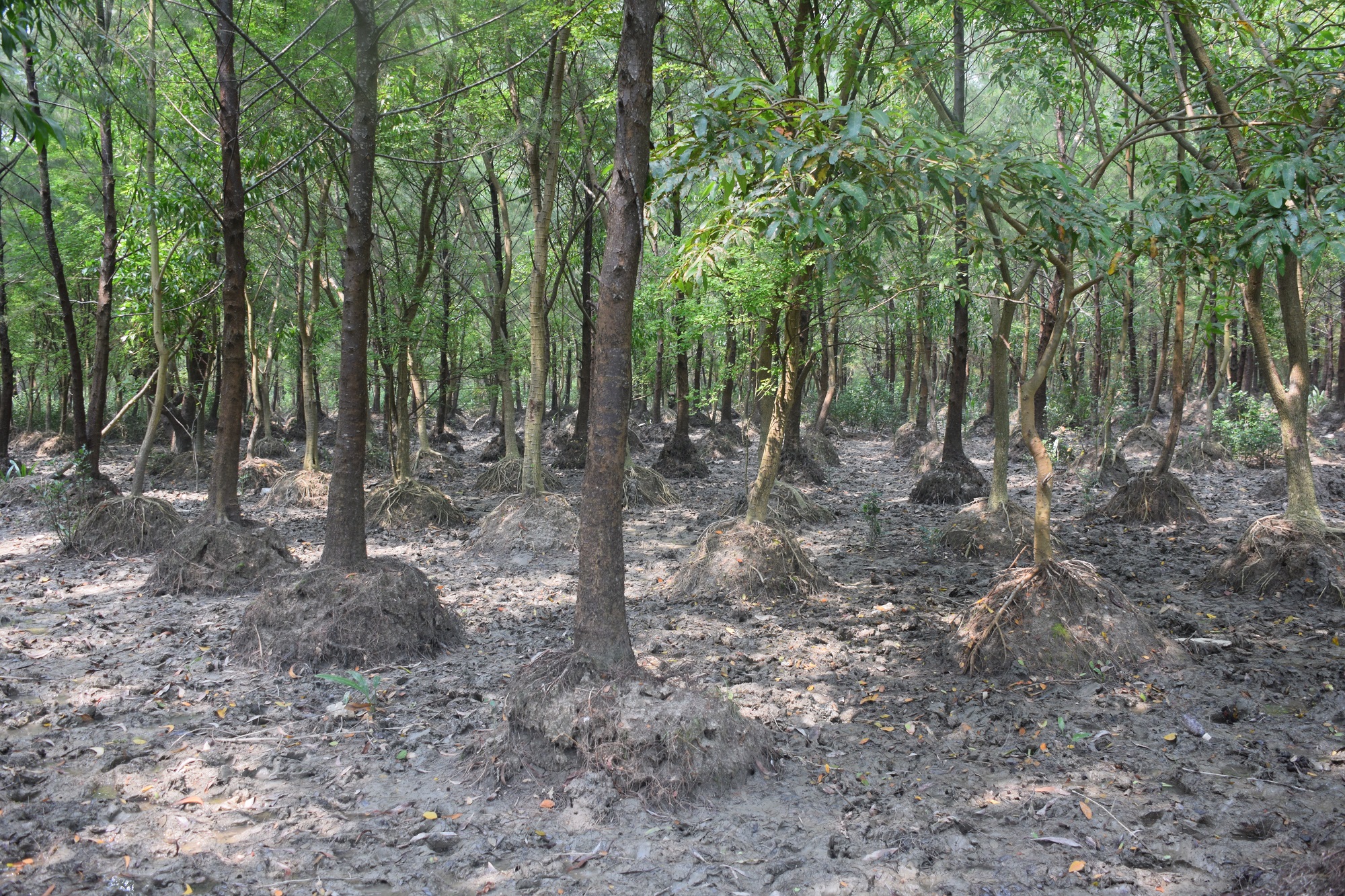
- 📍 South Salimpur, Sitakundo, Chittagong
- 📷 Md. Fazlay Arafat
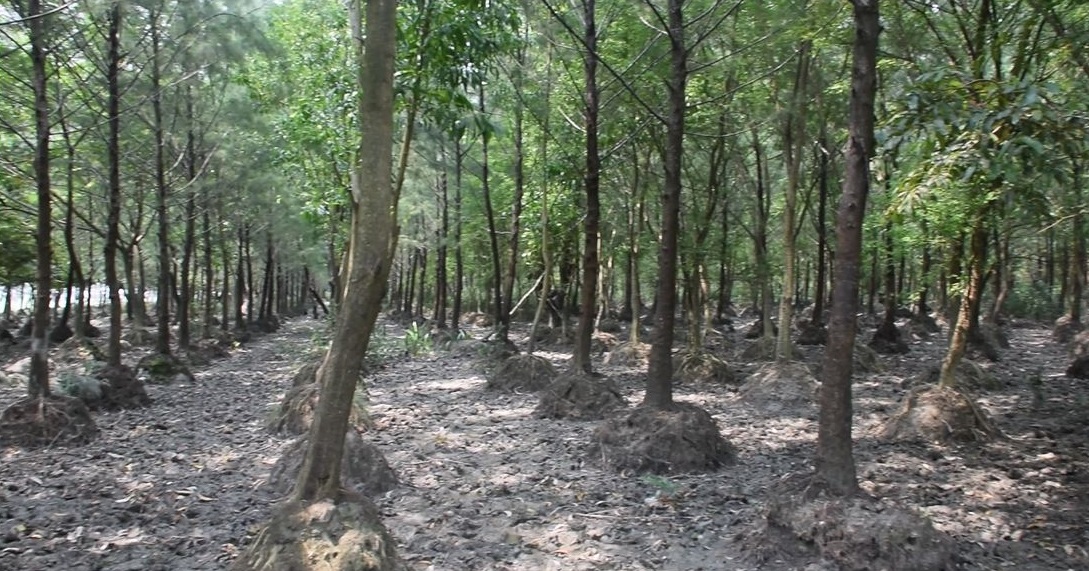
- 📍 Kattoli,Sitakundu, Chittagong
- 📷 Md. Fazlay Arafat