
Application of crop rotation in farming conditions
Type: Technologies
Creation: 2019-06-27 09:14 Updated: 2025-08-10 18:38
Compilers: Dzhumabaeva Salamatkhan
Reviewers: Rima Mekdaschi Studer, Olga Andreeva
Country/ region/ locations where the Technology has been applied and which are covered by this assessment
- Country: Kyrgyzstan
- Region/ State/ Province: Zhar-Maala village, Suzak district, Jalalabad region
- Further specification of location (e.g. municipality, town, etc.), if relevant: Latitude 41.099358; Longitude 73.370870
- Map: View Map
Description of the SLM Technology
Short description of the Technology
Organizing crop rotations as a way to use land efficiently, taking into account the economic interests of landowners and land users, as well as ecological and economic factors.
Detailed description of the Technology
In Kyrgyzstan, land degradation and desertification is a pressing problem that poses a threat not only to ecosystems but also has a negative impact on living standards and economic development. The agrarian reform carried out in 1991 had both positive and negative aspects. One of the positive aspects of the reform was the creation of equal starting conditions: every rural resident, whether employed or unemployed, infants or pensioners, doctors or teachers was entitled to receive the share of land and property. As a result of the reform, 510,000 families received land shares, and most farms today consist of a single family. The country is dominated by small-scale peasant farms, which cannot obtain large incomes. The main costs are associated with production, transportation, and marketing of agricultural products.
In addition, a lack of knowledge about land cultivation, growing suitable crops, and the small size of land plots have led to negative consequences such as decreased soil quality and fertility, erosion, and other problems. Centuries of accumulated agricultural experience show that continuous cultivation of almost any crop results in a significant decline in yields, erosion, contamination, and soil salinization.
Crop rotation plays an important role in addressing the issue of maintaining soil fertility. To restore and improve soil fertility, a crop rotation system has been introduced at the farm level. This technology was implemented within the FAO/GEF project “Sustainable Management of Mountain Forest and Land Resources under Climate Change Conditions.” To facilitate its application, training seminars and workshops were held for farmers, and a demonstration plot was selected.
The demonstration plot is relatively small: 1 ha, divided into three almost equal sections of 0.3–0.4 ha each. These sections are used for the alternating cultivation of different crops and the performance of necessary agricultural activities. To restore the soil and ensure good harvests, it is important to follow a planting plan.
Crop rotation plan
Crop alternation by year
Plot Year 1 Year 2 Year 3
1 (0.3 ha) Maize Cabbage Potato
2 (0.4 ha) Potato Maize Cabbage
3 (0.3 ha) Cabbage Potato Maize
Land users noted that applying crop rotation has had a positive impact on farm income by providing additional products. In addition, costs for pest and disease control, application of mineral and organic fertilizers, and weed management have decreased.
Biofertilizer Fitop-Flora-S was used to improve growth and increase yields. This product provides a comprehensive approach, enhancing soil fertility and improving crop yields.
Photos of the Technology
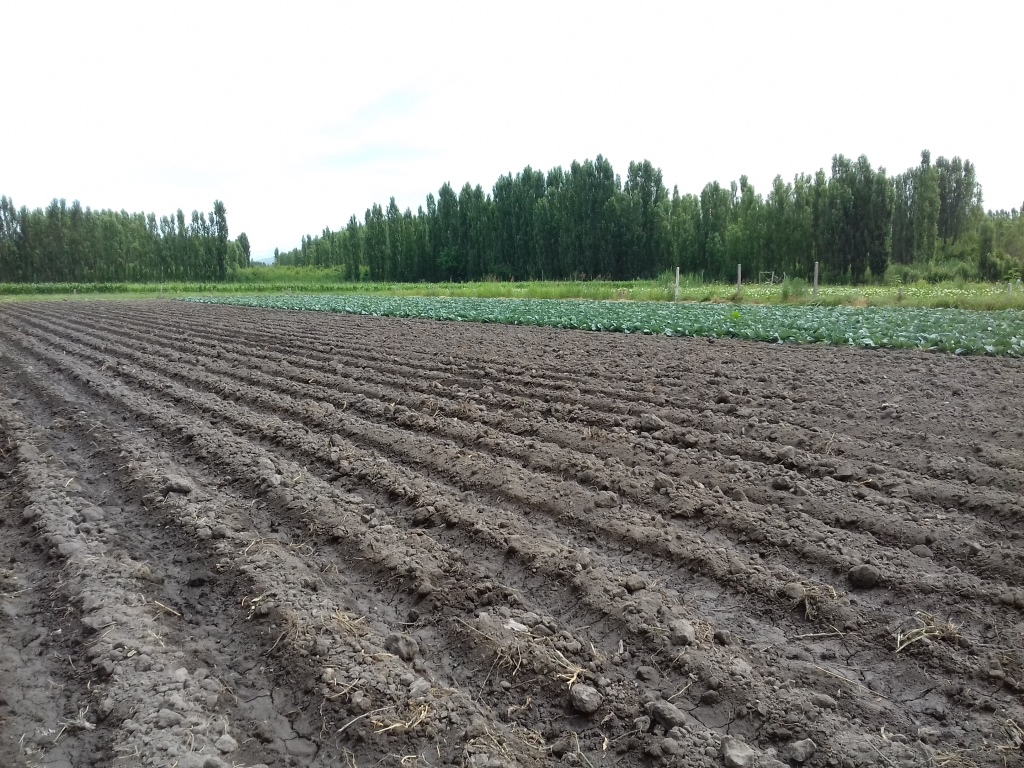
- 📍 Zhar-Maala village, Suzak district, Jalalabad region
- 📷 Sovetbek Mamytkanov