
Sub-surface water harvesting for an efficient use of water resources
Type: Technologies
Creation: 2016-08-11 11:16 Updated: 2019-09-05 15:33
Compilers: Eveline Studer
Reviewers: Hanspeter Liniger, Nicole Harari, Alexandra Gavilano
Country/ region/ locations where the Technology has been applied and which are covered by this assessment
- Country: Pakistan
- Region/ State/ Province: Southern Khyber Pakhtunkhwa
- Further specification of location (e.g. municipality, town, etc.), if relevant: Karak, Laki Marwat & Dera Ismail Khan
- Map: View Map
Description of the SLM Technology
Short description of the Technology
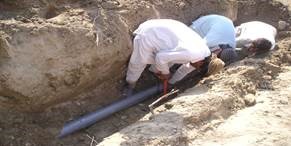
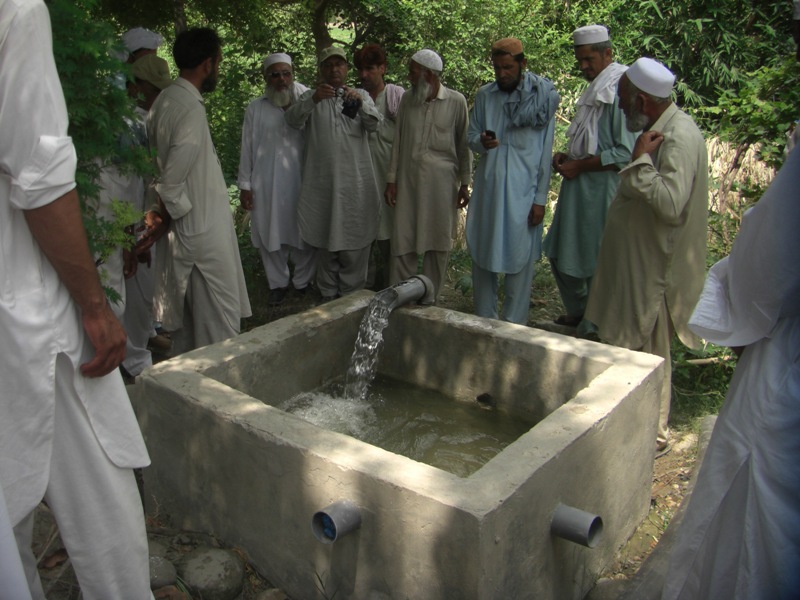
The purpose of this water harvesting technology is to capture, collect and distribute sub-surface water. First, an infiltration gallery is developed, which allows the percolation and collection of sub-surface water through perforated pipes at a depth of approximately 3-4.5 metres. Sub-surface water is filtered by gravel/sand underground and infiltrates into the gallery. The harvested water is used for household needs as well as for livestock and irrigation through gravity flow.
Detailed description of the Technology
This method is applied in areas with low rainfall, where soils have a sandy-gravelly texture and where the sub-surface water can not percolate deeply, but instead flows laterally in shallow sub-surface channels. The technology consists of the following main elements: filtration materials (sand / gravel), collection chambers, perforated pipes, conveyance lines made from solid blocks, and storage tanks. Construction includes the following main activities and inputs:
• Excavation of rectangular trenches with machinery or by hand
• Construction of a solid base line with PCC (plain cement concrete) blocks on the top of boulders
• Installation of perforated and blind pipes - and storage tanks where necessary
• Coverage of the trench first with boulders and then sand on top.
Once the gallery is constructed there is no further need for intervention; this means that maintenance costs for the user (farmer, households of the local community) are minimal. Traditionally, the technology has been implemented by local farmers for many years. Where improvements are required, support by local technicians is provided. The technology is based on local knowledge, and locally available construction materials. The method is technically simple, cost-effective and environmentally friendly. Farmers and other users consider this technology as very efficient as there is no need for external energy supply, and it can be easily replicated. Furthermore, it requires a minimum of external construction material and the operation costs are minimal. The captured water is filtered through the subsurface layers and - as long as there is no specific external contamination - it is safe and can be used for various purposes as already noted. This extra water supply is particularly effective for irrigation, contributing to increased production and allowing diversification of crop production (potentially also of high value crops), thereby improving the livelihoods of remote rural communities. The primary impact of this technology is to reduce risks related to droughts or water scarcity as natural phenomena or consequences of climate change effects. Additionally infiltration of water into the galleries reduces surface erosion of fertile soil, hence it lessens soil degradation.
Photos of the Technology
- 📍 Dera Ismail Khan
- 🗓 2026-06-06
- 📷 Helvetas Swiss Intercooperation Pakistan
- 📍 Dera Ismail Khan
- 🗓 2026-06-06
- 📷 Helvetas Swiss Intercooperation Pakistan