Conservation Agriculture for cereal production in rainfed areas of Kazakhstan
Type: Technologies
Creation: 2020-02-04 13:46 Updated: 2025-08-27 16:52
Compilers: Kulyash Iskandarova
Reviewers: Rima Mekdaschi Studer
Country/ region/ locations where the Technology has been applied and which are covered by this assessment
- Country: Kazakhstan
- Region/ State/ Province: Northern Kazakhstan: Akmola and North Kazakhstan regions (provinces)
- Further specification of location (e.g. municipality, town, etc.), if relevant: Smirnovo village, Akkayin district, Northern Kazakhstan region; Valikhanovo village, Zharkainsk district, Akmola region; Astrahanovka village, Astrahanskyi district, Akmola region; 4) Vishnevka village, Arshalinsky district, Akmola region
- Map: View Map
Description of the SLM Technology
Short description of the Technology
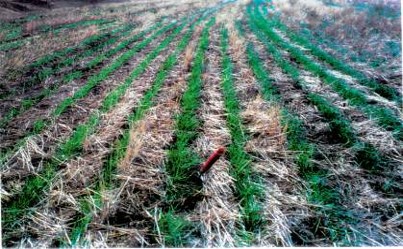
Conservation agriculture applied in Northern Kazakhstan is based on no-tillage direct sowing of cereals into the soil permanently covered by crop residues. It contributes to reverse soil degradation, enhance water use efficiency, increase crop productivity in the rainfed lands.
Detailed description of the Technology
The cropping system in Northern Kazakhstan is based mainly on continuous wheat production using conventional technologies. Negative components of this system are intensive tillage, returning little organic matter to the land and monoculture. This system has led to soil degradation (wind and water erosion), soil fertility loss, boost-up of diseases, weed infestation and other problems.
Conservation Agriculture (CA) involves removing these negative components of conventional farming systems and includes three basic principles: 1) minimal soil disturbance, 2) permanent soil cover with crop residues and 3) crop rotation.
In accordance with these principles,
Conservation Agriculture technology includes 3 main operations:
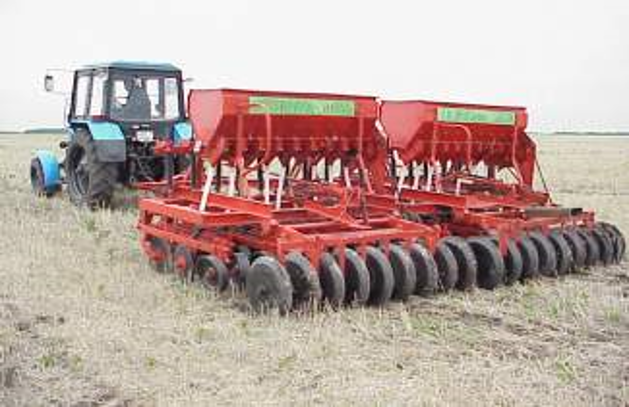
1. Sowing with simultaneously soil fertilization using direct seeder.
2. Post-sowing (after 1-2 days) treatment by non-selective herbicide
3. Harvesting combined with simultaneous plant residues chopping and spreading
For comparison Conventional technology includes 7 operations:
1. Deep fall soil tillage (25 cm).
2. Early spring soil treatment.
4. Pre-sowing soil treatment.
5. Sowing with simultaneously soil fertilization using conventional seeder.
6. Selective herbicide application 2,4-Dichlorophenoxyacetic acid (2-4-D).
7. Harvesting.
The CA technology was applied in four farms in Akmola and North-Kazakhstan oblasts:
1.Farm “DARYN”, village Valikhanovo, Zharkainsky rayon, Akmola oblast, Kazakhstan.
2.Farm “Surayev”, village Vishnevka, Arshalinsky rayon, Akmola oblast, Kazakhstan.
3.Farm “Dostyk”, village Astrahanovka, Arshalinsky rayon, Akmola oblast, Kazakhstan.
4. Farm “Cherezdanov”, village Smirnovo, Akkayinskii rayon, Northern Kazakhstan oblast, Kazakhstan.
Depending on the capability of these four farms in total 330 ha agricultural land were allocated for the testing and adaptation of the technology. On each farm, field trials under equal conditions (soil, temperature, humidity, landscape, etc.) were conducted and included 2 treatments: Conventional (7 operations) and Conservation Agriculture (3 operations).
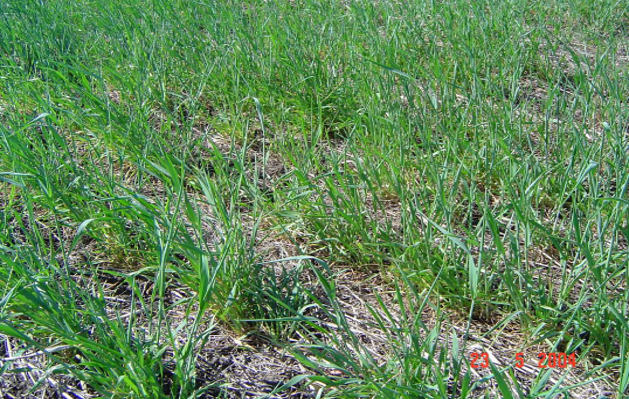
Analysis of 2002-2004 trials data demonstrated that yield of wheat and other cereals under CA technology was in average 15-25% higher in comparison with the conventional technology. The advantages of CA technology are especially evident in the years of drought (up to 40% in dry 2004 year). Economic evaluation of the technology made by two independent experts from Kazakhstan (Kazakh Research Institute for Grain Farming) and USA (Idaho State University) suggested that costs of labor, fuel, repairs and spare parts as well as machinery and equipment wearing-out under the Conservation Agriculture technologies is significantly lower as compared to those of traditional technology. In general, it is important to emphasize that the experience of the CA adaptation in North Kazakhstan helped farmers/land-users:
•To determine the appropriate level of tillage in a cropping system that is feasible with direct sowing and CA technology requirements as a potential goal.
•To retain sufficient residue on the soil surface to reduce soil erosion, enhance crop/water productivity, improve soil fertility (because of plant organic material bioprocessing in the soil) and better ensure long term, sustainable production.
•Employ economically viable, diversified crop rotations that can improve cropping system productivity and offer farmers new options to reduce risk that is extremely important for the conditions of Northern Kazakhstan relating to the area of risk farming.
The introduction of the technology for cereal production in the rainfed areas of Kazakhstan was realized within the framework of the FAO/TCP/KAZ/2801 (T) Project “Conservation Agriculture for Sustainable Crop Production in Northern Kazakhstan”, under active cooperation with counterparts: Ministry of Agriculture of the Republic of Kazakhstan (MoA RK), FAO, CIMMYT, Union of Farmers of Kazakhstan (UFK), national agriculture research organizations.
Photos of the Technology
- 📍 Northern Kazakhstan
- 📷 Muratbek Karabayev
- 📍 Northern Kazakhstan
- 📷 Muratbek Karabayev
- 📍 Northern Kazakhstan
- 📷 CIMMYT-Kazakhstan office