
Cactus Fruit Plantation in Arid Dry Lands
Type: Technologies
Creation: 2020-12-19 15:56 Updated: 2021-04-13 15:30
Compilers: Joren Verbist
Reviewers: Rima Mekdaschi Studer
Country/ region/ locations where the Technology has been applied and which are covered by this assessment
- Country: Jordan
- Map: View Map
Description of the SLM Technology
Short description of the Technology
This technology is based on the natural advantages and the multi-purpose usage of spineless cactus pear (Opuntia fiscus-indica), to cultivate marginal lands in Jordan, generating environmental and socio-economic benefits.
Detailed description of the Technology
In the arid parts of Jordan with limited rainfall, little irrigation, high water evaporation, poor soil quality and unsustainable land management result in land degradation (erosion and salinization) and productivity loss. Therefore, the International Center Agricultural Research in the Dry Areas (ICARDA) and National Agricultural Research Centre of Jordan (NARC) organized field days (started in 2014) to disseminate knowledge regarding the cultivation of the cactus pear, Opuntia ficus-indica, cactus crop. Cacti can cope with high temperatures and grow well in (semi)-arid areas with 250-600mm annual rainfall or where irrigation is available. Additionally, the plant is very resilient as it can withstand a long dry season due to its high water-content and water-use -efficiency, which are a result of its morphology (waxy cuticle, no actual leaves) and the Crassulacean Acid Metabolism (CAM). In CAM plant, stomata in the leaves remain shut during the day to reduce evapotranspiration, but open at night to collect and fix carbon dioxide (CO2). In general, cacti have multiple products that benefit local livelihoods, these are for example stable production of fodder for livestock and fruits for human consumption. Also, cactus can grow and produce requiring few inputs such as fertilizers, therefore marginal lands are well suited for cactus cultivation.
The market for cactus fruits is very promising in Jordan. Nowadays, there is high demand for cactus fruits as people grow fond of the fruits but also for medicinal uses. This documentation is focused on a farm covering roughly 10 hectares, where cactus was planted due to its socio-economic and environmental advantages i.e. the high prices for cactus fruits and the ability of cactus to grow in marginal lands with little input and cover the soil hence preventing soil erosion. However, the farm is not located ideally for cactus cultivation. Therefore, the farm is currently intensively managed in terms of fertilizer application and the irrigation. The previous land use was poor cultivation of barley to feed (grazing) sheep and goats. This led to little soil cover resulting in land degradation in the form of erosion. The farmer paid for the establishment of the cactus-plantation. The cacti are spaced by 4 meters between plants and 3 meters between rows. This spacing is specific for fruit production, in case of fodder production a higher crop density is recommended. The cacti are planted on the contours in pits (40 centimetres depth and diameter) to ensure rain-water collection and efficient fertilizer application as the farm is situated on a 15% slope. The cacti reduce erosion as the roots hold the soil together. Field preparation for the establishment of the cactus field includes: (1) soil scrapping; (2) deep soil ploughing; (3) surface soil ploughing; and (4) pit digging. No fertilizer was applied in the establishment stage. Recurrent activities and costs are weeding, applying fertilizer and organic manure, maintaining the pits and harvesting. 200 kilograms per hectare of inorganic fertilizer (NPK) is applied between March and May. A total of 4 tons per hectare of organic manure is applied in September-November. These activities are non-mechanized, and therefore labour intensive.
The farm receives less than 200mm of annual rainfall and a public dam for irrigation is available. Therefore, the farmer invests in three water tanks to store water brought from the dam using his own truck, and in a drip irrigation system for high irrigation efficiency. The farm is irrigated by 360 cubic meter per month, divided in three events. The costs per cubic meter is 0.95 Jordanian Dinar (JOD) (including transportation costs). Before the realization of the drip irrigation system, the cacti were watered by hand (19991-2015). During the initial three years, cacti produce no fruits making the short-term return on investment rather negative. Currently, the cactus-plantation produces 32.5 ton/ha, equivalent to 65 kg /plant. The average net income per hectare varies between 1650 JOD to 2750 JOD. This makes the farmer relatively medium- wealthy with respect to the area. Most costs are induced by labour as the farmer uses manual weeding, harvesting and fertilizer application.
Even though the cultivation of cacti for its fruits on marginal lands has many benefits like the reduction in erosion, stable production, high output/input efficiency and good prices. There are some weaknesses, for example the relative young market of cactus products in Jordan compared to Tunisia. The Tunisian market for cactus products has a longer history, a high demand for other cactus-products like oil and juice and a better infrastructure (e.g. processing units) exist. These create more consistent prices for farmers, so less price drops during harvesting periods. Another weak point is the fact that cacti are cultivated in mono-culture. This significantly increases the risk of new pests and potential damage of the cultivated crop.
To conclude, this documentation shows that even though the selected farm does not represent an ideal site for cactus pear cultivation, the implementation of cacti is socio-economically and environmentally appropriate to cultivate dry marginal lands as cacti uses water and nutrients highly efficient while reducing land degradation. Therefore, the out-scaling of cacti is very valuable and a practical option to fight land degradation and enhance smallholder’s income.
Photos of the Technology

- 📍 35.801478, 31.599354
- 📷 Sawsan Hassan (Extracted from google earth 2020)
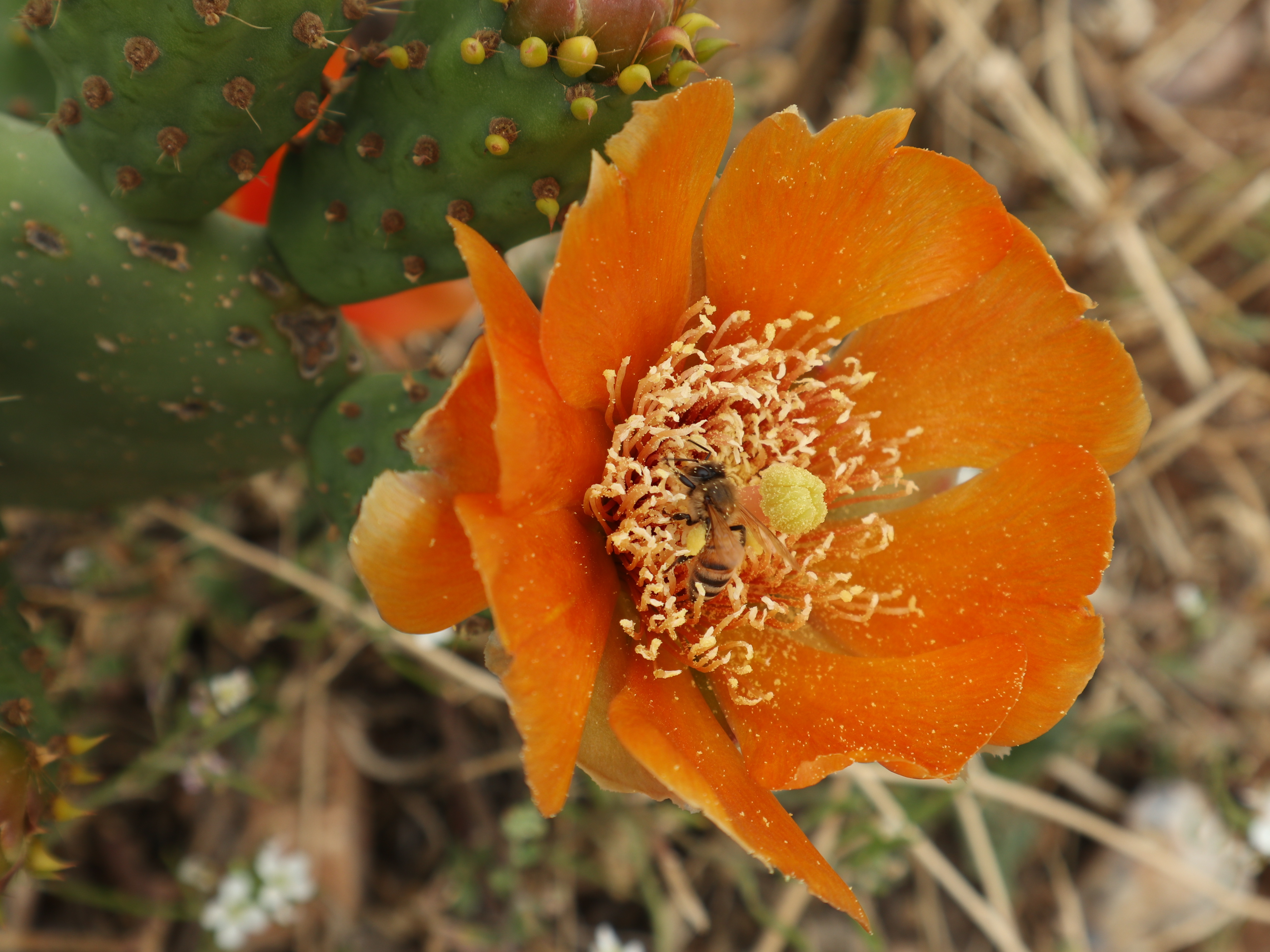
- 📍 Muchaqqer station, Jordan
- 🗓 2019-02-02
- 📷 Mounir Louhaichi, Sawsan Hassan (21/2/2019).

- 📍 Muchaqqer station, Jordan
- 📷 Mounir Louhaichi, Sawsan Hassan. (21/2/2019). Opuntia ficus-indica red fruits Muchaqqer station, Jordan.